
19 Sep 2026
0 comments
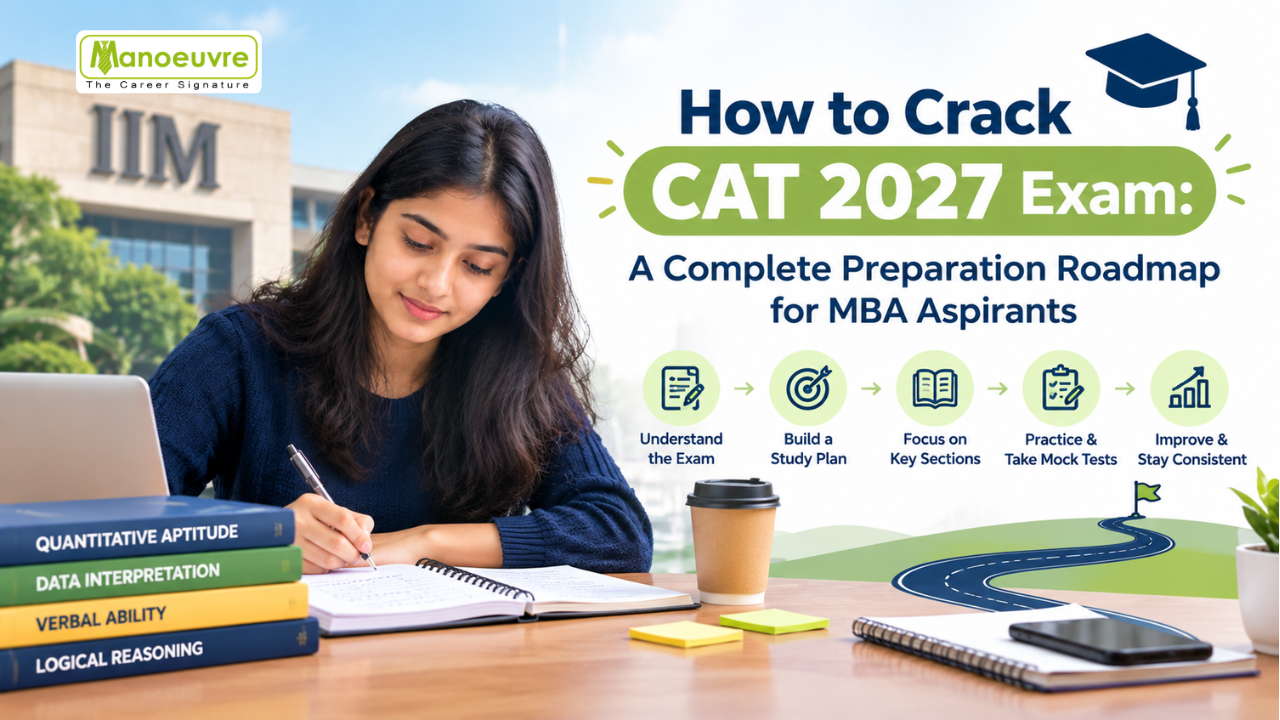
How to Crack CAT 2027 Exam: A Complete Preparation Roadmap for MBA Aspirants Preparing for CAT 2027 can appear overwhelming given the level of competition, the breadth of the syllabus, and the speed required to solve questions within the given time. However, effective preparation does not require studying every topic at once. It requires a clear understanding of the exam pattern, a solid foundation in basics, regular and structured practice, and consistent learning from mistakes.For those researching how to crack the CAT exam for MBA admissions, the first requirement is a preparation plan that can be followed consistently. A steady routine maintained over several months tends to produce better results than short bursts of intensive study followed by long gaps.This guide outlines a practical approach to preparing for CAT 2027. Understand the CAT Exam Before You Begin Preparation Before diving into prep, take time to understand how the exam is organized and what each section entails. CAT evaluates candidates across three sections:● VARC - Verbal Ability and Reading Comprehension● DILR - Data Interpretation and Logical Reasoning● QA - Quantitative AptitudeEqual proficiency in all three sections is not required at the outset. The first step is to assess your current level of preparedness.Attempt a few questions from each section, or take a diagnostic mock test. The score at this stage is not important. The objective is to identify your strengths, weaknesses, and the question types that require more time to solve. Begin CAT 2027 Preparation with the Fundamentals For candidates starting preparation from the beginning, it is advisable not to attempt difficult questions immediately.● Quant - Revise basic concepts and formulas before progressing to more challenging problems.● VARC - Develop a consistent reading habit and focus on understanding passages rather than memorising vocabulary alone.● DILR - Begin with manageable sets and gradually increase the level of difficulty.A strong foundation makes subsequent practice significantly more effective. Creating a CAT 2027 Study Plan An effective CAT 2027 study plan should be divided into distinct stages rather than attempting to cover all areas simultaneously.Stage 1: Build the FoundationThis stage should focus on understanding core concepts across all three sections, recognising different question types, and solving easy to moderate questions without emphasis on speed. Accuracy and conceptual clarity should take priority at this point. This is also the stage to identify topics that require additional attention and to establish a consistent study routine.Stage 2: Increase PracticeOnce the fundamentals are reasonably clear, preparation should shift towards mixed and timed practice. This includes solving varied DILR sets and reading comprehension passages, and combining Quant questions from different topics to build the ability to identify the required concept quickly.At this stage, preparation should move from learning concepts to applying them under time constraints.Stage 3: Focus on Mocks and RevisionAs the exam approaches, mock tests should form a central part of preparation. However, the value of a mock test lies primarily in the analysis that follows it, not in the score alone.After each mock test, review the following:● Which questions were answered incorrectly, and why● Which questions consumed excessive time● Which questions should have been skipped● Whether errors were conceptual or due to calculation mistakes● Which section had the greatest impact on overall performanceMaintaining a mistake log and reviewing it regularly can help identify recurring patterns. Section-Wise Preparation for CAT 2027 Each section of the CAT exam requires a distinct approach. Applying the same method across VARC, DILR and Quant is unlikely to yield the best results. Section Core Focus Areas Preparation Approach VARC Reading Comprehension, Verbal Ability Read regularly and practise a variety of passage types and verbal questions DILR Data Interpretation, Logical Reasoning Practise diverse sets and develop speed along with sound set selection Quant Arithmetic, Algebra, Geometry, Number System Strengthen concepts, practise mixed questions, and introduce timed practice CAT VARC PreparationRegular reading contributes significantly to VARC preparation. Editorials, essays and long-form articles across different subjects can help build familiarity with unfamiliar topics and longer passages.While practising, attention should be given to:● Reading comprehension● Para-based questions● Sentence arrangement● Verbal reasoning● Vocabulary in context● Understanding the author's argumentIn the initial stages, focus should be on understanding the tone, central idea and structure of a passage rather than on completing it quickly. Speed generally improves with consistent practice.CAT DILR PreparationDILR requires both logical reasoning ability and the capacity to work through unfamiliar information without losing time. It is advisable to practise a range of set types rather than limiting practice to familiar formats.Preparation should cover:● Tables and charts● Arrangements● Games and tournaments● Distribution● Networks● Caselets● Logical conditionsSet selection is a critical skill in this section. During practice, candidates should note which sets can be solved efficiently and which ones require excessive time, as this understanding supports better decision-making during the actual exam.CAT Quantitative Aptitude PreparationFor Quant, concepts should be strengthened before attempting difficult questions. Once a topic is well understood, question variety should be increased, followed by the gradual introduction of time limits.Important areas include:● Arithmetic● Algebra● Geometry● Number system● Modern mathematics● Percentages● Profit and loss● Ratio and proportion● Averages● Time, speed and distance● Time and workProgress isn't about quantity. Instead, measure yourself by the quality of your responses, your error patterns, and whether you're actually learning from each question. When an error occurs, it is important to understand its cause. Addressing recurring mistakes early tends to be more beneficial than solving a larger volume of questions. How Many Hours Should You Study for CAT 2027? There's no universal formula saying you need to study 5 hours or 8 hours every day. Different students need different timeframes based on their starting level, learning pace, and existing knowledge. The appropriate duration depends on the time available before the exam, the candidate's current level of preparation, and other daily commitments.For candidates starting early, even a few focused hours each day, maintained consistently, can be effective. Those with college, work or other responsibilities should create a schedule that reflects the time realistically available to them.A routine that can be sustained over several months generally produces better outcomes than an intensive schedule that cannot be maintained. Can You Crack CAT 2027 Without Coaching? Yes, self-study is a viable option, though it requires discipline. Candidates preparing independently should ensure they have reliable study material, a structured preparation plan, regular practice, and adequate mock tests.Coaching can provide structure and guidance, but enrolling in a course does not replace individual effort and practice. Similarly, self-study can be effective when supported by a clear plan and consistent progress tracking.Go with what suits your learning and schedule. How to Improve Your CAT Preparation ● Analyse mistakes regularly. Work on patterns of errors, not new problems. ● Practise with a timer. Add time pressure only once you understand the concept. ● Revise on a consistent basis. Concepts and formulas that are not revised are easily forgotten.● Read daily. Regular reading builds comfort with lengthy and unfamiliar passages.● Take mocks seriously. The purpose of a mock test extends beyond the score; it should inform your approach.● Avoid frequent changes in strategy. Allow sufficient time to evaluate whether a preparation method is working. Common Mistakes to Avoid During CAT Preparation Common Mistake What You Should Do Instead Starting with difficult questions Build fundamentals first and increase difficulty gradually Using too many study materials Rely on a few reliable resources and complete them thoroughly Ignoring a weak section Identify weak areas through practice and give them regular attention Taking mocks without analysis Review incorrect, skipped and time-consuming questions after every mock Focusing only on attempts Track accuracy along with the number of questions attempted Spending too long on one question Recognise when to move on to preserve time for other questions Leaving revision until the end Revise concepts and formulas consistently throughout preparation The objective is not to eliminate every mistake, but to identify them early and refine your approach as preparation progresses. Final Thoughts on CAT 2027 PreparationThere is no single method that guarantees success in CAT. Different candidates reach their goals through different preparation routines.Begin by assessing your current level, strengthening your fundamentals, and developing a realistic CAT 2027 preparation strategy. Gradually increase the difficulty of your practice, incorporate mock tests, and use your mistakes to refine your approach.Candidates with more preparation time should use it to build strong fundamentals rather than rushing through the syllabus. Those with limited time should prioritise important areas, practise strategically, and dedicate more time to performance analysis.The primary objective of CAT preparation should be steady improvement in accuracy, speed, decision-making and overall confidence. Maintaining consistency and adjusting strategy based on mock-test performance are essential to this process. Frequently Asked Questions 1. Can I crack CAT in three months? Yes, preparation within three months is possible, provided the approach remains focused. Prioritize core topics, frequent practice, tests, and analysis. 2. Is the CAT exam difficult to crack? CAT is a competitive exam, and its difficulty varies depending on a candidate's fundamentals, quality of practice, and ability to manage time effectively during the exam.3. How should I start my CAT preparation from scratch?Begin by understanding the three sections, assessing your current level, and building your fundamentals. Next, create a schedule with practice, revision, and tests. 4. How many hours should I study for CAT 2027? No standard hour count fits all students. A realistic daily schedule should be created based on the time available and followed consistently.5. Can I crack CAT 2027 without coaching? Yes. Self-study is a viable option provided the candidate has suitable study material, a proper preparation plan, regular practice and access to good-quality mock tests.6. How can I improve my CAT mock-test scores? Every mock test should be analysed after completion. Conceptual mistakes, time-management issues, questions that should have been skipped, and sections requiring improved accuracy should all be identified.7. When should I start CAT 2027 preparation? Starting early allows more time to build fundamentals, practise different question types, revise thoroughly, and attempt an adequate number of mock tests. However, the appropriate starting point depends on the candidate's current level and available study time.

17 Sep 2026
0 comments
Best Books for CAT Exam Preparation: CAT Books for Quant, DILR & VARC Preparing for CAT is not just about studying for long hours. Quality of study, practice method, and regular improvement matter most. The right books can make this process much easier by giving you a structured way to learn concepts, practise questions and work on your weak areas.For students preparing for CAT, books can be especially useful for building fundamentals before moving on to sectional tests and mock exams. Whether you are starting your preparation or aiming for a 99+ percentile, having the right study material can help you make your preparation more focused.In this guide, we will look at the role of books in CAT preparation, the topics you should cover, how books can improve your score and how to use them effectively. What Is CAT? The Common Admission Test (CAT) is a national-level management entrance examination conducted by the Indian Institutes of Management. CAT scores are used for admission to postgraduate management programmes at the IIMs and are also accepted by several other management institutes.The exam tests a candidate's ability in areas such as reading comprehension, verbal reasoning, data interpretation, logical reasoning and quantitative aptitude. A good CAT score can therefore open the door to some of the leading management programmes in India.It's not about memorizing - it's about understanding. It checks how well you can understand a problem, identify the right approach and arrive at an answer within a limited amount of time. Career Opportunities After an MBA Through CAT CAT is an entrance exam, but the larger goal for many students is to pursue an MBA or another management programme and build a career in business.After completing an MBA, students can explore roles across areas such as:● Marketing and brand management● Finance and investment● Business consulting● Human resources● Operations and supply chain● Business analytics● Product management● Sales and business development● General managementThe actual career path depends on factors such as the institute, specialisation, skills, internships and professional experience. CAT can be the first step towards accessing management education that leads to these opportunities. CAT Exam Highlights Before starting your preparation, it helps to understand the basic structure of the CAT exam. Knowing the exam mode, sections, question types and marking scheme gives you a clearer idea of what you will be preparing for and helps you plan your study material accordingly. Particular Details Exam Name Common Admission Test (CAT) Conducting Body Indian Institutes of Management Exam Mode Computer-Based Test Exam Sections VARC, DILR and QA Question Types MCQ and non-MCQ questions Marking Scheme Positive marks for correct answers with negative marking applicable to incorrect MCQs Exam Purpose Admission to postgraduate management programmes The exact CAT pattern, number of questions and other exam-day details can change, so candidates should always check the official notification for the year they are appearing. The official CAT information confirms the three sections: VARC, DILR and QA, with both MCQ and non-MCQ formats used in the examination. CAT Exam Syllabus The CAT syllabus is divided into three sections:● Verbal Ability and Reading Comprehension (VARC): Tests reading comprehension and verbal ability.● Data Interpretation and Logical Reasoning (DILR): Focuses on interpreting data and solving logical reasoning problems.● Quantitative Ability (QA): Covers mathematical concepts and their application in problem-solving.The three sections test different skills, making balanced preparation important for a strong overall CAT score. How CAT Books Can Boost Your Score Good books help you understand concepts, practice varied questions, and feel confident. With consistent practice, they can support improvement in speed, accuracy and problem-solving ability.1. Build Strong ConceptsBooks provide structured explanations that help you understand important CAT concepts before moving to advanced questions.2. Improve Problem-SolvingRegular practice exposes you to different question types and helps you develop faster and more effective solving approaches.3. Increase Speed and AccuracySolving questions regularly, especially with a time limit, helps you improve your calculation speed while reducing mistakes.4. Strengthen DILR SkillsPractising different sets can make you more comfortable with unfamiliar data, arrangements and logical problems.5. Improve Reading ComprehensionRegular VARC practice helps you become better at understanding passages, identifying key ideas and answering inference-based questions.6. Make Revision EasierBooks serve as guides for formulas, concepts, hard questions, and areas needing more work. Best Books for CAT Quantitative Aptitude When choosing a Quantitative Aptitude book, look for material that covers the major CAT topics and provides enough practice at different difficulty levels.A useful Quant book should help you work on:● Arithmetic concepts and applications● Algebraic problem solving● Geometry● Number systems● Modern mathematics● Mixed practice● CAT-level questionsStart with concept-based questions and gradually move towards more challenging problems. After mastering a topic, practice with a timer to get faster. Recommended Book for CAT Quantitative AptitudeManoeuvre’s Quantitative Aptitude Book offers a structured way to strengthen your fundamentals and gradually move towards CAT-level problem solving, making it useful for both learning and regular practice. Best Books for CAT DILR Preparation DILR requires working through various set formats. Look for books that provide practice across areas such as:● Tables and charts● Caselets● Arrangements● Distribution● Games and tournaments● Venn diagrams● Logical puzzles● Mixed DILR setsAttempt whole sets, not just separate questions. This will help you practise understanding the information first and then deciding how to approach it.Recommended Books for CAT DILRManoeuvre’s DILR Books provide varied practice designed to improve your ability to understand sets, identify patterns, and arrive at solutions efficiently-skills that are essential for tackling DILR under time pressure. Best Books for CAT VARC Preparation VARC materials should offer practice in both comprehension and verbal skills. Useful areas include:● Reading comprehension● Para summaries● Para jumbles● Sentence-based questions● Inference● Main idea● Author's tone● Verbal reasoningAlong with solving questions, make reading a regular part of your preparation. This can help you become more comfortable with different writing styles and improve your ability to understand passages efficiently.Recommended Book for CAT VARCManoeuvre’s English/VARC Book combines conceptual guidance with focused practice to help improve comprehension and verbal reasoning, while building the confidence needed to handle CAT-level questions. How to Choose Books for CAT Preparation You do not need to choose study material simply because it is popular. Look for books that fit your preparation level and give you enough scope for practice.Consider whether the book:● Covers the CAT syllabus properly● Explains concepts clearly● Includes solved examples● Provides questions at different difficulty levels● Has CAT-level practice● Offers detailed solutions● Can be used for revisionThe right material should make it easier for you to move from learning a concept to applying it independently. How to Use CAT Books for Maximum Score Improvement Simply buying books will not improve your CAT score. Your approach to using them matters.Follow a simple preparation cycle:Learn → Practise → Analyse → Revise → TestStart by understanding the concept. Solve the examples given in the book and then attempt questions on your own. Whenever you get a question wrong, spend time understanding the mistake rather than immediately moving to the next one.Once you are comfortable with a topic, start solving questions under a time limit. Later, use sectional tests and mock exams to check how well you can apply what you have studied. CAT Books and Mock Tests: How Do They Work Together? Books and mock tests serve different purposes, and using both can make your preparation more effective.Books teach concepts and let you practice varied questions. Sectional tests help you apply those concepts within a fixed time.Mock tests give you a broader picture of your preparation and help you understand how you perform across all three sections.The process can be as simple as:Study → Understand Concepts → Solve Problems → Test Sections → Full Mocks → Check Performance → Get BetterDo not treat mock-test analysis as an afterthought. If a particular topic repeatedly causes problems, return to your books, revise the concept and practise similar questions again. FAQs on Books for CAT Preparation 1. How to prepare for CAT MBA?Start by understanding the syllabus, choose suitable study material, build your concepts, practise regularly, take sectional tests and use mock exams to improve your exam strategy.2. Which books are best for CAT preparation?The best CAT preparation books are those that cover the syllabus clearly, provide sufficient practice and include questions that gradually build your problem-solving ability.3. Which books are useful for CAT Quantitative Aptitude preparation?Select books that teach concepts, show applications, include exam-level questions, and explain solutions clearly. 4. Which books are useful for CAT DILR preparation?Look for DILR books that provide a variety of data interpretation and logical reasoning sets, including arrangements, charts, caselets, distribution and puzzle-based questions.5. Which books are useful for CAT VARC preparation?VARC books should provide regular practice in reading comprehension, para-based questions, inference, sentence arrangement and verbal reasoning.6. Can CAT books improve speed and accuracy?Yes. Consistent practice can help you become faster at recognising question types, selecting the right approach and solving problems while maintaining accuracy.7. Are books enough for CAT preparation?Books can provide a strong foundation, but CAT preparation also benefits from sectional tests, mock exams, previous questions and regular performance analysis.
16 Sep 2026
0 comments
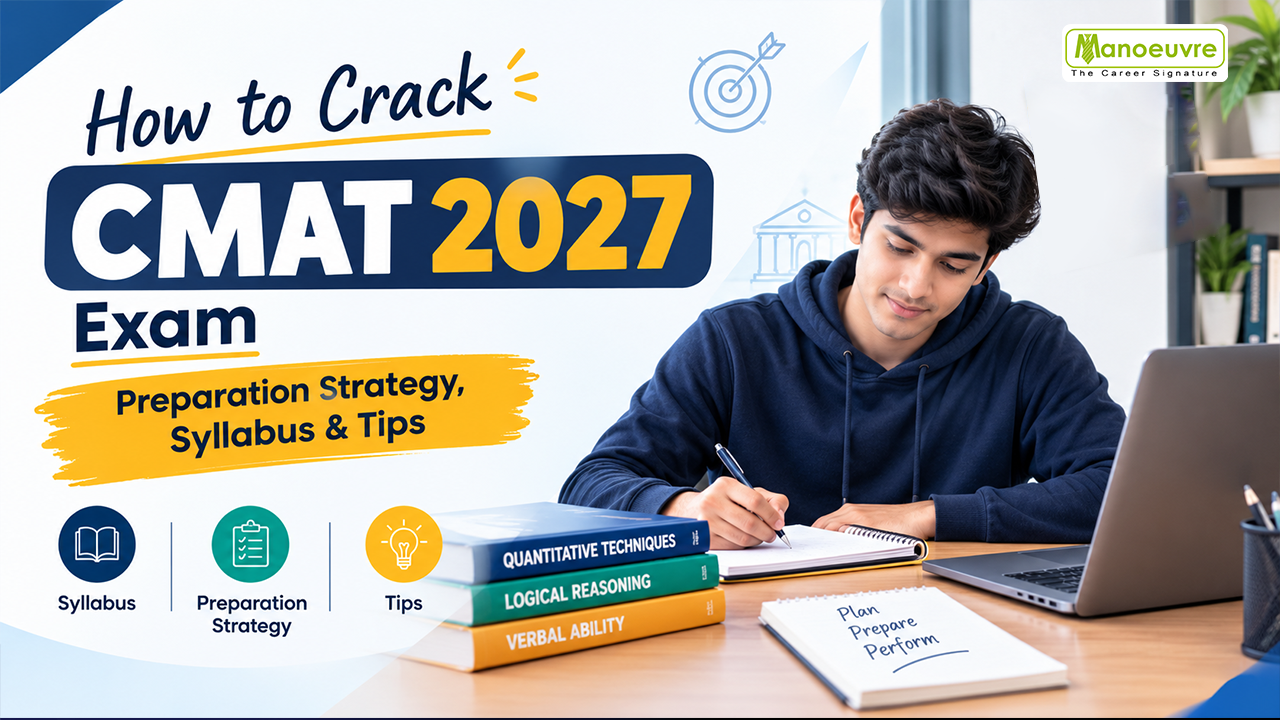
How to Crack CMAT 2027 Exam: Preparation Strategy, Syllabus & Tips Preparing for CMAT is not just about finishing the syllabus and taking a few mock tests at the end. The bigger challenge is learning how to manage different sections, improve speed, avoid unnecessary mistakes and make the most of the time available.If you are targeting CMAT 2027, starting early gives you enough time to work on your weak areas instead of rushing through everything in the final few weeks. A sensible CMAT 2027 preparation plan should include concept building, regular practice, revision and mock-test analysis.Here is a practical approach to help you understand what to study and how to prepare for the exam. CMAT 2027 Exam Highlights Before starting your CMAT 2027 preparation, it helps to have a quick understanding of the exam. CMAT 2027 details aren't out yet, so use 2026 as your guide. Particular Details Exam Name Common Management Admission Test (CMAT) Conducting Body National Testing Agency (NTA) Exam Level National Level Mode of Exam Computer-Based Test Frequency Once a year Expected Exam Month January 2027 Duration 3 hours Main Sections Logical Reasoning, Quantitative Techniques & Data, Language Skills, Awareness, Enterprise Marking Scheme Right answer = 4 marks | Wrong answer = -1 mark Maximum marks 400 Note: The CMAT 2027 exam pattern, marking scheme and schedule will be confirmed by NTA through the official notification. The details above are based on the latest available CMAT examination pattern and should be checked again when the CMAT 2027 notification is released. CMAT 2027: What Should You Know First? CMAT is a national entrance exam run by NTA for management programs. CMAT scores are used by AICTE-approved institutions, university departments and affiliated colleges for admission to management programmes.The exam covers areas such as Quantitative Techniques & Data Interpretation, Logical Reasoning, Language Comprehension, General Awareness, and Innovation & Entrepreneurship.Before beginning your preparation, go through the latest CMAT syllabus, understand the exam structure and get familiar with the type of questions asked. CMAT Exam Date 2027 and Registration CMAT 2027 dates aren't out yet. The CMAT 2026 schedule can be used as a reference to understand the likely timeline.For CMAT 2026, registration was conducted before the examination, the admit card was released on 21 January 2026, and the exam was held on 25 January 2026. NTA later released the CMAT 2026 scorecard in February. Event CMAT 2026 CMAT 2027 Registration October-November 2025 Expected: October-November 2026 Admit Card 21 January 2026 Expected: January 2027 Exam Date 25 January 2026 Expected: January 2027 Result 13 February 2026 Expected: February 2027 The CMAT 2027 dates are expected dates based on the previous cycle, not officially announced dates. Check NTA's website for registration, admit card, and exam dates. CMAT Syllabus: What Do You Need to Prepare? The CMAT syllabus covers five areas, testing students across quantitative ability, reasoning, language, general awareness and business-related knowledge. Instead of spending equal time on every topic, understand what each section expects and then plan your preparation accordingly. CMAT Section What It Covers Quantitative Techniques & Data Interpretation Basic mathematics, arithmetic, algebra, numbers, geometry and data-based questions Logical Reasoning Puzzles, arrangements, series, coding-decoding, relationships and other reasoning questions Language Comprehension Reading comprehension, grammar, vocabulary and verbal ability General Awareness Current affairs, static GK, business, economy and important national and international events Innovation & Entrepreneurship Entrepreneurship, innovation, startups, business concepts and related developments The syllabus gives you the broad areas to prepare, but your focus should gradually shift from understanding topics to solving questions accurately within the available time. How to Start CMAT 2027 Preparation You do not need to begin by studying for several hours every day. Begin by figuring out where you are right now. 1. Take a Diagnostic TestAttempt a mock or sample paper before serious preparation. What you gain is more important than what you score. You may discover that Quant is taking too long, your Reading Comprehension accuracy is low or you are leaving too many questions in Logical Reasoning.2. Divide the Syllabus Into Smaller TargetsInstead of writing “complete Quant” in your study plan, break it into manageable topics.For example, give yourself a few days for arithmetic concepts, followed by practice sets and revision. Smaller targets are easier to track and less overwhelming.3. Give More Time to Weak AreasStudents often spend most of their preparation time on subjects they already enjoy. That feels productive, but it does not necessarily improve the overall score.Keep your stronger sections active while giving additional practice to the areas where you consistently lose marks. CMAT 2027 Preparation Strategy: Section-Wise Approach Once you have gone through the syllabus, the next step is to decide how to prepare for each section. Every section needs a slightly different approach. Quant requires regular problem-solving, Reasoning improves with variety, while General Awareness needs consistent revision.Prioritize these topics in your preparation: CMAT Section Topics to Cover Quantitative Techniques & Data Interpretation Numbers, ratio, time & work, percentages, geometry, charts, profit & loss, speed-distance, algebra, interest, averages, arithmetic, equations, mensuration, tables and graphs Logical Reasoning Puzzles, arrangements, coding-decoding, series, blood relations, directions, syllogisms, analogy, classification, statements and logical relationships Language Comprehension Reading comprehension, vocabulary, grammar, sentence correction, verbal ability, synonyms, antonyms and para-based questions General Awareness Current affairs, business and economy, awards, sports, government schemes, important national and international events and static GK Innovation & Entrepreneurship Entrepreneurship, startups, innovation, business terms, entrepreneurs, funding, business environment and related developments Quantitative Techniques & Data InterpretationBuild your basics first, especially in arithmetic, and then gradually work on speed. Do not depend on shortcuts before you are comfortable with the concepts.For Data Interpretation, practise tables, charts and graphs regularly. Focus on accurate calculations and learn to avoid spending too much time on a single set.Logical ReasoningRegular practice is the key to improving Logical Reasoning. Cover different types of questions such as puzzles, arrangements, series, coding-decoding, blood relations, directions and syllogisms.While practising, keep track of time and learn to skip questions that are taking too long.Language ComprehensionMake reading a regular part of your preparation instead of leaving it for the last few weeks. Read different types of articles and practise Reading Comprehension, grammar and vocabulary questions.Review your mistakes to understand where you are losing marks and improve gradually.General AwarenessKeep up with current affairs throughout your CMAT 2027 preparation rather than trying to cover everything at the end.Focus on major national and international events, business, economy, government initiatives and other important developments. Review consistently to keep information sharp. Innovation & EntrepreneurshipBegin by understanding basic concepts related to entrepreneurship, startups, innovation, funding and business.Follow important developments in the startup and business world, and focus on understanding concepts instead of memorising long lists of facts. CMAT 2027 Preparation: Mock Tests and Previous-Year Questions Mocks should not be treated as something you start only when the syllabus is finished.Once you have covered the basic concepts, begin with sectional tests and gradually move towards full-length mocks.After every test, look beyond the score. Check:● Which questions did you get wrong?● Which questions took too much time?● Were your mistakes due to concepts, calculation or reading?● Which questions should you have skipped?● Which topics need another round of practice?Previous-year questions are equally useful because they help you understand the style and level of questions you need to handle. How to Improve CMAT Speed and Accuracy Speed improves naturally when you become familiar with the questions, but you still need deliberate practice.Use timed question sets, practise calculations regularly and avoid spending several minutes trying to force your way through one difficult question.Accuracy is just as important. If you are attempting many questions but making frequent errors, simply increasing your speed will not solve the problem.The goal should be to find a balance between attempts, accuracy and time management. Common Mistakes While Preparing for CMAT 2027 Some preparation mistakes can cost students more time than difficult questions themselves.● Starting without understanding the syllabus● Collecting too many study resources● Ignoring General Awareness until the end● Taking mocks without analysing them● Spending too long on one question● Revising only before the exam● Concentrating on favorite sections and avoiding weaker ones ● Changing the preparation strategy every few weeksA simple plan followed consistently is usually more useful than a complicated plan that keeps changing. CMAT 2027 Preparation Timeline Your preparation can broadly be divided into four stages: Stage Main Focus Starting Phase Understand syllabus and assess your level Concept Phase Build fundamentals and practise topic-wise Practice Phase Timed sets, previous-year questions and sectional tests Final Phase Full mocks, revision, weak areas and exam strategy If you have only one month left, do not try to learn every topic from scratch. Concentrate on important areas, practise questions, take mocks and revise your mistakes. Final Tips to Crack CMAT 2027 Exam To crack CMAT 2027 exam, you do not need a complicated strategy. You need a preparation routine that you can actually maintain.Understand the syllabus, identify your weak areas and work on them consistently. Take mocks regularly, but spend just as much time understanding your mistakes. Keep revising instead of constantly moving on to new topics.Most importantly, do not judge your preparation by the number of hours you study. Judge it by whether your accuracy, speed and mock-test performance are improving. FAQs 1. What is the CMAT exam?CMAT, or the Common Management Admission Test, is a national-level entrance examination conducted by the National Testing Agency for admission to management programmes. Its scores are accepted by participating AICTE-approved institutions, university departments and affiliated colleges.2. Is CMAT accepted in IIT?Yes, CMAT may be accepted for certain IIT management programmes, depending on the institute and admission year. For example, IIT (ISM) Dhanbad has been listed among institutes accepting CMAT scores. Check the latest admission notification before applying. 3. Is the CMAT result out?The CMAT result is usually released in February after the examination. For CMAT 2027, the result is expected in February 2027, subject to the official NTA schedule.4. Can I clear CMAT in 1 month?Yes, it is possible, particularly if your basic concepts are already strong. With one month available, focus on important topics, previous-year questions, mock tests, revision and improving accuracy instead of trying to cover every topic in depth.5. Can I get IIM through CMAT?No, IIMs focus on CAT for main programs. CMAT is used by participating management institutes that accept CMAT scores.6. Is CMAT held twice a year?CMAT is generally conducted once a year. Check NTA's official notification for exam schedule details. 7. Which Tier 1 colleges accept CMAT?JBIMS Mumbai and SIMSREE Mumbai are among the reputed Maharashtra management institutes where CMAT scores can be considered through the applicable admission process. Other institutes may also accept CMAT, so check the latest eligibility and admission rules before applying.
15 Sep 2026
0 comments
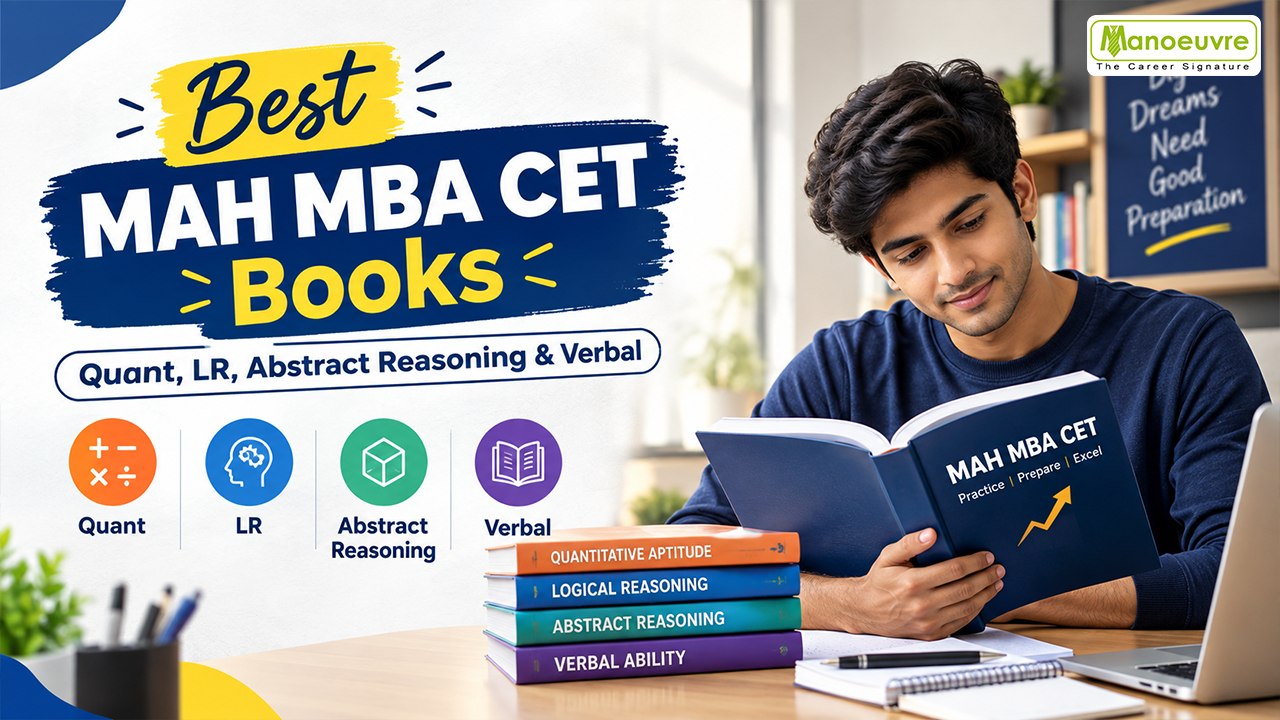
Best MAH MBA CET Books: Quant, LR, Abstract Reasoning & VerbalPreparing for MAH MBA CET can feel confusing when there are so many books and study resources available. Many students gather multiple materials without knowing which ones actually help. Select books based on what the exam covers and your prep stage. A useful book should explain concepts clearly, provide enough practice and help you become faster and more accurate.This guide covers the different types of MBA CET books you can use for preparation, along with tips on choosing study material, using mock tests and planning your preparation. MAH MBA CET Exam Highlights MAH MBA CET Exam OverviewThe MAH MBA CET is a Maharashtra state-level entrance test used for admission to eligible MBA and MMS programmes offered by participating institutes. Understanding the exam structure is important before starting your MBA CET preparation, as it helps you select the right books and study material. Exam Particular Details Exam Name MAH-MBA/MMS-CET Full Form Maharashtra Common Entrance Test for MBA/MMS Conducting Authority State Common Entrance Test Cell, Maharashtra Exam Level State Level Exam Mode Online Computer-Based Test (CBT) Question Type Multiple Choice Questions (MCQs) Total Questions 200 Maximum Marks 200 Exam Duration 150 Minutes Medium English and Marathi Marks per Question 1 Mark Negative Marking No MAH MBA CET Syllabus and Section-Wise PatternThe MAH MBA CET syllabus is divided into four sections. Logical Reasoning has the highest number of questions, followed by Quantitative Aptitude, Verbal Ability & Reading Comprehension, and Abstract Reasoning. MBA CET Section Number of Questions Maximum Marks Logical Reasoning 75 75 Abstract Reasoning 25 25 Quantitative Aptitude 50 50 Verbal Ability & Reading Comprehension 50 50 Total 200 200 Regular practice and speed are crucial since you have 150 minutes for 200 questions. The absence of negative marking also allows candidates to attempt questions strategically without losing marks for incorrect answers. What Should You Look for in an MAH MBA CET Book? Before choosing an MAH MBA CET book, check whether it matches the exam requirements. The right resource should not only explain concepts but also give you enough questions to practise them.Look for books that offer:● Coverage of the relevant MBA CET syllabus● Clear and simple explanations● Solved examples● Topic-wise practice questions● Different levels of difficulty● Practice sets for speed and accuracy● Detailed solutions for incorrect questionsYour preparation does not become better simply because you have more books. A small set of useful resources that you actually complete is usually more practical. Best Books for MAH MBA CET Quantitative Aptitude A Quant book should cover the mathematical concepts required for the exam and provide plenty of questions for practice. For students looking for focused MAH MBA CET books, the Manoeuvre Quant Book can be used as a dedicated resource for building concepts and practising Quantitative Aptitude questions. Important areas generally include:● Arithmetic● Percentages● Profit and loss● Ratio and proportion● Averages● Time, speed and distance● Time and work● Interest● Number system● Algebra● Geometry● Mensuration● Data interpretationWhen selecting a Quant book, give preference to one that explains the basics before moving to tougher questions. This is particularly useful for students who are not very comfortable with mathematics.Once your concepts are clear, use the practice questions to improve calculation speed and accuracy. Best Books for MAH MBA CET Logical Reasoning Logical Reasoning demands practice across different question types. Therefore, an LR book should contain a broad range of questions rather than repeatedly focusing on one format. The Manoeuvre LR Book can be used for structured Logical Reasoning practice, helping students work through different question types and improve their problem-solving approach. You can look for practice covering:● Puzzles● Seating arrangements● Coding-decoding● Blood relations● Directions● Series● Syllogisms● Venn diagrams● Statements and conclusions● Analytical reasoningWhile practising, try to understand the logic behind each question. If you repeatedly make the same type of mistake, note it down and revisit that topic instead of simply moving to the next chapter. Best Books for MAH MBA CET Abstract Reasoning Abstract Reasoning involves identifying patterns and relationships between figures. Since these questions are visual in nature, regular practice is important. The Manoeuvre Abstract Reasoning Book can be used for practising different figure and pattern-based questions relevant to this section. An Abstract Reasoning book can include topics such as:● Figure series● Figure analogy● Classification● Odd one out● Pattern recognition● Figure completion● Visual sequencesWhen solving these questions, pay attention to changes in shape, position, direction, rotation and the number of elements. Practising different patterns can gradually make these questions easier to recognise. Best Books for MAH MBA CET Verbal AbilityFor Verbal Ability, choose a book that combines language concepts with sufficient practice. The Manoeuvre Verbal Book can be used as a dedicated resource for practising grammar, vocabulary and different types of verbal questions for MBA CET preparation. A good Verbal Ability book should cover areas such as:● Grammar● Vocabulary● Synonyms and antonyms● Sentence correction● Fill in the blanks● Sentence completion● Para jumbles● Verbal reasoningGo slow - build vocabulary bit by bit and revise consistently. Build your vocabulary gradually and revise regularly. Reading articles, editorials and other quality content can also complement your preparation. Best Books for MAH MBA CET Reading Comprehension Reading Comprehension needs a slightly different approach because understanding the passage quickly is just as important as answering the questions correctly. For focused RC practice, students can use the Manoeuvre RC Book to work on passage-based questions and improve comprehension skills. Your RC practice material should include different types of passages and questions based on:● Main idea● Inference● Author's tone● Supporting details● Conclusions● Vocabulary in contextStart by focusing on comprehension. Once you become comfortable with the passages, introduce timed practice to improve your reading speed. MAH MBA CET Book List: Books, Practice and Mock TestsBooks are only one part of effective MBA CET preparation. Once you have learnt the concepts, you need opportunities to apply them.A balanced study material for MBA CET can include: Resource Main Purpose Quant book Concepts and mathematical practice LR book Reasoning concepts and problem-solving Abstract Reasoning book Figure and pattern practice Verbal Ability book Grammar and vocabulary RC material Reading and comprehension practice Previous-year questions Familiarity with question formats Topic-wise tests Practice after individual topics Sectional tests Section-wise speed and accuracy MBA CET mock test Full-length exam practice Revision notes Quick revision before tests You do not have to use every resource from the beginning. Start with books and topic-wise practice, and gradually increase your testing as your preparation progresses. How to Use MBA CET Mock Tests EffectivelyAn MBA CET mock test gives you an opportunity to practise in a time-bound environment. However, taking a mock is only half the process.After every test, check:● Which questions you got wrong● Which questions you could not attempt● Which topics caused repeated mistakes● Where you spent too much time● How your accuracy varied across sectionsInstead of immediately moving to another mock, spend some time fixing the issues you found.A simple cycle to follow is:Attempt → Analyse → Improve → Revise → Attempt AgainThis makes mock tests a useful part of your preparation rather than simply a way of checking your score. MAH MBA CET Preparation StrategyYour MAH MBA CET preparation should follow the requirements of each section. Section Preparation Focus Quantitative Aptitude Build concepts, practise calculations and improve speed Logical Reasoning Practise different question types and develop accuracy Abstract Reasoning Regularly solve figure and pattern-based questions Verbal Ability Strengthen grammar, vocabulary and sentence skills Reading Comprehension Improve comprehension and reading speed Start by building your concepts through the appropriate books. After that, increase your focus on practice sets and timed questions.As the exam approaches, give more importance to sectional tests, revision and full-length MBA CET mock tests. This also helps you understand which areas still need attention. How to Choose the Best Book for MAH MBA CET There is no single best book for MAH MBA CET that will suit every student. Your choice should depend on what you need from the resource.If your basics are weakChoose books with detailed explanations, solved examples and easier practice questions.If your concepts are already clearLook for resources with more mixed and exam-oriented practice.If you are preparing close to the examPrioritise revision, timed practice, previous-year questions and mock tests rather than starting several new books.Always check the syllabusBefore selecting an MBA CET book, compare its contents with the current syllabus. This helps you avoid spending valuable preparation time on unnecessary topics. Common Mistakes While Choosing MBA CET Books Students often make the mistake of believing that more resources automatically mean better preparation. Some common mistakes include:● Buying too many books● Choosing material without checking the syllabus● Using very difficult material unnecessarily● Ignoring practice questions● Reading solutions without attempting questions● Delaying mock tests until the last few weeks● Not analysing mistakes after tests● Switching between resources too frequentlyA focused approach is much easier to manage. Select useful resources, complete them properly and revise your weak areas regularly. Final Takeaway Choosing the best book for CET MBA preparation is less about finding the biggest or most popular resource and more about finding material that suits your requirements.A practical MAH MBA CET book list can include separate resources for Quantitative Aptitude, Logical Reasoning, Abstract Reasoning, Verbal Ability and Reading Comprehension. Add previous-year questions, topic-wise practice and MBA CET mock tests as you progress.Most importantly, use your books actively. Read the concept, solve questions, identify mistakes and revisit difficult areas. With consistent practice and regular testing, your study material becomes much more useful for actual exam preparation. FAQs 1. Which book is best for MBA CET preparation?Manoeuvre MBA CET book is one that matches the syllabus, explains concepts clearly and provides enough practice. The right choice can also depend on whether you are a beginner, intermediate or advanced learner.2. What is the MBA CET exam for?MAH MBA CET is a management entrance examination used for admission to eligible MBA/MMS programmes offered by participating institutes in Maharashtra.3. How many subjects are in MBA CET?The main areas covered in preparation are Logical Reasoning, Abstract Reasoning, Quantitative Aptitude, Verbal Ability and Reading Comprehension.4. Which book is best for MAH MBA CET Quantitative Aptitude?Choose a Quant book that covers the required mathematical topics and provides enough solved examples and practice questions to build speed and accuracy.5. Which book is best for MAH MBA CET Logical Reasoning?An LR book covering puzzles, arrangements, coding-decoding, series, analytical reasoning and other relevant question types can be useful for preparation.6. Which book is best for MAH MBA CET Verbal Ability?A good Verbal Ability book should cover grammar, vocabulary, sentence-based questions, para jumbles and other relevant verbal topics along with practice exercises.7. Should I choose MBA CET books according to the syllabus?Yes. Checking the MBA CET syllabus before selecting study material helps you focus on relevant topics and avoid spending unnecessary time on areas that are not part of your preparation.

15 Sep 2026
0 comments
Best MBA in Finance Colleges in Mumbai: Fees, Courses & AdmissionMumbai is one of the most preferred cities for students who want to build a career in management and finance. With banks, financial institutions, investment companies, consulting firms and corporate organisations based in the city, students get exposure to a wide range of finance-related career opportunities. There are several MBA in Finance colleges in Mumbai, but they do not all offer the same type of programme. Some institutes offer an MBA with Finance as a specialisation, while others offer PGDM or MMS programmes with a Finance focus. So, while choosing a college, students should look at the course structure, entrance exam, fees, admission process and career opportunities instead of focusing only on the programme name. What Is an MBA in Finance? An MBA in Finance is a management programme that focuses on financial management along with other areas of business. Students learn how organisations manage money, analyse financial information, evaluate investments and make financial decisions.The course usually covers areas such as financial management, accounting, investment analysis, financial markets, corporate finance and risk management. Students also study general management subjects such as economics, marketing, operations and strategy.An MBA in Finance can be suitable for students who enjoy working with numbers, have an interest in business and want to explore careers in banking, investments, corporate finance or financial analysis. Why Choose an MBA in Finance? Finance is an important part of almost every organisation. Businesses need professionals who can understand financial information, manage resources and support important financial decisions.Choosing Finance as a specialisation can give students the opportunity to explore different career areas. Some of the common reasons to choose an MBA in Finance include:● Banking & Financial Services● Corporate Finance● Investment & Financial Markets● Financial Analysis● Consulting Opportunities● Risk Management● Multiple Industry Options● Finance + Management SkillsMumbai can also be an attractive location for finance students because of its strong financial and corporate ecosystem. MBA in Finance Syllabus The MBA in Finance syllabus differs from one college to another. However, most programmes cover a combination of core management subjects and finance-focused subjects. Area Common Subjects Financial Management Financial Management, Corporate Finance Accounting Financial Accounting, Management Accounting Investments Investment Analysis, Portfolio Management Financial Markets Financial Markets and Institutions Banking Banking and Financial Services Risk Management Financial Risk Management Business Economics, Strategy and Business Analytics The exact subjects and electives depend on the institute. Students should check the latest curriculum of their preferred college before applying. Top MBA in Finance Colleges in Mumbai Students looking for MBA in Finance colleges in Mumbai have several options. However, it is important to understand that all of these institutes do not offer a programme titled exactly “MBA in Finance”. Some offer an MBA, while others offer PGDM or MMS programmes with Finance as a specialisation. College Programme Finance Focus Entrance Exam IIM Mumbai MBA Finance-related coursework CAT IIT Bombay - SJMSOM MBA Finance courses/electives CAT SPJIMR Mumbai PGDM Finance specialisation CAT / GMAT JBIMS Mumbai MMS Finance MН-СЕТ, САТ, СМАТ, ХАТ, АТМА, МАТ, GMAT, others NMIMS SBM Mumbai MBA Finance NMAT K J Somaiya Institute of Management MBA Finance CAT, XAT, GMAT, NMAT, or CMAT N. L. Dalmia PGDM (Finance) Finance specialisation CAT, XAT, GMAT, CMAT, MH-CET, others Welingkar Mumbai PGDM Finance CAT, XAT, CMAT, others SIESCOMS MMS Finance Applicable admission route SIMSREE MMS Finance MHCET, GMAT, MAT, CAT, CMAT, XAT IIM MumbaiIIM Mumbai offers a two-year MBA programme. Students interested in Finance can study finance-related subjects as part of the wider management curriculum.Admission to the programme is based on the institute's prescribed eligibility and selection criteria, with CAT used for the regular MBA admission route.IIT Bombay - SJMSOMThe Shailesh J. Mehta School of Management (SJMSOM), IIT Bombay offers a two-year MBA programme. Students can study Finance through the programme's curriculum and electives.For the 2026-28 batch, the official total programme fee for General, EWS and OBC-NCL candidates is ₹15,55,800. The fee for SC, ST and PwD candidates is ₹7,55,800. Additional charges, including refundable deposits and hostel and mess fees where applicable, may apply.SPJIMR MumbaiSPJIMR offers a two-year full-time PGDM with Finance as one of the available specialisations. Although the programme is called PGDM, the institute states that it is equivalent to an MBA.For Indian participants, the official programme fee is ₹24,86,000, while the fee for international participants is ₹34,77,500. This includes tuition fees and basic hostel accommodation. The institute states that the fee is indicative and subject to revision. Additional expenses may apply for optional components such as Global Fast Track (GFT) and International Exchange.JBIMS MumbaiJamnalal Bajaj Institute of Management Studies offers the Master of Management Studies (MMS) programme. Finance is an important part of the curriculum, and the institute also offers an MMS in Financial Management.Students interested in finance can therefore consider JBIMS even though its flagship management degree is called MMS rather than MBA.NMIMS School of Business ManagementNMIMS School of Business Management offers its two-year full-time MBA programme. Students receive broad management exposure and can develop their understanding of Finance as part of the programme.The flagship MBA admission process uses NMAT. Students should refer to the latest official admission information for current fees and selection requirements.K J Somaiya Institute of ManagementK J Somaiya Institute of Management offers a two-year MBA programme with Finance among its areas of study.For the 2026-28 batch, the official fee is ₹11,52,000 for the first year and ₹12,35,500 for the second year. Students should also check the latest fee notice for any changes or additional charges.N. L. Dalmia Institute of Management Studies & ResearchN. L. Dalmia offers a dedicated PGDM (Finance) programme. This makes it a relevant option for students who want a stronger focus on Finance.The institute lists the two-year PGDM Finance fee at ₹16.5 lakh for the 2026-28 batch.Welingkar Institute of ManagementWelingkar Institute of Management Development & Research offers a full-time PGDM programme in Mumbai, with Finance among its areas of study.For the 2026-28 programme, the institute lists tuition and other fees at ₹7 lakh per year. Other applicable charges may be separate.SIES College of Management StudiesSIESCOMS offers a two-year full-time MMS programme affiliated with the University of Mumbai. Finance is one of the functional specialisations available under the programme.Students should check the institute's latest admission notice for the current fee structure and admission requirements.SIMSREESydenham Institute of Management Studies, Research and Entrepreneurship Education, commonly known as SIMSREE, offers a two-year full-time MMS programme.Finance is one of the specialisations available to MMS students. The institute lists the fee at ₹67,000 plus ₹2,000 library fees per year. Students should check the latest admission and fee notices for any updates or additional charges. MBA in Finance Fees in Mumbai The MBA in Finance fees in Mumbai vary from one institute to another depending on the programme, fee structure and admission category. Students should also look at the minimum eligibility or entrance cut-off before applying.Here is a quick comparison of the fees and minimum qualifying criteria for some leading finance-focused management programmes in Mumbai: College Programme Fee Minimum Cut-Off / Qualifying Criteria IIT Bombay - SJMSOM MBA ₹15.55 lakh 60% in graduation for General/EWS/OBC-NCL; CAT required SPJIMR PGDM ₹24.86 lakh 85 percentile overall in CAT; 75 percentile in each section K J Somaiya MBA ₹23.88 lakh Minimum 50% in graduation; entrance score considered N. L. Dalmia PGDM Finance ₹16.5 lakh Minimum 50% in graduation + accepted entrance exam score Welingkar PGDM ₹7.50 lakh/year* 80 percentile in CAT/XAT/GMAT; 85 percentile in ATMA/CMAT SIMSREE MMS ₹67,000 + library fee/year 50% in graduation; 45% for applicable reserved categories The figures above are based on the latest official information available from the respective institutes. Fees and admission criteria may change by admission year, category and programme. Some colleges may also have additional charges for accommodation, deposits, examinations or other facilities.It is also important to understand that a minimum cut-off does not guarantee admission. Institutes may consider other factors such as academic performance, entrance-test scores, work experience, interviews and other selection criteria while preparing the final shortlist. Eligibility for MBA in FinanceEligibility varies by college and programme. Candidates generally need a recognised bachelor's degree and must meet the institute's minimum marks and entrance exam requirements.● IIT Bombay - SJMSOM: 60% in graduation for General/EWS/OBC-NCL and 55% for SC/ST/PwD + CAT.● SPJIMR Mumbai: 50% in graduation + CAT/GMAT as applicable.● K J Somaiya: 50% in graduation + an accepted management entrance exam.● N. L. Dalmia: 50% in graduation + an accepted entrance exam.● Welingkar Mumbai: 50% in graduation + an accepted entrance exam.● SIMSREE: 50% in graduation; 45% for applicable reserved categories + applicable entrance exam.These are the key eligibility requirements, but additional conditions or requirements may apply depending on the college and admission year. Students should always refer to the official website and latest admission notification of the respective institute before applying. Final-year students may also be eligible for some programmes, subject to the institute's conditions. MBA in Finance Admission Process The admission process for MBA in Finance colleges in Mumbai depends on the institute and the programme. While some colleges follow a common admission process through Maharashtra, others conduct their own selection rounds.1. Check Eligibility CriteriaFirst, check the graduation marks, degree requirements and other eligibility conditions specified by the college.2. Appear for the Required Entrance ExamDepending on the institute, students may need to appear for CAT, MAH MBA CET, NMAT, XAT, CMAT, GMAT, MAT or ATMA. The accepted exams vary from college to college.3. Apply to the CollegeCandidates need to fill in the respective college application form and submit the required documents and application fee.4. ShortlistingColleges may shortlist candidates based on entrance exam scores, academic performance, work experience, profile or a combination of these factors.5. Selection RoundsDepending on the institute, shortlisted candidates may have to appear for a Personal Interview (PI), Group Discussion (GD), Written Ability Test (WAT), Problem Solving Analysis (PSA) or other selection activities. For example, K J Somaiya includes WAT, PSA and PI in its MBA selection process, while N. L. Dalmia considers entrance scores, academics, GD, PI and work experience.6. CAP Round, Where ApplicableStudents applying to institutes that participate in the Maharashtra Centralised Admission Process may need to register for CAP rounds. For example, JBIMS states that admission to its MMS programme is conducted through the common CAP process.7. Final AdmissionAfter selection or seat allotment, candidates need to complete document verification, pay the required fees and confirm their admission within the specified deadline.The admission process is not identical for all colleges. Students should check the latest official admission notification of their preferred institute for the exact entrance exam, selection process and deadlines. MBA in Finance JobsThere are several MBA in Finance jobs available across banking, corporate finance, investment and consulting.Some common roles include:● Financial Analyst● Investment Banking Analyst● Corporate Finance Analyst● Credit Analyst● Risk Analyst● Equity Research Analyst● Wealth Management Associate● Financial Consultant● Treasury Analyst● Business Finance AnalystThe actual career opportunities depend on the student's college, skills, internships, academic performance and recruitment opportunities. Career Scope After MBA in FinanceAn MBA in Finance can lead to opportunities in different sectors. Students may work in banking and financial services, investment banking, corporate finance, asset management, wealth management, equity research, risk management or financial consulting.Students with strong analytical and technical skills can also explore finance roles involving business analytics, financial modelling and data-driven decision-making.The career path does not have to remain limited to the first job. With experience and additional skills, professionals can move into more specialised finance and management roles. How to Choose the Best MBA in Finance College in Mumbai?Choosing a college should not be based only on rankings or the name of the programme. Before applying, compare:● Finance curriculum and electives● Entrance examination● Total programme fees● Internship opportunities● Industry exposure● Placement opportunities● Faculty and learning environment● Location and overall expensesAlso check whether Finance is offered as a dedicated specialisation or only as an elective. This can be important if you already have a specific finance career in mind. MBA vs MBA in Finance An MBA provides broad management education, while an MBA in Finance gives greater importance to finance-related subjects. MBA MBA in Finance Broader management focus Greater focus on Finance Covers multiple business functions Covers more finance-related subjects Suitable for varied management careers Suitable for finance-oriented careers Finance may be an elective Finance is a major area of study If you are still exploring different management careers, a general MBA may provide greater flexibility. If you already know that you want to work in finance, a Finance-focused programme may be more suitable. Frequently Asked Questions 1. What is MBA in Finance?MBA in Finance is a management programme that combines general business education with specialised study of financial management, investments, accounting and financial markets.2. Is an MBA worth it in finance?An MBA can be worthwhile for students who want to build a career in finance, provided they choose a programme that matches their career goals, budget and preferred area of work.3. What is the difference between MBA and MBA in finance?An MBA covers different areas of management, while an MBA in Finance places greater emphasis on financial subjects and finance-related career paths.4. Is finance MBA hard?Finance includes numbers, accounting, economics and analytical concepts. It may seem challenging initially, but regular practice and a good understanding of the basics can make it manageable.5. Is MBA finance a good option?MBA Finance can be a good option for students interested in banking, corporate finance, investments, financial analysis, risk management and consulting.6. What are the top MBA in Finance colleges in Mumbai?Some prominent options include IIM Mumbai, IIT Bombay - SJMSOM, SPJIMR, JBIMS, NMIMS SBM, K J Somaiya, N. L. Dalmia, Welingkar, SIESCOMS and SIMSREE. The programmes differ, with some offering MBA programmes and others offering PGDM or MMS programmes with Finance specialisations.

10 Sep 2026
0 comments
Best MBA CET Online Classes in Maharashtra for Effective Exam PreparationPreparing for the MBA CET requires more than simply completing the syllabus. The exam tests speed, accuracy, logical thinking and the ability to make quick decisions under time pressure. Since a large number of questions need to be attempted within a limited duration, students need a preparation approach that combines concept building with consistent practice.For students looking for MBA CET online classes in Maharashtra, online learning can provide a structured way to prepare from home while accessing live teaching, practice material, mock tests and doubt-solving support. The right programme can also help students maintain consistency and identify areas that need improvement throughout their preparation. Understanding the MBA CET Exam The Maharashtra MBA CET, conducted by the State Common Entrance Test Cell, Maharashtra, is an important entrance examination for admission to MBA and MMS programmes offered by participating institutes.The examination primarily assesses a candidate's ability in areas such as logical reasoning, abstract reasoning, quantitative aptitude and verbal ability/reading comprehension. Unlike exams where students can spend considerable time on individual questions, MBA CET preparation requires an emphasis on speed because of the exam's question-intensive format.This makes regular timed practice an important part of preparation.Students should therefore focus on three things:● Understanding the concepts tested in each section● Developing question-solving speed● Improving accuracy through regular analysis Why Choose Online Preparation for MBA CET? Online preparation has become a practical option for students who want flexibility without compromising on structured learning. Instead of travelling to a classroom, students can attend sessions from wherever they are and continue their preparation alongside college or other commitments.A well-designed online course can provide:● Live interactive classes● Recorded sessions for revision● Topic-wise study material● Sectional and full-length mock tests● Doubt-solving support● Performance analysis● Regular practice assignments● Guidance for improving speed and accuracyThe advantage is not simply convenience. A structured online programme can bring all the major parts of preparation together, allowing students to follow a planned routine instead of relying on scattered resources. What Should You Look for in MBA CET Online Coaching? Not every online course follows the same teaching approach. Before enrolling, students should compare the features that directly influence their preparation.Experienced FacultyThe quality of teaching plays an important role in entrance exam preparation. Faculty should be able to explain concepts clearly while also introducing efficient methods for solving questions within a limited time.For MBA CET, this is particularly relevant because students often need to learn how to recognise question patterns and select the quickest suitable approach.Complete Syllabus CoverageA course should cover the major topics required for the examination rather than concentrating only on commonly asked areas.Students should check whether the programme provides systematic coverage of:● Logical Reasoning● Abstract Reasoning● Quantitative Aptitude● Verbal Ability● Reading ComprehensionComplete coverage gives students enough time to identify their strengths and work on weaker areas before the examination.Regular Mock TestsMock tests are one of the most useful tools for MBA CET preparation. They allow students to experience a timed examination environment and understand how they perform under pressure.However, simply taking tests is not enough. Students should review their attempts and identify:● Questions that consumed excessive time● Repeated calculation or conceptual errors● Topics with low accuracy● Questions that could have been solved faster● Sections where time allocation needs improvementThis analysis gradually turns mock-test practice into measurable improvement.Doubt-Solving SupportStudents may understand a concept during a class but face difficulties when applying it to unfamiliar questions. Accessible doubt-solving support can prevent these issues from becoming recurring weaknesses.A good online learning setup should make it reasonably easy for students to clarify concepts, understand alternative approaches and move forward with their practice. How to Prepare for MBA CET Effectively Joining an online course is only one part of preparation. Students also need a consistent study routine.Start with the Syllabus and Exam PatternBegin by understanding the sections, question types and overall structure of the examination. This helps you divide your preparation time according to the areas that require the most attention.Avoid starting preparation by randomly solving questions. Build a basic roadmap first.Strengthen Your FundamentalsBefore concentrating heavily on speed, make sure your fundamentals are clear. In quantitative aptitude, revise essential mathematical concepts. For reasoning, become familiar with common question patterns. In verbal ability and reading comprehension, focus on understanding language, vocabulary and passages.Strong fundamentals reduce the time required to solve questions later.Practise with a TimerSpeed is developed through repeated timed practice. Once you are comfortable with a topic, start solving sets within a fixed duration.Initially, prioritise accuracy. As your confidence improves, gradually reduce the time available for each set.This approach is more effective than trying to solve every question quickly from the beginning.Take Sectional TestsSectional tests help students understand their performance in individual areas. If your reasoning score is strong but quantitative aptitude accuracy is low, your preparation can be adjusted accordingly.Keeping a simple record of scores can help you track improvement over several weeks.Attempt Full-Length MocksOnce the basics and individual topics are reasonably strong, introduce full-length mock examinations into your routine.After every mock, spend time analysing the result. Your objective should not only be to see your score but to understand why marks were lost. Self-Study vs Online MBA CET Classes Both self-study and online coaching can work, but the right choice depends on how independently a student can plan and maintain preparation.FactorSelf-StudyOnline ClassesStudy scheduleFully self-managedStructured scheduleFaculty guidanceLimitedRegular guidanceDoubt solvingSelf-researchDedicated supportStudy materialNeeds to be arrangedUsually providedMock testsMust be sourced separatelyGenerally integratedPerformance trackingSelf-managedOften supported through analysisFlexibilityHighHighStudents who already have a strong preparation strategy may prefer self-study. Those who find it difficult to organise resources, maintain consistency or evaluate their performance may benefit from a structured online programme. How Manoeuvre Education Can Support Your PreparationFor students comparing online MBA CET coaching, Manoeuvre Education provides a structured learning environment focused on entrance-exam preparation. The approach combines live classes, practice, mock tests and guidance so that students can work on both conceptual understanding and exam performance.The useful part of such a setup is the ability to keep learning and practice connected. Instead of completing lessons separately and searching for practice resources elsewhere, students can follow a more organised preparation process and use performance feedback to decide what to work on next.This can be particularly helpful as the examination approaches, when students need to shift from learning concepts to improving speed, accuracy and question selection. Common Mistakes to Avoid During MBA CET Preparation Even students who study regularly can lose marks because of an inefficient preparation strategy.Some common mistakes include:● Collecting too many study resources instead of completing selected material● Ignoring weaker sections● Taking mock tests without analysing mistakes● Focusing only on speed and neglecting accuracy● Leaving revision until the final weeks● Practising without a fixed schedule● Spending too much time on difficult questions during testsA simple, consistent preparation plan is usually more useful than constantly changing study methods. Final Thoughts Effective MBA CET preparation is a combination of the right concepts, regular practice, mock-test analysis and disciplined time management. Students should choose a preparation method that fits their learning style while providing enough opportunities to practise and measure progress.For students considering MBA CET online preparation, a structured course can reduce the effort involved in organising resources and create a more consistent path from learning concepts to improving actual test performance. The key is to remain regular, analyse mistakes honestly and keep adjusting the preparation strategy based on results. Frequently Asked Questions 1. Are online classes effective for MBA CET preparation?Yes. Online classes can provide structured lessons, expert guidance, study material, regular practice and mock tests. They are especially useful for students who prefer flexible learning from home.2. How many months are enough to prepare for MBA CET?The required preparation time depends on your existing aptitude level and target score. Starting a few months in advance generally provides enough time for learning concepts, practising questions, taking mocks and revising.3. What subjects should I prepare for MBA CET?Preparation should cover Logical Reasoning, Abstract Reasoning, Quantitative Aptitude, Verbal Ability and Reading Comprehension. Students should give additional practice time to sections where their accuracy is comparatively low.4. How can I improve my speed for the MBA CET exam?Regular timed practice is one of the best ways to improve speed. Solve topic-wise and sectional sets with a timer, review questions that took too long and learn to identify which questions should be attempted first.5. Are mock tests necessary for MBA CET?Yes. Mock tests help students become familiar with the examination environment, improve time management and assess their preparation. Analysing mistakes after each test is equally important.6. Can I prepare for MBA CET through online coaching while attending college?Yes. Online coaching can make preparation easier to manage alongside college because students can attend classes from home and follow a planned study schedule without spending time travelling to a coaching centre.7. What should I consider before choosing an MBA CET online course?Check the faculty experience, syllabus coverage, quality of study material, live classes, mock-test frequency, doubt-solving support and performance analysis. The course should also provide a structured preparation plan rather than only recorded content.8. Can I prepare for MBA CET without coaching?Yes. Self-study is possible if you can follow a consistent timetable, arrange reliable study material, practise regularly and analyse your performance. Coaching can be useful for students who want structured guidance and ongoing academic support.
Featured Blogs
 MBA Entrance
 LAW 5years Entrance
 LAW 3years Entrance
 MCA Entrance
 CUET PG Entrance
 BBA Entrance
 BCA Entrance
 Hotel-Management
 B.ED Entrance
