 MBA Entrance
 LAW Entrance
 MCA Entrance
 TISS Entrance
 BBA Entrance
 Hotel-Management
 B.ED Entrance
 BCA Entrance
- Enquiry: +91 88285 81455 |
- Support: +91 88579 45882 |
- 10:00 AM - 07:00 PM


25 May 2026
0 comments
IPM Indore Preparation 2027: Complete Strategy to Crack the Exam The Integrated Programme in Management offered by Indian Institute of Management Indore is one of the most competitive management entrance programs in India. Every year, thousands of students appear for the IPMAT exam to secure admission into this prestigious five-year management course.If you are planning to appear for the IPMAT 2027 exam, starting your preparation early can significantly improve your chances of success. A smart strategy, proper study plan, and regular practice are the key factors that help students crack the exam with confidence.In this detailed guide, you will learn everything about IPM Indore preparation, including exam pattern, syllabus, preparation strategy, study materials, section-wise tips, time management, and mistakes to avoid. What is IPMAT Indore? The Integrated Program in Management Aptitude Test (IPMAT) is the entrance examination conducted by Indian Institute of Management Indore for admission into its five-year Integrated Programme in Management (IPM).The program is designed for students after Class 12 who want to build a career in management and business administration.The selection process generally includes:● IPMAT entrance exam● Personal Interview (PI)● Academic profile evaluationBecause of increasing competition, students now begin preparation as early as Class 11. Why Start IPM Indore Preparation Early? Starting preparation early provides several advantages:Better Concept ClarityStudents get enough time to understand quantitative aptitude concepts deeply.Strong Vocabulary and Reading SkillsVerbal Ability requires regular reading habits and vocabulary building over time.More Mock Test PracticeEarly preparation gives students time to solve multiple mock tests and analyze mistakes.Reduced Exam PressureA long-term strategy prevents last-minute stress and improves confidence. IPMAT Indore 2027 Exam Pattern Understanding the exam pattern is the first step toward effective preparation.Expected Exam StructureSectionType of QuestionsDifficulty LevelQuantitative Ability (SA)Short AnswerModerate to DifficultQuantitative Ability (MCQ)Multiple ChoiceModerateVerbal AbilityMCQModerateThe exam is computer-based and tests students on aptitude, logical understanding, reading comprehension, grammar, and mathematics. IPMAT Indore 2027 Syllabus The syllabus mainly covers topics from Class 9 to 12 mathematics and English language skills.Quantitative Aptitude TopicsImportant topics include:● Percentages● Profit and Loss● Time and Work● Time, Speed, and Distance● Ratio and Proportion● Probability● Permutation and Combination● Number System● Geometry● Algebra● Linear Equations● Quadratic Equations● Data Interpretation● Averages● Simple and Compound InterestVerbal Ability TopicsKey areas include:● Reading Comprehension● Vocabulary● Synonyms and Antonyms● Para Jumbles● Sentence Correction● Grammar● Fill in the Blanks● Idioms and Phrases How to Start IPM Indore Preparation 2027 A proper roadmap helps students stay consistent throughout preparation.Step 1: Understand the Exam ThoroughlyBefore starting preparation, understand:● Syllabus● Sectional weightage● Time limit● Difficulty level● Previous year trendsThis helps in creating a realistic study plan. Step 2: Build Strong BasicsMany students directly jump to advanced questions. This is a common mistake.Start with:● Basic arithmetic● Fundamental algebra● Grammar rules● Reading habitsStrong fundamentals improve speed and accuracy later. Step 3: Create a Daily Study PlanConsistency matters more than studying for long hours occasionally.Ideal Daily Study ScheduleActivityTimeQuantitative Aptitude2 HoursVerbal Ability1.5 HoursReading Newspaper/Articles30 MinutesPractice Questions1 HourMock Test Analysis30 MinutesStudents preparing alongside school should focus on balanced preparation. Section-Wise Preparation Strategy for IPMAT 2027 Quantitative Aptitude Preparation TipsQuantitative Aptitude is usually the most challenging section for many students.Focus on Conceptual LearningDo not memorize formulas without understanding their application.For example:a2+b2=(a+b)2−2aba^2+b^2=(a+b)^2-2aba2+b2=(a+b)2−2abUnderstanding identities and shortcuts improves calculation speed.Practice Mental CalculationsImprove speed by practicing:● Squares● Cubes● Fractions● Percentage conversionsSolve Topic-Wise QuestionsFinish practicing one topic thoroughly before starting the next one. Important Topics to Prioritize● Algebra● Arithmetic● Geometry● Modern MathematicsThese topics generally carry significant weightage. Verbal Ability Preparation TipsMany students underestimate this section, but it plays a crucial role in overall percentile.Develop Reading HabitRead daily:● Editorials● Business articles● Magazines● Non-fiction booksThis improves comprehension and vocabulary.Learn New Words DailyMaintain a vocabulary notebook and revise regularly.Improve Grammar BasicsFocus on:● Tenses● Subject-verb agreement● Prepositions● Sentence structurePractice Reading ComprehensionTry solving RC passages within a time limit. Best Books for IPM Indore Preparation 2027 Choosing the right study material is important.Quantitative Aptitude Books● Arun Sharma for Quantitative Aptitude● RS Aggarwal Quantitative Aptitude● NCERT Mathematics BooksVerbal Ability Books● Word Power Made Easy● High School English Grammar and Composition● Reading comprehension practice booksMock Test PlatformsRegular mock tests help students:● Improve speed● Identify weak areas● Learn time management Importance of Mock Tests in IPMAT Preparation Mock tests play a crucial role in the overall preparation process. Why Mock Tests MatterThey help students:● Experience real exam pressure● Improve accuracy● Learn question selection● Manage sectional timingSuggested Mock Test StrategyPreparation StageMock FrequencyInitial Phase1 Mock Every 2 WeeksIntermediate Phase1 Mock Per WeekFinal Phase2-3 Mocks Per Week Time Management Strategy for IPMAT 2027 Time management can make a major difference in your score.Smart Time AllocationDo not spend excessive time on a single difficult question.Recommended Strategy● Solve easy questions first● Skip lengthy calculations initially● Return to difficult questions later● Maintain sectional balanceEfficient time management improves overall attempts. Common Mistakes Students Should Avoid Ignoring BasicsAdvanced preparation without strong fundamentals creates confusion.Not Practicing Enough QuestionsTheory alone is not enough for aptitude exams.Avoiding Mock AnalysisMany students give mocks but do not analyze mistakes.Poor Revision StrategyRegular revision is necessary for long-term retention.Studying Without a PlanRandom preparation often leads to inconsistency. IPMAT Preparation for Class 11 Students Students starting in Class 11 have a major advantage.Suggested StrategyFirst 6 MonthsFocus on:● Arithmetic basics● Vocabulary building● Reading habitNext 6 MonthsStart:● Algebra● Geometry● Mock testsClass 12 PhaseFocus heavily on:● Full-length mocks● Advanced practice● Revision Can Self-Study Help in Cracking IPMAT?Yes, self-study can work effectively if students remain disciplined.However, coaching can provide:● Structured preparation● Expert guidance● Regular tests● Competitive environmentStudents should choose the preparation mode based on their learning style. How Many Hours Should You Study for IPMAT 2027?There is no fixed number.Recommended Study DurationStudent TypeSuggested HoursSchool Students3–4 Hours DailySerious Aspirants5–6 Hours DailyQuality of study matters more than quantity. Revision Strategy for IPMAT 2027Revision is essential to improve accuracy and confidence.Effective Revision Tips● Revise formulas weekly● Maintain short notes● Reattempt incorrect questions● Practice sectional tests● Review mock test errorsConsistent revision improves retention significantly. Last 3 Months Preparation StrategyThe final months are crucial for maximizing performance.Focus AreasMock TestsAttempt full-length tests regularly.Speed ImprovementWork on calculation speed and question selection.Weak AreasImprove topics where accuracy is low.RevisionAvoid learning entirely new topics at the last moment. Motivation Tips During PreparationLong-term preparation can sometimes feel exhausting.Stay ConsistentSmall daily progress creates big results over time.Track PerformanceMaintain records of:● Mock scores● Accuracy levels● Weak topicsAvoid ComparisonFocus on your own improvement journey. Final ThoughtsCracking IPMAT 2027 requires dedication, consistency, and smart preparation. Students who start early and follow a structured strategy have a higher chance of securing admission into Indian Institute of Management Indore.Focus on concept clarity, regular practice, mock tests, and revision. A balanced preparation approach can help you perform confidently in the exam.Whether you are in Class 11 or Class 12, this is the right time to begin your IPM Indore preparation journey and work toward your dream management career. FAQs Is IPMAT Indore difficult to crack?The exam is competitive, but students with proper preparation and regular practice can crack it successfully.When should I start preparing for IPMAT 2027?Starting preparation in Class 11 is generally considered ideal.Which section is toughest in IPMAT?Quantitative Aptitude is generally regarded as the most difficult section by many students. Are mock tests necessary for IPMAT preparation?Yes, mock tests are extremely important for improving speed, accuracy, and confidence.Can I prepare for IPMAT without coaching?Yes, disciplined self-study with the right resources can help students prepare effectively.How many mock tests should I attempt before the IPMAT Exam?Students should ideally attempt 25–40 full-length mock tests before the exam.Is NCERT enough for IPMAT Quant preparation?NCERT helps build fundamentals, but additional practice books are also recommended.Does IPMAT have negative marking?Yes, some sections generally include negative marking for incorrect answers.

25 May 2026
0 comments
Which Stream Is Best for Law After 10th? A Complete Guide for Indian Students Choosing the right stream after Class 10 is one of the most important decisions for students who dream of becoming a lawyer. The good news: students from Science, Commerce, or Arts can all pursue law in India — no stream is barred from admission. What matters far more is early preparation, strong communication skills, and a clear understanding of where you want to go.This guide covers stream options, entrance exams, real career pathways, and what the data says about who's cracking CLAT. Can You Study Law After 10th? You cannot enroll in an LLB program directly after Class 10. The minimum eligibility for law courses in India is Class 12 with at least 45% marks (40% for SC/ST candidates). However, Class 10 is the perfect time to choose the right stream and start building the skills that will make you competitive.After 10th, you can:● Choose a stream suited to your legal career goals● Begin reading newspapers and legal news regularly● Work on communication, reasoning, and writing skills● Explore short certificate or diploma-level legal awareness courses Which Stream Is Best for Law? Arts/HumanitiesArts is widely considered the most aligned stream for law aspirants. Subjects like Political Science, History, Sociology, and Economics directly overlap with legal concepts — constitutional law, governance, rights, and society.Real-world example: Fali S. Nariman, one of India's most celebrated senior advocates, pursued a Humanities background before his law degree. His deep grounding in political thought and history is often cited as a foundation for his constitutional practice. Today, many toppers at premier National Law Universities (NLUs) come from Arts backgrounds, particularly those who specialise in constitutional law, human rights, or public interest litigation.Arts students also tend to find CLAT preparation easier — the exam's English, Legal Reasoning, and Current Affairs sections align naturally with Humanities coursework.CommerceCommerce is an excellent choice for students interested in corporate law, taxation, banking law, or intellectual property. India's booming startup ecosystem and growing regulatory landscape have created enormous demand for lawyers with a financial and business background.Real-world example: Many partners at top Indian law firms like AZB & Partners, Cyril Amarchand Mangaldas, and Shardul Amarchand Mangaldas hold BCom LLB or BBA LLB degrees. Their commerce training gives them fluency in balance sheets, corporate structures, and business contracts — skills that pure Arts graduates often need to develop separately.Commerce students typically perform well in the Quantitative Aptitude and Logical Reasoning sections of law entrance exams.ScienceScience students can and do become highly successful lawyers, particularly in specialisations like Intellectual Property (patents), Cyber Law, Environmental Law, and Pharmaceutical Law. The analytical rigour of a Science education is a genuine asset in legal practice.Real-world example: Patent attorneys — among the highest-paid legal professionals globally — almost exclusively hold Science or Engineering degrees alongside their law qualifications. In India, candidates sitting for the Patent Agent Examination under the Indian Patent Office are required to have a science or technical degree. A BTech + LLB combination can command starting salaries of ₹12–18 LPA at IP law firms. What the Data Says Understanding who actually clears these exams can help set realistic expectations:● CLAT 2024 received approximately 80,000+ registrations for around 2,500 UG seats across 24 National Law Universities — an acceptance rate of roughly 3%.● According to surveys of NLU students, approximately 55–60% of enrolled students come from Arts/Humanities backgrounds, around 25–30% from Commerce, and 10–15% from Science.● The average CLAT score of students admitted to top-5 NLUs (NLSIU Bangalore, NALSAR Hyderabad, NUJS Kolkata, NLU Jodhpur, NLU Delhi) in 2024 was above 100/120.● A 2023 survey by found that students who started CLAT preparation in Class 11 scored, on average, 12–15 marks higher than those who began in Class 12 — equivalent to roughly a 100-rank improvement.● India currently has approximately 1.7 million enrolled advocates (Bar Council of India data, 2023), but only around 20,000 lawyers earn above ₹10 LPA — underscoring the importance of attending a reputed institution and specialising early. Stream vs Career Goal: A Quick Reference Career GoalRecommended StreamWhyConstitutional & Civil LitigationArtsPolitical Science, History, Civics alignmentCorporate & M&A LawCommerceFinance, accounting, business law overlapPatent & IP LawScienceTechnical degree often legally requiredCyber LawScience/CommerceTechnology + regulatory understandingJudiciary (Judge/Magistrate)ArtsHistory of legal reasoning, essay writingCivil Services + LawArtsUPSC syllabus heavily overlaps How to Prepare: A Step-by-Step Roadmap Step 1 — Choose your stream (Class 10–11) Pick based on your interests and career goals above. If you're still undecided, Arts is the safest all-round choice for a law career.Step 2 — Target the right entrance exam (Class 11–12) The major law entrance exams in India are:ExamTarget CollegesCLATAll 24 National Law UniversitiesAILETNLU DelhiSLATSymbiosis Law SchoolsMH CET LawMaharashtra state law collegesLSAT IndiaPrivate law universities (Jindal, etc.)Step 3 — Build daily habits Read one newspaper editorial daily. Follow Supreme Court judgements on basic constitutional matters. These habits directly improve your Legal Reasoning and Current Affairs scores.Step 4 — Develop core skills Law rewards: clear writing, public speaking, logical reasoning, and research ability. These matter more in practice — and in entrance exams — than your stream.Step 5 — Consider coaching strategically Self-study is viable for disciplined students. Coaching helps primarily with mock test exposure and structured syllabus coverage. If budget is a concern, free CLAT resources from PW Law and Unacademy are competitive with paid programs. Career Options After Law The legal profession in India spans far more than courtroom work:● Litigation advocate — district courts to Supreme Court● Corporate counsel — in-house lawyer at a company● Law firm associate — transactional or advisory work● Public prosecutor / Government lawyer● Judicial services — magistrate, district judge● Legal journalist or policy researcher● Academic (law professor)● Patent agent / IP specialist FAQs Which stream is best for law after 10th? Arts offers the most natural alignment with law entrance exams and legal studies. But Commerce and Science students perform equally well when they prepare early and choose the right specialisation.Can I do law after 10th without Arts? Yes. CLAT, AILET, and all major law entrance exams have no stream restriction.Is Commerce good for law? Particularly for corporate law, taxation, and finance law — yes. Many top corporate lawyers and firm partners hold Commerce + Law degrees.Is Science suitable for law? Yes, especially for patent law, cyber law, and IP. A Science background can actually command premium salaries in technical legal fields.Are diploma courses in law available after 10th? Yes — diplomas in Cyber Law, Labour Law, Human Rights, and Paralegal Studies are available. These build awareness but do not qualify you to practise as an advocate. An LLB degree remains essential for that.How early should I start CLAT preparation? Data suggests starting in Class 11 gives a meaningful advantage. Many toppers begin in Class 10 itself.
23 May 2026
0 comments
MHCET Law 5 Year LLB 2026 Answer Key Released – Objection Tracking Started The Maharashtra State CET Cell has officially released the MAH LLB 5-Year CET 2026 provisional answer key along with the objection tracking facility for candidates appearing in the entrance examination for the academic year 2026-27.Students can now check their responses, verify the provisional answers, and raise objections online through the official CET Cell portal. MAH LLB 5 Year CET 2026 Answer Key Released The provisional answer key helps candidates estimate their expected scores before the final result declaration. Along with the answer key, the CET Cell has activated the objection tracker window for candidates who wish to challenge any answer.Candidates must carefully review the answer key and submit objections within the prescribed deadline. Important Dates ● Answer Key Release Date: 24th May 2026● Objection Tracking Start Date: May 24, 2026● Last Date to Submit Objections: May 26, 2026After reviewing all objections, the CET Cell will publish the final answer key followed by the result announcement. Objection Fee Details Candidates need to pay:● ₹1000 per objection/question challengedThe fee payment can be completed online through the candidate login portal. Steps to Check MAH LLB 5 Year CET 2026 Answer Key Use the following steps to access the answer key: 1. Visit the official Maharashtra CET Cell website2. Sign in using your registered email ID and password 3. Go to the “Objection Tracking” or “Answer Key” section 4. View the provisional answer key and your responses5. Download the answer key PDF and keep it for future reference How to Raise Objections If candidates find any incorrect answer in the provisional key, they can raise objections by:● Selecting the question to challenge● Uploading supporting proof/documents● Paying the objection fee online● Submitting the objection before the deadline Official PDF Notice Candidates can directly download the official notice here:Download MAH LLB 5-Year CET 2026 Answer Key Notice PDF Official Website For latest updates regarding MAH CET Law admissions, answer keys, and results, visit:Maharashtra State CET Cell Official Website Why This Update Matters The release of the provisional answer key gives candidates an opportunity to estimate their scores and ensure transparency in the evaluation process. Any valid objections submitted by students will be reviewed by subject experts before the final answer key is released.Students are advised to complete the objection process before the last date to avoid missing the correction window. FAQs – MAH LLB 5-Year CET 2026 Answer Ke 1. When was the MAH LLB 5 Year CET 2026 answer key released?The MAH LLB 5 Year CET 2026 provisional answer key was officially released by the Maharashtra State CET Cell on 24th May 2026 on the official website.2. How can I check the MAH CET Law 5 Year answer key 2026?Candidates can check the MAH CET Law 5 Year answer key 2026 by logging into the official CET Cell portal using their registered credentials and accessing the objection tracking section.3. What is the objection fee for MAH LLB 5 Year CET 2026 answer key?The objection fee for MAH LLB 5 Year CET 2026 is ₹1000 per question challenged. The payment must be made online through the candidate login portal.4. What is the last date to raise objections against the MAH LLB 5 Year CET 2026 answer key?Candidates can submit objections against the MAH LLB 5-Year CET 2026 provisional answer key till May 26, 2026, as per the official CET Cell notice.5. Where can I download the MAH LLB 5 Year CET 2026 answer key PDF?Students can download the MAH LLB 5 Year CET 2026 answer key PDF and official objection tracking notice from the Maharashtra State CET Cell official website.
23 May 2026
0 comments
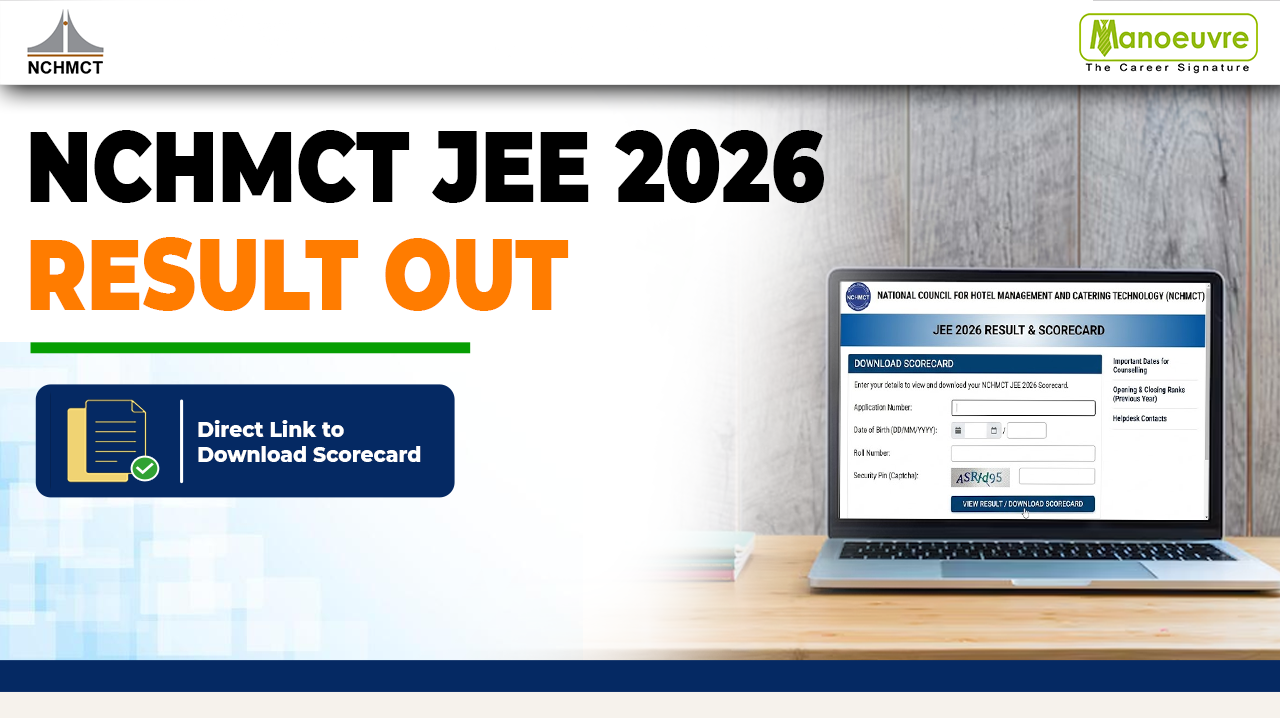
NCHMCT JEE 2026 Result Out: Direct Link to Download Scorecard The National Testing Agency (NTA) has officially announced the NCHMCT JEE 2026 result for candidates who appeared for the hotel management entrance test. Students can now access their scorecards online through the official portal using their application number and date of birth. The declaration of the result is an important step for students seeking admission to B.Sc. Hospitality and Hotel Administration programs offered by institutes affiliated with the National Council for Hotel Management and Catering Technology (NCHMCT). Post-Result Support by Manoeuvre Education Google Forms: Candidates are urged to fill out the result form link by clicking below image. The team will analyze their scores to provide college selection and shortlisting advice. Dedicated WhatsApp Groups ● Five rank-specific WhatsApp groups have been set up to share relevant cutoff PDFs and activity details join the group by clicking group name below:○ Group 1: AIR 1 to 500○ Group 2: AIR 501 to 1,500○ Group 3: AIR 1,501 to 2,500○ Group 4: AIR 2,501 to 3,500○ Group 5: AIR 3,501 and above NCHM JEE 2026 Result Released Candidates who appeared for the entrance examination can now check their scores and All India Rank (AIR) through the official NTA website. The scorecard contains important details such as candidate information, marks obtained, rank, qualifying status, and category details.According to official updates, the result has been released after the publication of the final answer key and evaluation process conducted by NTA. Direct Link to Download NCHMCT JEE 2026 Scorecard Candidates can visit the official website to access their results:NCHM JEE Official WebsiteAfter visiting the portal, students need to log in using their credentials to download the scorecard PDF. Steps to Check NCHM JEE Result 2026 Use the following steps to download your scorecard: 1. Visit the official NTA NCHM portal2. Click on the “NCHM JEE 2026 Scorecard” link3. Enter your application number along with your date of birth 4. Fill in the security code displayed on the screen 5. Click on the submit button6. Your scorecard will appear on the screen7. Download and save the result for future admission processesThese steps have been mentioned in the official result notification and scorecard instructions released online. Details Mentioned on the Scorecard The downloaded scorecard includes the following information:● Candidate’s Name● Roll Number● Application Number● Category● Gender● Date of Birth● NTA Score● All India Rank (AIR)● Qualifying StatusStudents are advised to verify all details carefully after downloading the result. What After the Result? After the result declaration, qualified candidates will be eligible to participate in the counselling process conducted for admission into participating hotel management institutes. The counselling registration is expected to begin soon on the official counselling portal.During counselling, candidates will be required to:● Register online● Fill preferred college choices● Upload required documents● Pay counselling fees● Participate in seat allotment roundsAdmission will be granted based on rank, category, seat availability, and counselling preferences. Documents Required for Counselling Candidates should keep the following documents ready:● NCHM JEE 2026 Scorecard● Admit Card● Class 10 Marksheet● Class 12 Marksheet● Identity Proof● Passport Size Photographs● Category Certificate (if applicable)Having these documents prepared in advance can help avoid last-minute issues during admission. Importance of NCHMCT JEE The entrance examination is held for admission to hotel management programs offered by reputed institutes across India. Students interested in hospitality, hotel operations, tourism, food production, and event management appear for this examination every year. The hospitality sector continues to offer strong career opportunities in hotels, airlines, cruise lines, tourism companies, and international hospitality brands. Final Words The release of the NCHMCT JEE 2026 result marks the beginning of the admission process for hotel management aspirants. Candidates should download their scorecards immediately and stay updated regarding counselling schedules and seat allotment notifications.Students are advised to keep multiple copies of the scorecard and regularly check the official website for further updates related to counselling and admissions. FAQs – NCHMCT JEE 2026 Result 1. When was the NCHMCT JEE 2026 result declared?The National Testing Agency (NTA) has officially released the result on 22nd May 2026 for the NCHMCT JEE 2026 examination on its official website.2. Where can I check my NCHM JEE 2026 scorecard?Candidates can download their scorecard from the official NTA NCHM portal by logging in with their application number and date of birth.3. What details are required to download the result?Students need their application number, date of birth, and security pin to access the scorecard online.4. What details are mentioned on the NCHMCT JEE scorecard?The scorecard includes the candidate’s name, roll number, rank, category, NTA score, and qualifying status.5. What is the next step after the NCHMCT JEE 2026 result declaration?Qualified candidates will have to participate in the counselling and seat allotment process for admission to hotel management institutes.6. Is the NCHM JEE 2026 scorecard mandatory for counselling?Yes, candidates must carry the downloaded scorecard during counselling and admission verification.7. Can I get admission without appearing for counselling?No, taking part in the counselling process is mandatory for seat allocation in participating institutes. 8. What courses are offered through NCHMCT JEE?The examination is conducted for admission to B.Sc. Hospitality and Hotel Administration programs offered by affiliated institutes.9. What should I do if there is an error in my nchmct jee scorecard?Candidates should promptly contact the official NTA helpdesk for any scorecard correction or discrepancy-related issues. 10. Which documents are required during nchmct jee counselling?Important documents include the scorecard, admit card, Class 10 and 12 marksheets, ID proof, photographs, and category certificate if applicable.

20 May 2026
0 comments
MAH MCA CET Cut Off 2026 & Top MCA Colleges – Complete Guide The MAH MCA CET is one of the most important entrance exams for students seeking admission into top MCA colleges across Maharashtra. Every year, thousands of aspirants compete for limited seats in reputed institutes like VJTI, SPIT, PCCOE, VESIT, SIES, and many more.Scoring a good percentile is important, but securing admission also depends on multiple factors such as:● Percentile obtained● CAP Round strategy● Reservation category● Option form filling● Previous year cut off trendsThis complete guide will help you understand:● MAH MCA CET 2026 expected cut offs● Top MCA colleges in Maharashtra● Percentile-wise college insights● Free PDF Download for MCA CET Colleges Download MAH MCA CET 2026 Expected Cut Off List Get the detailed category-wise expected cut offs for top MCA colleges across Maharashtra.The PDF includes:● Government MCA Colleges● Private MCA Colleges● University Departments● Autonomous Institutes● Category-wise Expected Cut Offs● OMS & Maharashtra Candidature TrendsDownload MAH MCA CET 2026 Expected Cut Off List (140+ MCA Colleges) | Score Vs Percentile What is MAH MCA CET Cut Off? The MAH MCA CET cut off refers to the minimum percentile required for admission into a particular MCA college through the CAP (Centralized Admission Process).Cut offs vary every year depending on:● College demand● Seat intake● Reservation category● CAP round● OMS vs Maharashtra candidature● Difficulty level of exam● Number of applicantsTop institutes generally witness very high cut offs because of strong placements, ROI, and limited seats. Top MCA Colleges Through MAH MCA CET 2026 1. Veermata Jijabai Technological InstituteWhy Students Prefer VJTI● One of Maharashtra’s most reputed government institutes● Strong placement opportunities● Excellent coding culture● High ROI2. Sardar Patel Institute of TechnologyHighlights● Excellent academic environment● Strong technical exposure● Industry-focused curriculum● Preferred by top MCA aspirants3. Savitribai Phule Pune University Department of Computer ScienceHighlights● University-backed reputation● Excellent faculty support● Strong academic ecosystem● Affordable fees with good ROI4. Pimpri Chinchwad College of EngineeringHighlights● Consistent placement record● Good infrastructure● Strong technical exposure● Popular among MCA aspirants5. Vivekanand Education Society Institute of TechnologyHighlights● Strong placement opportunities● Excellent campus environment● Industry-oriented learning● Growing reputation in MCA admissions6. SIES College of Management StudiesHighlights● Good placement support● Corporate exposure● Preferred Mumbai-region MCA college● Excellent student ecosystem7. MET Institute of ManagementHighlights● Mumbai location advantage● Good industry interaction● Consistent academic performance● Decent placement opportunities8. Dr. D. Y. Patil Institute of Master of Computer Applications and ManagementHighlights● Strong academic infrastructure● Popular Pune MCA institute● Good placement support● Strong CET preference college9. Thakur College of Engineering and TechnologyHighlights● Excellent Mumbai location● Strong student network● Good technical exposure● Preferred among Mumbai students10. Indira College of Engineering and ManagementHighlights● Strong placement assistance● Good academic ecosystem● Industry-oriented approach● Well-known Pune institute MAH MCA CET 2026 Expected Cut Off (General Category) CollegeExpected PercentileVJTI Mumbai99.75+SPIT Mumbai99.68+SPPU Pune99.11+PCCOE Pune99.28+VESIT Mumbai98.76+SIES Navi Mumbai97.80+MET Mumbai98.38+DY Patil Akurdi Pune96.11+Thakur College Mumbai96.11+Indira College Pune97.80+Expected cut offs are based on previous admission trends and may vary depending on CAP rounds, category, and seat matrix. Factors Affecting MAH MCA CET Cut Offs 1. Difficulty Level of Exam● Easier exam generally leads to higher cut offs● Tougher paper may reduce closing percentiles2. Number of ApplicantsHigher competition directly increases cut offs.3. Seat AvailabilityLimited seats in top institutes raise competition significantly.4. Reservation CategoriesCut offs vary for:● Open● OBC● SC● ST● EWS● TFWS● OMS5. CAP Round TrendsClosing percentiles fluctuate between CAP rounds depending on seat vacancies. How to Choose the Right MCA College? Do not select a college only based on brand value.Consider factors like:● ROI● Placements● Coding culture● Faculty quality● Infrastructure● Internship opportunities● Industry exposure● Alumni network● Location advantageA smart MCA decision can strongly influence your long-term career growth. MAH MCA CET 2026 Counselling Tips ● Analyze previous CAP cut off trends● Prepare a smart option form strategy● Keep documents ready before counselling starts● Use all CAP rounds strategically● Stay updated with official CET Cell notifications Conclusion The MAH MCA CET 2026 admission process is highly competitive, especially for top MCA colleges in Maharashtra. Understanding expected cut offs, CAP trends, and counselling strategy can significantly improve your chances of securing admission into your preferred college.A high percentile increases opportunities.A smart CAP strategy secures the right college. FAQs – MAH MCA CET 2026 Cut Off & Colleges 1. Which is the best MCA college through MAH MCA CET?Veermata Jijabai Technological Institute is considered one of the top MCA colleges through MAH MCA CET.2. What percentile is required for VJTI MCA admission?Generally, 99.7+ percentile is considered competitive for General category students.3. Is 95 percentile good in MAH MCA CET?Yes, 95 percentile can help secure admission in several reputed MCA colleges across Maharashtra.4. Can I get MCA admission with a low percentile?Yes, through strategic CAP option filling, institute-level rounds, and emerging colleges.5. Does category affect MCA CET cut offs?Yes, reservation categories significantly impact closing cut offs during admissions.
19 May 2026
0 comments
Top BBA Colleges Accepting CUET UG Score The demand for BBA courses in India is growing rapidly as students are becoming more career-focused right after Class 12. With the introduction of the Common University Entrance Test (CUET UG), admission to many reputed universities has become more transparent and centralized. Today, several prestigious universities and institutes offer BBA admission through CUET UG scores, making it easier for students to secure seats in top management colleges across India.If you are planning to pursue management studies after 12th, knowing the best BBA colleges accepting CUET UG score can help you make the right decision. In this guide, we will explore leading colleges, eligibility criteria, admission process, fees, placements, and career opportunities after BBA. Why Choose BBA Through CUET UG? CUET UG has simplified the admission process for undergraduate courses across central, state, deemed, and private universities. Instead of appearing for multiple entrance exams, students can now apply to several universities using a single CUET score.Here are some major benefits:● One entrance exam for multiple universities● Fair and standardized admission process● Access to reputed government and private institutions● Better opportunities for scholarships and placements● Reduced stress of multiple applications and examsFor management aspirants, CUET UG has become one of the most important pathways to enter top BBA colleges in India. Top BBA Colleges Accepting CUET UG Score Here are some of the best universities and colleges where students can get admission into BBA programs through CUET UG.College/UniversityLocationApprox FeesHighlightsShaheed Sukhdev College of Business Studies (SSCBS)Delhi₹80,000 – ₹1 LakhsTop DU college for managementDeen Dayal Upadhyaya CollegeDelhi₹60,000 - ₹80,000 LakhGood academics and placementsGuru Gobind Singh Indraprastha University (Selected Colleges)Delhi₹4 – ₹7 LakhsIndustry-oriented curriculumCentral University of KarnatakaKarnataka₹30,000 – ₹50,000 Affordable educationCentral University of HaryanaHaryana₹70,000 – ₹1.5 LakhsGrowing placement opportunitiesDr. B.R. Ambedkar University DelhiDelhi₹3 – ₹3.5 LakhsModern business educationBennett UniversityGreater Noida₹9 – ₹11 LakhsStrong corporate exposureGalgotias UniversityGreater Noida₹3 – ₹5 LakhsGood infrastructureChandigarh UniversityPunjab₹5 – ₹7 LakhsExcellent industry collaborationsLovely Professional University (LPU)Punjab₹6 – ₹8 LakhsStrong placement support Best Government BBA Colleges Through CUET UG Students aiming for affordable education with quality academics often prefer government institutions. Some top government BBA colleges include:Shaheed Sukhdev College of Business Studies (SSCBS)SSCBS, affiliated with the University of Delhi, is considered one of the best colleges for management studies in India. It offers excellent faculty, internship opportunities, and placements.Popular Courses:● BMS● BBA FIA● Business AnalyticsDeen Dayal Upadhyaya CollegeRecognized for its strong academic atmosphere and well-developed campus infrastructure, this DU college is highly preferred among CUET aspirants. Central UniversitiesMany central universities now offer BBA programs through CUET UG. These institutions are affordable and recognized nationwide. Top Private BBA Colleges Accepting CUET UG Score Private universities also accept CUET scores for admission into management programs. These colleges focus heavily on industry exposure, internships, and skill development.Bennett UniversityBacked by the Times Group, Bennett University provides modern management education with practical learning opportunities.Chandigarh UniversityThis university has gained popularity because of strong placement support, international collaborations, and industry-oriented curriculum.Lovely Professional University (LPU)LPU offers specialized BBA programs in areas like Finance, Marketing, HR, and International Business. Eligibility Criteria for BBA Admission Through CUET UG Before applying, students must ensure they meet the eligibility requirements.Basic Eligibility● Candidates must have completed Class 12 from a recognized board ● The minimum aggregate marks requirement generally ranges between 50% and 60% ● Students from any stream can applyCUET UG RequirementCandidates must appear for CUET UG and choose subjects according to university requirements.Some universities may also consider:● English language score● General Test score● Domain-specific subjects CUET UG Admission Process for BBA Colleges The admission process is generally simple and follows these steps:Step 1: Register for CUET UGVisit the official CUET portal and complete the registration process.Step 2: Select Relevant SubjectsChoose subjects required by your preferred universities.Step 3: Appear for the ExamPrepare thoroughly for:● English Language● Quantitative Aptitude● Logical Reasoning● General AwarenessStep 4: Apply to UniversitiesAfter results are announced, apply to participating universities through their counseling portals.Step 5: Merit List and Seat AllotmentUniversities release cutoffs and merit lists based on CUET scores. Expected CUET UG Cutoff for Top BBA Colleges Cutoffs vary every year depending on:● Number of applicants● Difficulty level of exam● Seat availability● Reservation categoryHere is an estimated cutoff range: College/UniversityExpected CUET UG PercentileShaheed Sukhdev College of Business Studies (SSCBS), Delhi98 – 99+Deen Dayal Upadhyaya College, Delhi92 – 97Central Universities75 – 90Private Universities60 – 85 Students aiming for top government colleges should target a very high percentile. BBA Specializations Available Through CUET UG Colleges Many universities now offer specialized BBA programs. Popular options include:● BBA in Finance● BBA in Marketing● BBA in Human Resource Management● BBA in Business Analytics● BBA in International Business● BBA in Digital Marketing● BBA in EntrepreneurshipSelecting the right specialization can enhance your career growth and earning potential. Placement Opportunities After BBA Top BBA colleges accepting CUET UG score offer strong placement support and internship opportunities.Popular Recruiters● Deloitte● EY● KPMG● Accenture● TCS● Wipro● HDFC Bank● ICICI BankAverage SalaryFresh graduates can expect an average package between:● ₹3 LPA to ₹8 LPATop colleges may offer even higher packages depending on skills and internships. Career Options After BBA A BBA degree opens multiple career paths for students.Job Roles● Business Analyst● Marketing Executive● HR Executive● Financial Analyst● Operations Manager● Sales Manager● Digital Marketing SpecialistHigher Education OptionsMany students also pursue:● MBA● PGDM● MIM● Professional certificationsA strong BBA foundation helps students build managerial and leadership skills early in their careers. Tips to Score Well in CUET UG for BBA Admission Here are some preparation tips to improve your chances of getting into top colleges:Focus on English and AptitudeMost universities give significant importance to language and reasoning sections.Practice Mock TestsRegular mock tests improve speed and accuracy.Stay Updated with Current AffairsGeneral awareness plays an important role in scoring high.Analyze Previous Year PapersUnderstanding the exam pattern can help you prepare strategically. How to Choose the Right BBA College? While selecting a college, consider the following factors:● Accreditation and ranking● Placement records● Faculty quality● Infrastructure● Industry exposure● Internship opportunities● Fee structure● Alumni networkDo not choose a college based only on brand name. Always compare placements, ROI, and learning opportunities. Final ThoughtsThe number of top BBA colleges accepting CUET UG score is increasing every year, giving students better opportunities to pursue management education from reputed institutions. Whether you aim for prestigious government colleges like SSCBS or modern private universities with global exposure, CUET UG can help you achieve your goal through a single entrance exam.Start your preparation early, understand the admission process carefully, and target colleges that align with your career aspirations. A well-chosen BBA program can become the first step toward a successful management career. FAQs1. Which are the top BBA colleges accepting CUET UG score?Some top colleges include SSCBS Delhi, Deen Dayal Upadhyaya College, Bennett University, Chandigarh University, and LPU.2. Is CUET mandatory for BBA admission?Many universities now require CUET UG scores for BBA admissions, especially central universities and Delhi University colleges.3. What is a good CUET score for BBA admission?A percentile above 90 is considered good for reputed colleges, while top colleges may require 98+ percentile.4. Can commerce students apply for BBA through CUET?Yes, commerce students commonly apply, but students from all streams are eligible.5. Which private universities accept CUET UG for BBA?Bennett University, LPU, Chandigarh University, and Galgotias University accept CUET scores.6. What career opportunities are available after BBA? Students can work in marketing, finance, HR, business analytics, sales, and operations.7. What is the average salary after BBA?Fresh graduates generally earn between ₹3 LPA and ₹8 LPA depending on college and skills.8. Does Delhi University offer BBA through CUET?Yes, DU colleges like SSCBS and Deen Dayal Upadhyaya College offer management courses through CUET UG.9. Is mathematics compulsory for BBA through CUET?It depends on the university. Some colleges require mathematics, while others do not.10. Can I pursue MBA after completing BBA?Yes, BBA is considered one of the strongest undergraduate options for students who plan to pursue an MBA in the future.
Featured Blogs