MBA Entrance
 LAW 5years Entrance
 LAW 3years Entrance
 MCA Entrance
 CUET PG Entrance
 BBA Entrance
 BCA Entrance
 Hotel-Management
 B.ED Entrance
- August 05, 2026
- |
-
0 comments
A 3-year LLB programme is a
popular choice among graduates who wish to enter the legal profession and build
a career in law. Unlike the 5-year integrated law course that students can
pursue after completing Class 12, the 3-year LLB course is specially
designed for candidates who have already completed their graduation in any
stream.
To secure admission into reputed law
colleges, students need to appear for different entrance examinations conducted
at the national, state, or university level. These exams evaluate important
skills required for legal education, including legal aptitude, logical
reasoning, general knowledge, English language ability, and awareness of
current affairs.
With multiple options available across
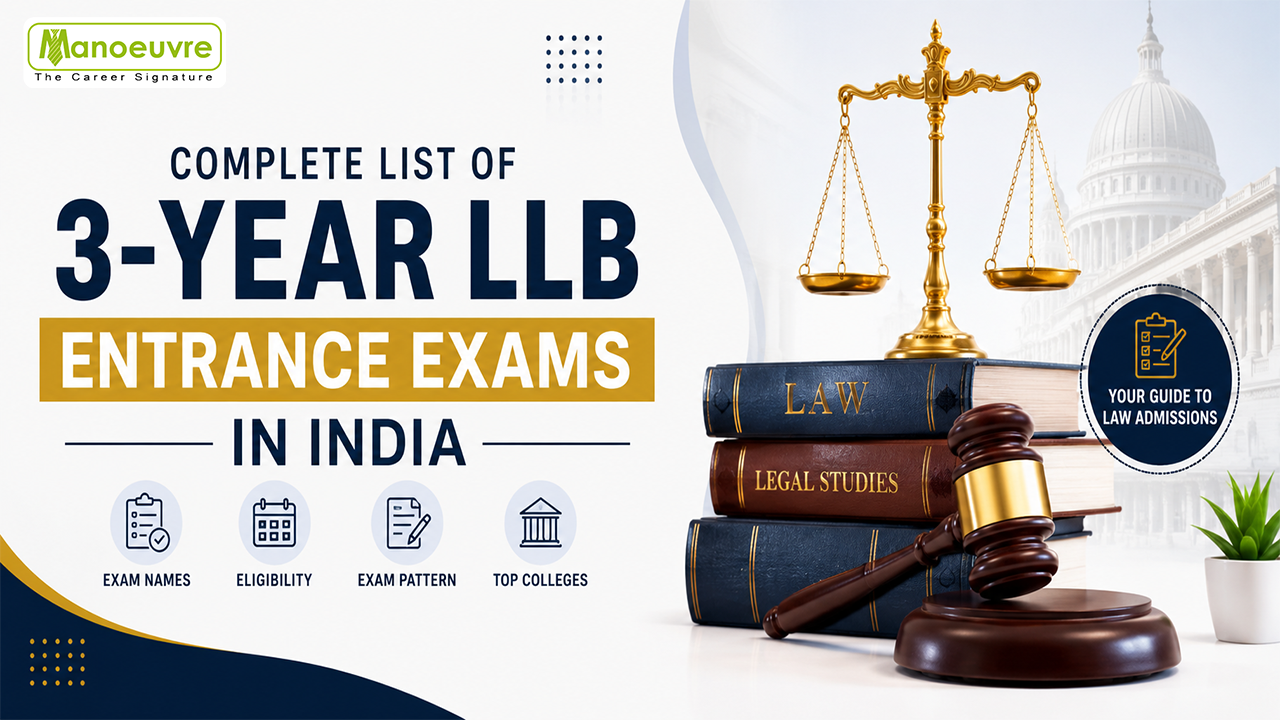
India, understanding the 3-year LLB entrance exams in India helps
students select the right examination and prepare with a clear strategy.

3-year LLB entrance exams are competitive examinations conducted for admission to LLB programmes
after graduation. These exams help colleges assess a candidate’s reasoning
ability, analytical skills, language understanding, and basic knowledge of
legal concepts.
Several government and private law
colleges consider scores from these entrance tests for admission. While some
universities conduct their own entrance examinations, others provide admission
through state-level law entrance tests.
Students who have completed graduation
courses such as BA, BCom, BSc, BBA, or any other recognised degree programme
can apply for these exams, provided they meet the required eligibility
criteria.
The eligibility requirements for 3-year
LLB entrance exams may differ depending on the university or examination
authority. However, most institutions generally follow similar criteria:
● Candidates should hold an undergraduate degree from a recognised university or institution.
●
Students from any academic stream
can apply for the programme.
●
Minimum graduation percentage
requirements may vary according to the college and candidate category.
●
There is generally no upper age
limit for pursuing a 3-year LLB course.
●
Final-year graduation students may
also be eligible for certain entrance examinations.
Before filling out the application form,
students should carefully check the official notification of the respective
exam to understand the exact eligibility conditions.
India offers several entrance
examinations for students who want to pursue a 3-year LLB programme.
Some of the major exams are discussed below:
The MH CET Law 3-Year LLB is one
of the most popular state-level law entrance examinations in India. It is
conducted by the State Common Entrance Test Cell, Maharashtra, for admission to
various law colleges across Maharashtra.
The exam is mainly designed for graduates
who want to pursue a 3-year LLB course. Many government, private, and
aided law colleges participate in the admission process through this
examination.
● Conducting Authority: State CET Cell, Maharashtra
●
Course: 3-Year LLB
●
Mode:
Online Computer-Based Test
●
Duration: 2 Hours
●
Question Type: Multiple Choice Questions
● Legal Aptitude and Legal Reasoning
●
Logical Reasoning
●
General Knowledge and Current
Affairs
●
English Language
●
Basic Mathematics
For students planning to study law in Maharashtra, the MH CET Law 3-Year LLB exam is an important pathway to secure admission in reputed law colleges.
The CUET PG LLB Entrance Exam is
conducted by the National Testing Agency (NTA) for admission to postgraduate
courses offered by participating universities. Some universities accept CUET PG
scores for admission to their law programmes.
Students interested in applying to these
universities can appear for this examination and compete for available seats
based on their performance.
The exam generally tests areas such as:
● Legal concepts
●
General awareness
●
Reasoning ability
●
Language comprehension
●
Subject-related knowledge
One of the major advantages of this exam is that students can apply to multiple participating universities through a single entrance test.
The University of Delhi offers admission
to its 3-year LLB programme through the CUET PG examination.
The Faculty of Law at Delhi University is
considered one of the well-known law institutions in India. Students who wish
to secure admission must fulfil the eligibility requirements and perform well
in the entrance examination.
Due to the reputation of the university and limited seats, the competition level for admission is generally high.
ILS Law College is among the reputed law
colleges in Maharashtra offering legal education. Admission to its 3-year
LLB programme is conducted according to the guidelines issued by the
concerned admission authority.
Students who are interested in joining this institution should regularly check official updates regarding admission dates, eligibility requirements, and the selection process.
Apart from national and state-level
examinations, several universities conduct their own admission processes for 3-year
LLB courses.
These university-level entrance exams may
evaluate candidates on different areas, including:
● Legal reasoning
●
General knowledge
●
English proficiency
●
Analytical ability
●
Current affairs
Students should check the individual
requirements of each university before applying to understand the admission
process.
Apart from national-level and
university-level examinations, several states conduct their own admission
processes for students who want to pursue a 3-year LLB course. These
exams provide opportunities to secure admission in law colleges within the
respective states.
Some important examples include:
Maharashtra conducts MH CET Law 3-Year
LLB for admission to various government, private, and aided law colleges
across the state. It is one of the most preferred options for graduates who
want to pursue law in Maharashtra.
Several universities and law colleges in
Karnataka follow their own admission procedures for 3-year LLB programmes.
Candidates should check the specific requirements of the institution they wish
to apply to.
Law admissions in Andhra Pradesh and
Telangana may be conducted through state-level entrance examinations and
individual university admission processes. Students should regularly check
official notifications for updated details.
Different states follow different
admission methods for 3-year LLB entrance exams in India. Some may
conduct entrance tests, while others may offer admission based on merit or
university-level examinations.
Since admission rules and exam patterns
may change from time to time, candidates should always verify the latest
information before applying.
Although every entrance examination has
its own structure, most 3-year LLB entrance exams assess similar skills
that are important for legal studies.
A general exam pattern includes the following
sections:
This section evaluates a candidate’s
vocabulary, grammar, reading comprehension, and overall language skills.
Regular reading practice can help students improve their performance in this
section.
This section tests the candidate’s
understanding of basic legal principles and their ability to apply legal
concepts to different situations. Developing conceptual clarity is important
for solving these questions accurately.
Logical reasoning questions assess
analytical thinking, problem-solving ability, and decision-making skills.
Regular practice can help improve speed and accuracy.
Candidates are expected to stay updated
with important national and international events. Reading newspapers, following
reliable news sources, and revising current affairs regularly can be helpful.
Some entrance exams include basic
mathematics questions to test numerical ability. Practising fundamental
concepts can help candidates handle this section confidently.
Understanding the exam pattern before
starting preparation allows students to create a better study plan and focus on
areas that need more attention..
Preparing for 3-year LLB entrance
exams in India requires consistent effort, regular practice, and proper
time management. Students can follow these strategies to improve their
preparation:
Before beginning preparation, students
should understand the complete syllabus and exam pattern. Knowing the
importance of each section helps candidates divide their preparation time
effectively.
Current affairs play an important role in
many law entrance exams. Reading newspapers, legal updates, and reliable online
sources regularly can help students improve their general awareness.
Practising previous year papers helps
candidates understand the exam difficulty level, frequently asked topics, and
the type of questions asked in the examination.
Logical reasoning requires regular
practice. Solving different types of reasoning questions can improve speed,
accuracy, and confidence during the exam.
Mock tests provide a real exam-like
experience and help students analyse their preparation level. They also help
identify weak areas and improve time management skills.
Many students prepare for law entrance
exams without following a proper strategy. Some common mistakes that candidates
should avoid include:
● Ignoring current affairs preparation
●
Giving more importance to only one
subject
●
Not practising enough mock tests
●
Delaying revision until the last
stage
●
Not analysing mistakes after
attempting practice tests
A balanced preparation approach covering
all sections is important to achieve a good score in 3-year LLB entrance
exams.
Preparing for law entrance exams along
with graduation studies can sometimes become challenging for students. Managing
multiple subjects, understanding concepts, and maintaining regular practice
requires proper planning.
Professional coaching can help students
follow a structured preparation approach with expert guidance, study materials,
regular assessments, and doubt-solving support.
Institutes like Manoeuvre Education
provide preparation support for various law entrance examinations through
experienced mentors, mock tests, and organised learning programmes. This
guidance helps students improve their concepts, build confidence, and stay
consistent throughout their preparation journey.
After completing a 3-year LLB degree,
graduates can explore several career options in the legal field. Some popular
career opportunities include:
● Advocate in courts
●
Legal advisor
●
Corporate lawyer
●
Government legal services
●
Legal consultant
●
Judiciary preparation
●
Compliance roles
The legal profession offers opportunities
across various sectors, including corporate organisations, government
departments, law firms, and independent legal practice.
The 3-year LLB entrance exams in India
provide graduates with an opportunity to enter the legal field and build a
successful career. With different state-level, university-level, and
national-level admission options available, students can choose the examination
that best matches their career goals.
Understanding the exam pattern, preparing
consistently, practising regularly, and staying updated with legal and current
affairs topics can significantly improve a candidate’s performance. With the
right preparation strategy and guidance, aspirants can increase their chances
of securing admission to their preferred law college.

Graduates from any stream who fulfil the
required eligibility criteria can apply for a 3-year LLB course.
Candidates should have an undergraduate degree from a recognised university or
institution.
MH CET Law 3-Year LLB is one of the most popular entrance exams for admission to law
colleges in Maharashtra.
No, CLAT is mainly conducted for
admission to 5-year integrated law programmes after Class 12. Most 3-year
LLB entrance exams follow separate admission processes conducted by states
or universities.
Yes, many entrance examinations allow final-year
graduation students to apply, depending on the eligibility conditions mentioned
by the respective exam authority.
The preparation time depends on a
student’s existing knowledge, study routine, and understanding of the subjects.
With consistent practice and proper planning, many students can prepare
effectively within a few months.
Latest Blog