MBA Entrance
 LAW 5years Entrance
 LAW 3years Entrance
 MCA Entrance
 CUET PG Entrance
 BBA Entrance
 BCA Entrance
 Hotel-Management
 B.ED Entrance
- September 19, 2026
- |
-
0 comments
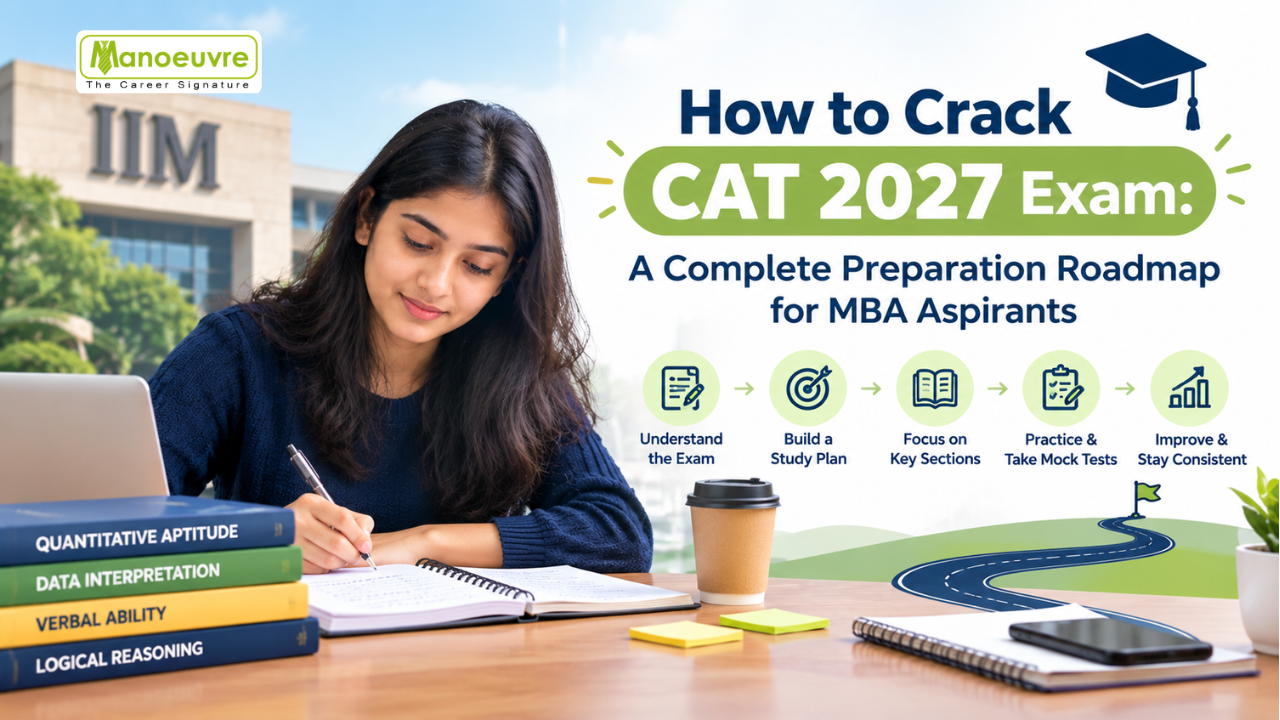
Preparing for CAT 2027 can appear overwhelming given the level of competition, the breadth of the syllabus, and the speed required to solve questions within the given time. However, effective preparation does not require studying every topic at once. It requires a clear understanding of the exam pattern, a solid foundation in basics, regular and structured practice, and consistent learning from mistakes.
For those researching how to crack the CAT exam for MBA admissions, the first requirement is a preparation plan that can be followed consistently. A steady routine maintained over several months tends to produce better results than short bursts of intensive study followed by long gaps.
This guide outlines a practical approach to preparing for CAT 2027.

Before diving into prep, take time to understand how the exam is organized and what each section entails. CAT evaluates candidates across three sections:
● VARC - Verbal Ability and Reading Comprehension
● DILR - Data Interpretation and Logical Reasoning
● QA - Quantitative Aptitude
Equal proficiency in all three sections is not required at the outset. The first step is to assess your current level of preparedness.
Attempt a few questions from each section, or take a diagnostic mock test. The score at this stage is not important. The objective is to identify your strengths, weaknesses, and the question types that require more time to solve.
For candidates starting preparation from the beginning, it is advisable not to attempt difficult questions immediately.
● Quant - Revise basic concepts and formulas before progressing to more challenging problems.
● VARC - Develop a consistent reading habit and focus on understanding passages rather than memorising vocabulary alone.
● DILR - Begin with manageable sets and gradually increase the level of difficulty.
A strong foundation makes subsequent practice significantly more effective.
An effective CAT 2027 study plan should be divided into distinct stages rather than attempting to cover all areas simultaneously.
This stage should focus on understanding core concepts across all three sections, recognising different question types, and solving easy to moderate questions without emphasis on speed. Accuracy and conceptual clarity should take priority at this point. This is also the stage to identify topics that require additional attention and to establish a consistent study routine.
Once the fundamentals are reasonably clear, preparation should shift towards mixed and timed practice. This includes solving varied DILR sets and reading comprehension passages, and combining Quant questions from different topics to build the ability to identify the required concept quickly.
At this stage, preparation should move from learning concepts to applying them under time constraints.
As the exam approaches, mock tests should form a central part of preparation. However, the value of a mock test lies primarily in the analysis that follows it, not in the score alone.
After each mock test, review the following:
● Which questions were answered incorrectly, and why
● Which questions consumed excessive time
● Which questions should have been skipped
● Whether errors were conceptual or due to calculation mistakes
● Which section had the greatest impact on overall performance
Maintaining a mistake log and reviewing it regularly can help identify recurring patterns.
Each section of the CAT exam requires a distinct approach. Applying the same method across VARC, DILR and Quant is unlikely to yield the best results.
|
Section |
Core
Focus Areas |
Preparation
Approach |
|
VARC |
Reading
Comprehension, Verbal Ability |
Read
regularly and practise a variety of passage types and verbal questions |
|
DILR |
Data
Interpretation, Logical Reasoning |
Practise
diverse sets and develop speed along with sound set selection |
|
Quant |
Arithmetic,
Algebra, Geometry, Number System |
Strengthen
concepts, practise mixed questions, and introduce timed practice |
Regular reading contributes significantly to VARC preparation. Editorials, essays and long-form articles across different subjects can help build familiarity with unfamiliar topics and longer passages.
While practising, attention should be given to:
● Reading comprehension
● Para-based questions
● Sentence arrangement
● Verbal reasoning
● Vocabulary in context
● Understanding the author's argument
In the initial stages, focus should be on understanding the tone, central idea and structure of a passage rather than on completing it quickly. Speed generally improves with consistent practice.
DILR requires both logical reasoning ability and the capacity to work through unfamiliar information without losing time. It is advisable to practise a range of set types rather than limiting practice to familiar formats.
Preparation should cover:
● Tables and charts
● Arrangements
● Games and tournaments
● Distribution
● Networks
● Caselets
● Logical conditions
Set selection is a critical skill in this section. During practice, candidates should note which sets can be solved efficiently and which ones require excessive time, as this understanding supports better decision-making during the actual exam.
For Quant, concepts should be strengthened before attempting difficult questions. Once a topic is well understood, question variety should be increased, followed by the gradual introduction of time limits.
Important areas include:
● Arithmetic
● Algebra
● Geometry
● Number system
● Modern mathematics
● Percentages
● Profit and loss
● Ratio and proportion
● Averages
● Time, speed and distance
● Time and work
Progress isn't about quantity. Instead, measure yourself by the quality of your responses, your error patterns, and whether you're actually learning from each question. When an error occurs, it is important to understand its cause. Addressing recurring mistakes early tends to be more beneficial than solving a larger volume of questions.
There's no universal formula saying you need to study 5 hours or 8 hours every day. Different students need different timeframes based on their starting level, learning pace, and existing knowledge. The appropriate duration depends on the time available before the exam, the candidate's current level of preparation, and other daily commitments.
For candidates starting early, even a few focused hours each day, maintained consistently, can be effective. Those with college, work or other responsibilities should create a schedule that reflects the time realistically available to them.
A routine that can be sustained over several months generally produces better outcomes than an intensive schedule that cannot be maintained.
Yes, self-study is a viable option, though it requires discipline. Candidates preparing independently should ensure they have reliable study material, a structured preparation plan, regular practice, and adequate mock tests.
Coaching can provide structure and guidance, but enrolling in a course does not replace individual effort and practice. Similarly, self-study can be effective when supported by a clear plan and consistent progress tracking.
Go with what suits your learning and schedule.
● Analyse mistakes regularly. Work on patterns of errors, not new problems.
● Practise with a timer. Add time pressure only once you understand the concept.
● Revise on a consistent basis. Concepts and formulas that are not revised are easily forgotten.
● Read daily. Regular reading builds comfort with lengthy and unfamiliar passages.
● Take mocks seriously. The purpose of a mock test extends beyond the score; it should inform your approach.
● Avoid frequent changes in strategy. Allow sufficient time to evaluate whether a preparation method is working.
|
Common
Mistake |
What
You Should Do Instead |
|
Starting
with difficult questions |
Build
fundamentals first and increase difficulty gradually |
|
Using
too many study materials |
Rely
on a few reliable resources and complete them thoroughly |
|
Ignoring
a weak section |
Identify
weak areas through practice and give them regular attention |
|
Taking
mocks without analysis |
Review
incorrect, skipped and time-consuming questions after every mock |
|
Focusing
only on attempts |
Track
accuracy along with the number of questions attempted |
|
Spending
too long on one question |
Recognise
when to move on to preserve time for other questions |
|
Leaving
revision until the end |
Revise
concepts and formulas consistently throughout preparation |
The objective is not to eliminate every mistake, but to identify them early and refine your approach as preparation progresses.
There is no single method that guarantees success in CAT. Different candidates reach their goals through different preparation routines.
Begin by assessing your current level, strengthening your fundamentals, and developing a realistic CAT 2027 preparation strategy. Gradually increase the difficulty of your practice, incorporate mock tests, and use your mistakes to refine your approach.
Candidates with more preparation time should use it to build strong fundamentals rather than rushing through the syllabus. Those with limited time should prioritise important areas, practise strategically, and dedicate more time to performance analysis.
The primary objective of CAT preparation should be steady improvement in accuracy, speed, decision-making and overall confidence. Maintaining consistency and adjusting strategy based on mock-test performance are essential to this process.

1. Can I crack CAT in three months?
Yes, preparation within three months is possible, provided the approach remains focused. Prioritize core topics, frequent practice, tests, and analysis.
2. Is the CAT exam difficult to crack?
CAT is a competitive exam, and its difficulty varies depending on a candidate's fundamentals, quality of practice, and ability to manage time effectively during the exam.
3. How should I start my CAT preparation from scratch?
Begin by understanding the three sections, assessing your current level, and building your fundamentals. Next, create a schedule with practice, revision, and tests.
4. How many hours should I study for CAT 2027?
No standard hour count fits all students. A realistic daily schedule should be created based on the time available and followed consistently.
5. Can I crack CAT 2027 without coaching?
Yes. Self-study is a viable option provided the candidate has suitable study material, a proper preparation plan, regular practice and access to good-quality mock tests.
6. How can I improve my CAT mock-test scores?
Every mock test should be analysed after completion. Conceptual mistakes, time-management issues, questions that should have been skipped, and sections requiring improved accuracy should all be identified.
7. When should I start CAT 2027 preparation?
Starting early allows more time to build fundamentals, practise different question types, revise thoroughly, and attempt an adequate number of mock tests. However, the appropriate starting point depends on the candidate's current level and available study time.
Latest Blog