
09 Oct 2026
0 comments
MAH BMS CET 2027: Exam Date, Registration, Eligibility, Syllabus & Pattern The MAH BMS CET 2027 is a state-level entrance exam for students seeking admission to Bachelor of Management Studies (BMS) courses in Maharashtra. The exam is conducted by the Maharashtra State Common Entrance Test Cell through the common MAH-BHMCT/BCA/BBA/BMS/BBM CET.The details below are based on the 2026 official CET Cell brochure and are being used as the reference for MAH BMS CET 2027. The 2027 schedule and any changes will be updated once the official details are released. MAH BMS CET 2027 Highlights The key details of MAH BMS CET 2027 are given below for a quick overview of the exam:ParticularDetailsExam NameMAH BMS CET 2027Conducting AuthorityMaharashtra State CET CellCourseBachelor of Management Studies (BMS)Academic Year2027-28Exam ModeOnline CBTMediumEnglishQuestion TypeMultiple Choice QuestionsTotal Questions100Maximum Marks100Exam Duration120 minutesNegative MarkingNoMark per Question1These details give candidates a quick idea of the MAH BMS CET 2027 exam format, duration and marking scheme. MAH BMS CET Exam Date 2027 The MAH BMS CET exam date 2027 and other important dates are yet to be announced.EventMAH BMS CET 2027 Expected DateRegistration beginsSecond week of January 2027Last date to applyThird week of February 2027Fee payment deadlineThird week of February 2027Exam dateFourth week of April 2027ResultSecond week of June 2027CAP registrationFirst week of July 2027Candidates should check the official CET Cell website for the final schedule before applying. MAH BMS CET 2027 Registration The MAH BMS CET 2027 registration will be completed online. Candidates should enter their details carefully because the information submitted during registration may be used later during the admission process.Steps to Apply1. Visit the official Maharashtra CET Cell website.2. Register using the required details.3. Fill in personal and academic information.4. Select the applicable course details.5. Upload the required photograph and other documents.6. Pay the application fee online.7. Check the form carefully.8. Complete and submit your application, then retain the confirmation information. Candidates should keep their application number and other login details safe for future use. MAH BMS CET 2027 Application Fee The fee is paid online and is non-refundable.Candidate CategoryApplication FeeOpen category, OMS and J&K Migrant candidates₹1,300Maharashtra reserved categories and applicable candidates₹1,000The lower fee applies to eligible Maharashtra candidates belonging to categories such as SC, ST, VJ/DT-NT, OBC, SBC, SEBC*, EWS and PwD, along with eligible orphan and transgender candidates. MAH BMS CET Eligibility Criteria 2027 The MAH BMS CET eligibility criteria are linked to the admission rules applicable to the course and affiliating university.Educational QualificationFor BMS:● Class 12 pass or equivalent qualification is required. ● Eligibility is subject to the admission policy of the affiliating university.● Students appearing for their Class 12 or equivalent examination can also appear for the CET.● Candidates must be Indian citizens.Is There an Age Limit?The eligibility section does not specify a separate BMS age limit. Candidates should therefore follow the eligibility conditions applicable to BMS admission for the relevant academic year.Are Specific Class 12 Subjects Required?The CET brochure does not prescribe a separate BMS subject combination. Students should check the applicable university admission requirements before applying. MAH BMS CET 2027 ReservationCandidates applying under a reserved category need to provide the required certificates during the admission process.Applicable categories include:● Scheduled Caste (SC)● Scheduled Tribe (ST)● VJ/DT-NT categories● Other Backward Classes (OBC)● SBC● SEBC● EWS● Persons with Disabilities (PwD)● Orphan candidates● Other categories covered under the applicable admission rulesReservation benefits are subject to Maharashtra government and CAP admission rules. MAH BMS CET 2027 Exam PatternThe MAH BMS CET exam pattern 2027 consists of four sections.SectionQuestionsMarksEnglish Language3030Reasoning - Verbal & Arithmetic3030General Knowledge & Awareness2020Computer Basics2020Total100100Key Points● The paper has 100 questions.● Each question carries 1 mark.● The total score is 100 marks.● The test duration is 120 minutes.● Questions are objective and have four options.● The examination is conducted online.● The test is conducted in English.● There is no negative marking. MAH BMS CET 2027 SyllabusThe MAH BMS CET syllabus 2027 covers four main areas.1. English LanguageThe English section checks a candidate's understanding of the language and ability to work with written information.Important areas can include:● Grammar● Vocabulary● Sentence-based questions● Reading comprehension● Verbal ability2. Reasoning - Verbal & ArithmeticThis section tests logical thinking and basic numerical reasoning.It includes questions based on:● Verbal reasoning● Logical thinking● Arithmetic reasoning● Problem-solving3. General Knowledge & AwarenessThis section covers general awareness and current topics. Areas mentioned in the CET syllabus include:● Indian and international affairs● Culture● Sports● Trade and commerce● Scientific inventions and discoveries● Current affairs● General awareness4. Computer BasicsThis section focuses on basic knowledge of computers and common computer-related concepts. MAH BMS CET 2027 Marking SchemeThe marking system is simple:ParticularDetailsCorrect answer+1 markIncorrect answerNo deductionUnattempted question0 marksMaximum score100 marksWith no negative marking, candidates can attempt questions without losing marks for an incorrect response. MAH BMS CET 2027 Admission ProcessGetting a CET score is only one part of the BMS admission process. Candidates also need to complete the applicable CAP process.Admission FlowCET Registration → Entrance Exam → Result → CAP Registration → Document Verification → Merit List → Option Form → Seat Allotment → College ReportingCandidates should keep their academic and category documents ready for the CAP process. MAH BMS CET 2027 Documents RequiredDuring CET RegistrationCandidates should keep the following information/documents ready:● Class 10 details● Class 12 details● Valid identity information● Recent photograph● Category details, if applicable● Aadhaar-related details● APAAR ID detailsDuring Admission/CAPDepending on the candidate's category and admission status, documents may include:● Class 10 certificate● Class 12 certificate● CET scorecard● Domicile certificate, where applicable● Caste certificate● Caste validity certificate● Non-Creamy Layer certificate, where applicable● EWS certificate, where applicable● PwD certificate, where applicable Final WordsThe MAH BMS CET 2027 exam tests Computer Basics, General Knowledge & Awareness, English, and Reasoning sections - understanding the format helps preparation. The information in this article uses the 2026 official CET Cell brochure as the reference, while the final 2027 details will depend on the official CET Cell announcement.Candidates should check the official website for the latest MAH BMS CET 2027 schedule and admission updates. Frequently Asked Questions 1. What is MAH BMS CET 2027?MAH BMS CET 2027 is an entrance examination used for admission to BMS and related undergraduate courses covered under the Maharashtra CET Cell's common CET.2. When is the MAH BMS CET exam date 2027?The MAH BMS CET exam date 2027 is yet to be announced.3. Who can apply for MAH BMS CET 2027?Candidates who have passed Class 12 or an equivalent examination and meet the applicable university admission requirements can apply. Students appearing for Class 12 can also appear for the CET.4. What is the MAH BMS CET 2027 exam pattern?100 marks through 100 questions distributed among Reasoning, English, Computer Basics, and General Knowledge & Awareness sections.5. Is there negative marking in MAH BMS CET?No. The exam pattern has no negative marking.6. What is the duration of MAH BMS CET?The test duration is 120 minutes.7. How many questions are asked in MAH BMS CET?There are 100 questions in total.8. What is the MAH BMS CET application fee?Fee structure: ₹1,300 for Open/OMS/J&K Migrants; ₹1,000 for Maharashtra reserved and other eligible categories. 9. Is MAH BMS CET conducted online?Yes, it's a Computer Based Test (CBT) examination. 10. What happens after MAH BMS CET?After the entrance exam and result, eligible candidates need to follow the applicable CAP admission process, including registration, document verification, merit list, option filling and seat allotment.
09 Oct 2026
0 comments
MAH BCA CET 2027 Eligibility Criteria: Qualification & Requirements Students planning to pursue a Bachelor of Computer Applications (BCA) in Maharashtra should check the eligibility requirements before applying for the MAH BCA CET. The entrance examination is conducted for admission to BCA and certain other undergraduate professional programmes in the state.The MAH BCA CET 2027 eligibility criteria will be confirmed through the official 2027 examination notification and the applicable CAP Information Brochure. Until those details are released, the eligibility provisions available for the 2026 examination can be used as a reference.Candidates should particularly check their Class 12 qualification, appearing status and the admission requirements prescribed by the concerned university before proceeding with admission. MAH BCA CET 2027 Eligibility Criteria Based on the currently available eligibility framework, candidates applying for BCA through MAH BCA CET should meet the following conditions:Eligibility FactorRequirementNationalityCandidate should be an Indian citizenEducational qualificationClass 12/HSC or an equivalent examinationClass 12 appearing candidatesCan appear for the entrance examinationAdmission requirementMust satisfy the applicable university and CAP eligibility conditionsCGPA/GradesConversion should follow the procedure prescribed by the concerned boardPercentage calculationPercentage is considered up to two decimal placesThe final BCA CET 2027 eligibility criteria should be checked against the official 2027 notification once released. MAH BCA CET 2027 Educational Qualification Candidates seeking admission to BCA need to have completed their 10+2/HSC or an equivalent level of education.However, passing Class 12 alone should not be treated as the only admission requirement. The applicable Admission Policy of the Affiliating University also needs to be considered. The requirements may be linked to the rules applicable during the CAP admission process.Students who have completed their qualifying examination should keep their academic documents ready before participating in the admission process.Candidates from an equivalent qualification route should also verify whether their qualification is accepted under the applicable admission rules. Can Class 12 Students Appearing in 2027 Apply for MAH BCA CET? Yes. Students who are still appearing for their Class 12 or equivalent examination can appear for the MAH BCA CET, subject to the applicable rules.This provision is particularly useful for students completing their 12th standard in the same academic year as the entrance examination.However, there is an important distinction between appearing for the CET and being eligible for final admission. Students must eventually fulfil the required academic conditions prescribed for admission through the applicable CAP and university rules.Therefore, Class 12 appearing candidates should not consider participation in the entrance test as automatic confirmation of admission eligibility. Is There a Minimum Percentage Required for MAH BCA CET 2027? The basic CET eligibility provisions do not establish a single universal percentage requirement for every BCA candidate. Instead, the eligibility framework refers candidates to the admission requirements applicable under the Affiliating University.This means students should avoid relying on an unofficial fixed percentage when determining their eligibility.The applicable CAP Information Brochure and university admission policy should be checked for the conditions that apply to BCA admission in the relevant admission year.Once the official MAH BCA CET 2027 eligibility criteria are published, candidates should verify whether any specific marks requirement has been prescribed or modified. MAH BCA CET 2027 Age Limit The basic eligibility information currently available for MAH BCA CET does not specify a separate age limit as part of the core CET eligibility conditions for BCA.However, candidates should check the official MAH BCA CET 2027 information brochure and the applicable admission guidelines for any change or additional condition related to age.It is better to rely on the rules released for the relevant admission year rather than assuming that an age condition from another examination or course also applies to BCA. How Is Percentage Calculated for MAH BCA CET Eligibility?Students should understand how their qualifying examination marks are considered for eligibility.The relevant percentage is based on the subjects and marks used by the candidate's education board when determining the overall result or class. Therefore, candidates should use the calculation method followed by their respective board.For students whose boards provide grades or CGPA instead of conventional marks, the conversion should be carried out according to the official method provided or certified by the concerned board.After conversion, the percentage is considered up to two decimal places.Candidates should retain the relevant board documentation, particularly when their marksheet does not directly mention an equivalent percentage. MAH BCA CET Eligibility for CGPA and Grade StudentsStudents who receive their Class 12 result in the form of CGPA or grades are not required to assume a percentage on their own.The conversion should follow the method specified by the board from which the candidate completed the qualifying examination.For example, a student should not simply multiply a CGPA by a self-selected conversion factor unless that method is officially applicable to their board.Using the correct conversion procedure is important because the converted percentage may be required during the admission or document-verification process. MAH BCA CET 2027 Eligibility for AdmissionOne of the most important points for BCA aspirants is the difference between entrance-test eligibility and admission eligibility.A candidate may be permitted to appear for the MAH BCA CET while still needing to satisfy additional conditions before securing admission to a BCA programme.The admission process may involve:MAH BCA CET → CAP registration → Document verification → University/college eligibility → Seat allotment → AdmissionTherefore, students should check both the CET requirements and the admission conditions applicable to their chosen BCA programme.The rules followed by the concerned affiliating university and the applicable CAP Information Brochure should be treated as the reference for final admission eligibility. Documents Related to BCA CET EligibilityCandidates should keep their academic records available for the admission process. Based on the specific requirements, these might encompass:● Class 10 marksheet or certificate● Class 12/HSC marksheet or certificate● Equivalent examination certificate, where applicable● Board-issued CGPA or grade conversion document, if required● Documents needed for CAP and admission verificationThe exact document list for MAH BCA CET 2027 should be checked once the official admission guidelines are released. MAH BCA CET 2027 Eligibility: Quick ChecklistBefore applying, BCA aspirants can use this checklist:● Check whether you are an Indian citizen.● Confirm that you have passed or are appearing for Class 12/HSC or an equivalent examination.● Check the BCA admission requirements of the applicable affiliating university.● If you receive grades or CGPA, follow your board's official conversion method.● Keep your academic documents ready for verification.● Check the latest CET notification and CAP Information Brochure before admission. Final WordsUnderstanding the MAH BCA CET 2027 eligibility criteria is an important first step for students planning to pursue BCA through the Maharashtra admission process. Candidates should check their 10+2 qualification, appearing status and the admission conditions applicable to the concerned university.Since the 2027 examination rules have not yet been finalised in the information currently available, students should verify the official MAH BCA CET 2027 notification and CAP Information Brochure when released. Any changes introduced for the 2027 admission cycle should take precedence over the reference criteria discussed above. FAQs on MAH BCA CET 2027 Eligibility Criteria 1. Who is eligible for MAH BCA CET 2027?Candidates who are Indian citizens and have passed or are appearing for 10+2/HSC or an equivalent examination can appear, subject to the applicable eligibility and admission conditions.2. Can Class 12 appearing students apply for MAH BCA CET 2027?Yes. Students appearing for their Class 12 or equivalent examination can appear for the CET. They must subsequently meet the applicable requirements for BCA admission.3. What is the minimum percentage required for MAH BCA CET 2027?The CET eligibility information does not establish one universal minimum percentage for BCA. Candidates should check the admission requirements prescribed by the relevant affiliating university and the applicable CAP rules.4. Is there an age limit for MAH BCA CET 2027?The currently available basic eligibility criteria do not specify a separate age limit for BCA. Candidates should verify the official 2027 notification for the final rules.5. Can CGPA students apply for MAH BCA CET 2027?Yes. Students whose board awards CGPA or grades can apply, with percentage conversion carried out according to the procedure prescribed by their board.6. Is CET eligibility the same as BCA admission eligibility?Not necessarily. Being allowed to appear for the entrance examination does not by itself guarantee admission. Candidates must also fulfil the applicable CAP and university admission requirements.
08 Oct 2026
0 comments
MAH BBA CET 2027 Eligibility Criteria: Qualification, Marks & Application Rules The Maharashtra State Common Entrance Test (MAH CET) is a gateway for aspiring business administration students seeking admission to top BBA colleges across Maharashtra. If you're planning to pursue a Bachelor of Business Administration degree, understanding the MAH BBA CET eligibility criteria 2027 is essential before you apply. This comprehensive guide covers everything you need to know to determine your eligibility for the exam and begin your journey toward a successful business education.This article is based on MAH BBA CET 2026 eligibility data for 2027 planning purposes. For official and most current eligibility criteria, candidates must visit the official MAH-CET website and refer to the latest Information Brochure. Eligibility criteria may be subject to change, and candidates are advised to verify all details from official sources before applying. Who Can Apply? Understanding Basic Eligibility Indian Citizenship RequirementTo appear for the MAH BBA CET 2027 exam, you must be a citizen of India. This is a fundamental requirement for all candidates regardless of their educational background or location within the country.10+2 Qualification MandatoryYou should have passed your 10+2 examination (or equivalent qualification) from a recognized board. Your qualification must meet the eligibility standards as per the Admission Policy of your Affiliating University. The 10+2 examination is the foundation upon which the BBA CET eligibility is determined.Recognized 10+2 Equivalents:● Higher Secondary Certificate (HSC)● Intermediate examination● Any equivalent examination recognized by State or Central Government● CBSE, ICSE, or State Board qualificationsAppearing Students Can Also ApplyOne of the most student-friendly aspects of the CET entrance exam for BBA is that candidates who are currently appearing for their 10+2 final examination are also eligible to sit for the entrance test. This means you don't have to wait for your results to apply and complete the registration process. Aggregate Marks and Percentage What exactly is Aggregate Marks?Aggregate marks refers to the grand total of marks obtained in all subjects on which your class declaration is made by your board. It's the sum of marks in all subjects that contribute to your final grade and overall academic performance evaluation.Critical Points About Aggregate:● Subject-Specific: Includes only subjects counted toward class declaration by your board● Board Variation: Different boards may calculate it differently based on their norms● Transparency: Your mark sheet will clearly display the aggregate percentage● Accuracy: It's crucial to verify the exact aggregate percentage from your boardUnderstanding Grade/CGPA ConversionIf your board awards grades or CGPA (Cumulative Grade Point Average) instead of numerical marks, here's what you need to know for the BBA CET 2027 application:Conversion Process:● Conversion will follow your board's certified conversion procedure● The percentage will be rounded off to two decimal places for uniformity● Grade conversion documents must be submitted during the application process● Different boards have different conversion formulasPractical Example:If your board's conversion formula is (CGPA × 9.5), a CGPA of 9.0 converts to 85.5%. Ensure you obtain the official conversion certificate from your board before applying. Eligibility Criteria for Different Scenarios For Current 12th Grade StudentsIf you're currently in your final year of 10+2:● You can apply for the MAH BBA CET 2027 exam● Your final admission will be subject to successful result declaration● Ensure you meet the aggregate requirement once results are declared● Don't wait for results; start preparing and apply immediatelyFor Students with CompartmentsIf you have a compartment in any subject:● You must clear the compartment examination before applying● Your aggregate will be calculated from your final mark sheet● Ensure all subjects are cleared in your official mark sheetFor Improvement/Additional Attempt CandidatesIf you took improvement exams or appeared for additional attempts:● The improved marks will be considered as your final aggregate● Submit the updated mark sheet showing the improved percentage● Your application will be based on the latest board records Step-by-Step Application Eligibility Verification Phase 1: Document PreparationBegin by gathering all necessary documents for the Maharashtra BBA CET 2027:Essential Documents:● Original 10+2 mark sheet or passing certificate● Aggregate percentage confirmation document● Grade conversion certificate (if applicable to your board)● Valid identification proof (Aadhar, PAN, Passport)● Citizenship proof documents● Recent passport-sized photographs (digital & physical)● Contact Information: An active mobile number and functional email address Phase 2: University ResearchDifferent universities may have varying eligibility criteria within Maharashtra:● Visit your preferred college/university's official website● Review their specific BBA CET eligibility requirements● Check if there are any additional criteria beyond the basic requirements● Note down any specific percentage or merit requirements● Understand their admission policy thoroughlyPhase 3: Self-Assessment ChecklistAcademic Eligibility:● ✓ Have you passed 10+2 or are you currently appearing?● ✓ Are you an Indian citizen with valid proof?● ✓ Have you verified your exact aggregate percentage?● ✓ Is your mark sheet from a recognized board?● ✓ Do you meet your target university's requirements?Documentation Status:● ✓ All documents scanned and stored digitally?● ✓ Physical copies organized and easily accessible?● ✓ Grade conversion done (if applicable)?● ✓ All information matches across documents?Phase 4: Online RegistrationOnce you've verified all the above:● Create your online account on the official MAH-CET portal● Fill in your personal and educational details accurately● Upload scanned copies of all required documents● Review everything before final submission● Submit before the official deadline Tips for Successful MAH BBA CET 2027 Application ● Gather Documents Early: Collect all required documents well in advance to avoid last-minute rush and ensure nothing is missed● Verify Information Twice: Double-check all details in your application form before submission - errors can lead to rejection or delays● Keep Digital & Physical Copies: Store copies of all documents digitally on your device and also keep printed versions for later use. ● Monitor Official Website: Regularly visit the official MAH-CET portal for important updates, deadline extensions, or eligibility changes● Research Your Target College: Understand the specific eligibility and admission criteria of your preferred institution before applying● Submit Before Deadline: Apply well before the submission deadline to avoid technical issues or server overload on the final day● Know Your Aggregate: Have your exact aggregate percentage ready and verified from your board before starting the application process ConclusionThe MAH BBA CET eligibility criteria 2027 is straightforward: you need to be an Indian citizen with a 10+2 qualification meeting your university's admission policy. Whether you're a current student or have already passed your board exams, ensure you have all necessary documents ready and verify your aggregate percentage accurately.By following this comprehensive guide and preparing your documents in advance, you can smoothly complete the application process and focus on your exam preparation. Start your journey toward a successful business education today! Frequently Asked Questions About MAH BBA CET Eligibility 1. Can students from outside Maharashtra apply for MAH BBA CET 2027?Yes, Indian citizens from any state can appear for the CET exam for BBA. However, seat availability and reserved category seats may differ for non-Maharashtra residents.2. Is there a minimum percentage requirement for appearing?The BBA CET eligibility criteria doesn't specify a minimum percentage for appearing in the exam itself. However, individual colleges have their own cut-off percentages for merit-based admissions.3. What if my aggregate percentage is very low?You can still apply for the MAH BBA CET 2027 as long as you've passed 10+2. Your admission chances depend on your CET performance and college-specific cut-offs.4. Can I apply if my 10+2 results aren't out yet?Yes, you can apply while awaiting results. However, final admission confirmation depends on your result declaration and meeting the aggregate requirement.5. What if I failed or skipped a subject in 10+2?You must pass all 10+2 subjects to be eligible. Clear any failed subjects through supplementary exams before applying for BBA CET 2027.
07 Oct 2026
0 comments
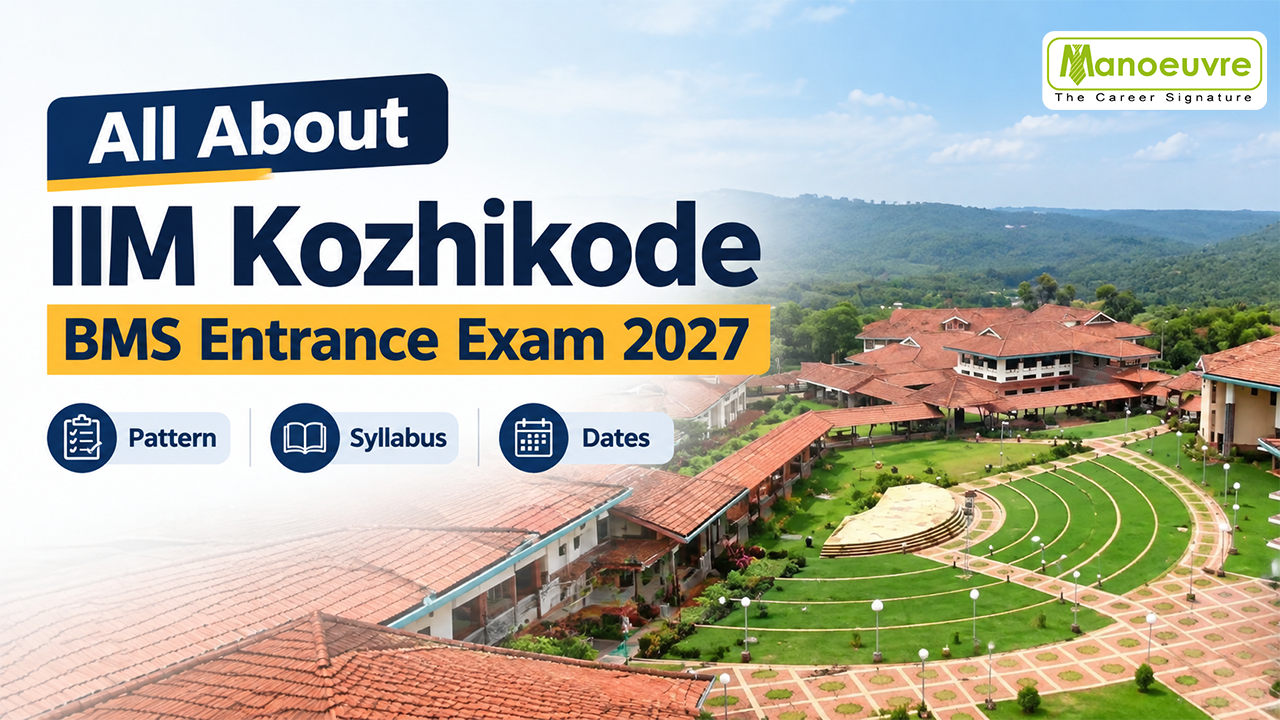
All About IIM Kozhikode BMS Entrance Exam 2027: Pattern, Syllabus & Dates If you are planning to pursue an undergraduate management degree from IIM Kozhikode, the IIM Kozhikode BMS Entrance Exam 2027 is an important exam to know about. IIM Kozhikode introduced its four-year BMS (Bachelor of Management Studies) program in 2026, with admission through the IIMK BMS Aptitude Test (IIMK BMS AT).The programme combines management education with subjects from areas such as economics, artificial intelligence, psychology, finance and liberal studies. It is offered at the IIM Kozhikode Kochi Campus.Note: The detailed 2027 admission information has not yet been published. This article covers the latest detailed information available from the official IIM Kozhikode sources for the 2026 admission cycle. Candidates applying for 2027 should check the official IIM Kozhikode website for the latest updates. IIM Kozhikode BMS Entrance Exam 2027 - HighlightsParticularDetailsExamIIMK BMS Aptitude TestConducting InstituteIIM KozhikodeProgrammeBachelor of Management StudiesDuration4 yearsCampusKochi CampusExam ModeComputer-Based TestLanguageEnglishSectionsVerbal Ability & Quantitative AbilityQuestions100Maximum Marks300Exam Duration120 minutesMarking+3 correct, -1 incorrectThe 2026 IIMK BMS AT was a two-hour computer-based test with 100 MCQs. Each section had a 60-minute time limit. What is the IIM Kozhikode BMS Programme? The IIM Kozhikode BMS (Bachelor of Management Studies) program is a full-time undergraduate management programme introduced by IIM Kozhikode.The course is designed to give students a management foundation while allowing them to explore other disciplines. Its academic structure includes:● Management as the major area● Interdisciplinary minor options● Research opportunities● Internship exposure● Experiential learning● International exchange opportunitiesIIM Kozhikode BMS Programme StructureThe programme spans four years and eight semesters. Students study management fundamentals along with specialised subjects and can pursue interdisciplinary areas through the minor structure.Major and Minor AreasThe Management major covers areas such as marketing, finance, strategy, operations, human resources and entrepreneurship.Minor options include:● Economics and Public Policy● Artificial Intelligence and Machine Learning● Psychology and Behavioural Sciences● Finance and Big Data● Liberal Studies● Marketing, Sales and Digital Promotion IIM Kozhikode BMS Entrance Exam 2027 - Exam Pattern The 2026 IIMK BMS AT pattern was as follows:FeatureDetailsModeComputer-Based TestDuration120 minutesSections2Questions100 MCQsMaximum Score300LanguageEnglishTime per Section60 minutesCorrect Answer+3 marksWrong Answer-1 markThe two sections are Verbal Ability and Quantitative Ability. Candidates have to attempt the sections in the prescribed order.IIMK BMS AT Marking SchemeThe marking system rewards accuracy but also penalises incorrect attempts:● Correct response: +3 marks● Incorrect response: -1 mark● Maximum score: 300 marksCalculators and other computing devices are not permitted during the examination. IIM Kozhikode BMS Entrance Exam 2027 Syllabus The IIMK BMS AT syllabus is divided into two broad areas.IIMK BMS AT Verbal Ability SyllabusThe Verbal Ability section includes:● Grammar● Vocabulary● Reading ComprehensionCandidates should work on basic grammar rules, word usage and their ability to understand and interpret written passages.IIMK BMS AT Quantitative Ability SyllabusThe Quantitative Ability section covers:● Number Systems● Algebra● Geometry● Coordinate Geometry● Trigonometry● Mensuration● Statistics● ProbabilityThe official IIMK syllabus also states that the sample questions are meant to indicate the nature and difficulty of the test and should not be treated as an exhaustive list of possible questions. IIM Kozhikode BMS 2027 Eligibility Criteria Based on the 2026 admission requirements, candidates could apply if they had:● Passed Class XII/HSC/IB or an equivalent examination from a recognised board, or● Completed a diploma after 10 years of schooling from a recognised stream.Students waiting for their 2026 Class XII/equivalent/diploma results were also permitted to apply for the BMS AT, subject to the conditions prescribed by IIM Kozhikode.Minimum PercentageThere was no minimum stipulated percentage or grade requirement for applying to the IIMK BMS AT 2026.Age LimitThere was no age restriction for appearing in the 2026 IIMK BMS Aptitude Test. IIM Kozhikode BMS 2027 Important Dates The following was the official schedule for the 2026 admission cycle:Admission Event2026 DateApplications Open20 February 2026Applications Close25 April 2026Admit CardBy 6 May 2026IIMK BMS AT19 May 2026InterviewsThird week of June 2026Classes BeginFirst week of August 2026 IIM Kozhikode BMS 2027 Registration For the 2026 cycle, applications were submitted online through the official IIM Kozhikode website.The basic process involved:1. Create your registration account using an active personal email address and a valid mobile number.2. Generate the login credentials.3. Enter the required personal and academic information.4. Upload the necessary documents.5. Select preferred examination cities.6. Pay the application fee.7. Preview the form carefully.8. Submit the application.Candidates were advised to use their own email address because important admission communication was sent to the registered email ID. IIM Kozhikode BMS 2027 Application Form The application form required candidates to provide information such as:● Personal details● Contact information● Class X academic details● Class XII/equivalent details● Category information● PwD details, where applicable● Examination-city preferences● Supporting certificates and documentsCandidates were advised to check the form carefully before submission. Certain personal details could not be edited after confirmation. IIM Kozhikode BMS 2027 Application Fee and Documents Application FeeFor the 2026 IIMK BMS AT:CategoryFeeGeneral/Other Categories₹4,250SC/ST/PwD₹2,125The fee was paid online using options such as credit card, debit card, net banking, UPI or wallet. The fee was non-refundable.Documents RequiredCandidates may need to keep the following ready:● Class X marksheet/certificate● Class XII marksheet/certificate, if available● Diploma documents, where applicable● Category certificate, where applicable● PwD certificate, where applicable IIM Kozhikode BMS 2027 Admit CardFor the 2026 exam, candidates downloaded the admit card from the IIMK website using their registration credentials. The admit card contained important details such as:● Candidate name● Test date● Test centre● Examination session● Examination time● PwD status, where applicableCandidates had to carry a printed copy of the admit card to the examination centre. The photograph affixed to it had to match the photograph uploaded during registration.The 2026 examination was conducted as a centre-based computer test, not as an exam that students could take from home. ConclusionThe IIM Kozhikode BMS Entrance Exam gives students an opportunity to enter an undergraduate management programme offered by one of India's leading management institutes. The IIMK BMS AT focuses on two key areas-Verbal Ability and Quantitative Ability-so students should build strong fundamentals while also developing speed and accuracy.This complete guide has been prepared using the official IIM Kozhikode information for the 2026 admission cycle. The detailed information for IIM Kozhikode BMS 2027 has not yet been published. Students planning to apply for the 2027 batch should therefore visit the official IIM Kozhikode website and verify the latest eligibility, dates, application fee, exam pattern and registration details once the 2027 admission information is released. FAQs on IIM Kozhikode BMS Entrance Exam 2027 1. What is the IIM Kozhikode BMS Entrance Exam?It is the IIM Kozhikode BMS Aptitude Test (IIMK BMS AT), conducted for admission to the institute's Bachelor of Management Studies programme.2. What is the IIMK BMS AT exam pattern?The 2026 test had 100 MCQs carrying 300 marks, with a total duration of 120 minutes divided between Verbal Ability and Quantitative Ability.3. Is there negative marking in IIMK BMS AT?Yes. Three marks are awarded for a correct answer and one mark is deducted for an incorrect answer.4. What is the syllabus for IIM Kozhikode BMS AT?The test covers Verbal Ability topics such as Grammar, Vocabulary and Reading Comprehension, along with Quantitative Ability topics including Algebra, Geometry, Number Systems, Statistics and Probability.5. Is there any minimum percentage required for IIM Kozhikode BMS?For the 2026 admission cycle, IIM Kozhikode did not prescribe a minimum percentage or grade for applying to the BMS AT.6. Is there an age limit for IIM Kozhikode BMS?No age restriction was specified for the 2026 IIMK BMS Aptitude Test.7. What was the IIMK BMS AT application fee?The 2026 fee was ₹4,250 for other categories and ₹2,125 for SC, ST and PwD candidates.8. Is IIMK BMS AT an online exam?The IIMK BMS AT is conducted as a computer-based examination at designated test centres, rather than as a home-based online test. 9. When was the IIMK BMS AT 2026 conducted?The 2026 test took place on 19 May 2026, from 2:00 PM to 4:00 PM.10. How can candidates apply for the IIM Kozhikode BMS programme?Applications are submitted online through the official IIM Kozhikode website. Candidates need to complete the application, upload the required documents, pay the applicable fee and submit the form.
07 Oct 2026
0 comments
IPMAT Eligibility Criteria 2027: Age, Qualification, Subjects & Reservation The IPM is a five-year management course meant for students eager to start management studies right after Class 12. Among the institutes offering this route, IIM Indore and IIM Rohtak are two important names that attract a large number of IPMAT aspirants.However, students should remember that IIM Indore and IIM Rohtak do not follow exactly the same eligibility rules. Their requirements related to age, academic marks and calculation of percentage can differ.Note: The eligibility information presented here reflects 2026 standards. IPMAT INDORE 2027 candidates should verify the official IIM websites and 2027 notifications for current requirements. Students preparing for IPMAT INDORE 2027 should check the respective official IIM websites and the 2027 admission notifications for the latest rules. IPMAT Eligibility Criteria 2027 at a Glance Before looking at each institute separately, here is a quick comparison: Criteria IIM Indore IIM Rohtak Programme Five-Year IPM Five-Year IPM Class X Passed Class X required Minimum marks requirement Class XII Passed/appearing as per applicable year criteria Minimum marks requirement Age Birth-date criterion applies Maximum age criterion applies Percentage rule Aggregate of subjects listed on marksheet Best five subjects Reservation Government of India norms Government of India norms 2026 intake 150 198 The above intake figures are for the 2026 batch and should not be assumed to be the intake for 2027. IIM Indore IPMAT Eligibility Criteria 2027 To qualify for IIM Indore's IPM, candidates must meet age and educational requirements.IIM Indore IPMAT Age LimitUnder the 2026 admission rules, applicants had to meet a specified date-of-birth condition. General-category candidates needed to be born on or after August 1, 2006.A five-year age relaxation was applicable to candidates belonging to SC, ST and PwD categories, subject to the conditions mentioned by the institute.For IPMAT INDORE 2027, students should wait for the new admission notification before using these dates to determine their eligibility.IIM Indore Educational QualificationFor the 2026 admission cycle, applicants could qualify through their Class XII/HSC or an equivalent examination if they had completed it in the specified qualifying years or were appearing for the examination in 2026.Passing Class X or an equivalent examination was also necessary.Students who were expected to complete their Class XII qualification within the prescribed period could apply provisionally. However, selected candidates had to submit the required academic records during programme registration. Failure to provide the required documents could result in cancellation of the provisional admission. How Does IIM Indore Calculate Class 10 and 12 Percentage? This is an important point for students whose boards calculate percentages differently.For the 2026 process, IIM Indore considered the marks obtained across all subjects mentioned in the candidate's marksheet or grade sheet rather than simply using a board's preferred percentage calculation method.If a board awards grades or grade points instead of marks, candidates need to follow the officially certified conversion method provided by the relevant board or competent authority.Students from international boards may also be eligible. Candidates from systems such as IGCSE and IB need to satisfy the institute's documentation and percentage-conversion requirements. IIM Rohtak IPMAT Eligibility Criteria 2027 The eligibility standards for IIM Rohtak's IPM differ from IIM Indore's specifications. IIM Rohtak IPM Age LimitFor the 2026 admission cycle, a candidate had to be 20 years of age or below as of June 30, 2026.SC and ST candidates received age relaxation, with the upper age limit extending to 25 years under the 2026 rules.The exact reference date and age limits for IPMAT Rohtak 2027 should be confirmed from IIM Rohtak's official admission notification.IIM Rohtak Educational QualificationCandidates needed to satisfy the Class X and Class XII academic requirements specified by the institute.Students who were still completing Class XII within the permitted period could also apply provisionally. Their final admission depended on meeting the required academic standard after their Class XII results were announced and submitting the necessary documents.Minimum Marks for IIM Rohtak IPMThe 2026 criteria specified different minimum marks for different categories: Category Minimum Percentage General 60% EWS 60% NC-OBC 60% SC 55% ST 55% DAP 55% For percentage calculation, IIM Rohtak's 2026 criteria used the best five subjects appearing in the marksheet or grade sheet.Therefore, students should not assume that the percentage calculation method used by IIM Indore will also apply to IIM Rohtak. IIM Indore vs IIM Rohtak Eligibility Criteria Although both programmes are five-year integrated management courses, their eligibility requirements have some notable differences.Age: IIM Indore's 2026 rule was based on a particular date of birth, whereas IIM Rohtak specified an upper age limit as of a particular date.Academic marks: IIM Rohtak specified category-wise minimum percentages. The 2026 IIM Indore criteria supplied here did not prescribe the same 60%/55% threshold.Percentage calculation: IIM Indore used the aggregate of subjects appearing on the marksheet, while IIM Rohtak used the best five subjects under its 2026 criteria.This means a student should check both institutes separately rather than assuming that satisfying one set of conditions automatically makes them eligible for the other. IPMAT Eligibility Subjects: Is Maths Compulsory? One of the most common questions among IPMAT aspirants is whether Mathematics must be studied in Class 11 and 12.Students should distinguish between the subjects studied in Class 12 and the sections tested in the entrance examination. The entrance test can assess quantitative aptitude even though academic eligibility and subject requirements are determined separately.Since eligibility conditions can be updated from one admission cycle to another, students targeting IPMAT INDORE 2027 should check the exact subject-related requirements in the official 2027 notification before applying. Can students from Commerce, Science, and Humanities backgrounds participate in IPMAT? IPM doesn't limit admissions to any particular academic background. Students from Commerce, Science and Humanities/Arts backgrounds should check the eligibility conditions of the institute they wish to apply to.The important factors are whether the candidate satisfies the prescribed Class X/Class XII qualification, age requirements, marks requirements and any subject-specific conditions applicable in that admission cycle. IPMAT Reservation Criteria Reservation is applicable according to the relevant Government of India reservation framework and institute-specific admission rules.IIM Indore ReservationUnder the 2026 criteria, the reservation structure included:● 27% for NC-OBC● 15% for SC● 7.5% for ST● Up to 10% for EWS● 5% for PwDCandidates seeking admission through a reserved category needed to provide valid supporting certificates issued by the appropriate authority.Reservation by itself does not remove the requirement to satisfy the institute's eligibility conditions or meet the required performance level in the selection process.IIM Rohtak ReservationFor the 2026 batch, IIM Rohtak stated that its 198 seats would be allocated according to the applicable Government of India reservation provisions across categories including General, SC, ST, NC-OBC, EWS and DAP.Admission offers were to be made according to merit/rank and the availability of seats within the respective category.The 198-seat figure relates specifically to the 2026-31 batch and should not be treated as confirmed intake for IPMAT INDORE 2027. Who Can Apply for IPMAT INDORE 2027? A prospective applicant should broadly check the following before filling out the application:● Have you completed or are you completing Class XII within the permitted qualification period?● Have you passed Class X?● Does your age fall within the eligibility range?● Do you meet the required percentage, where applicable?● Do you satisfy any subject-specific conditions?● If applying under reservation, do you have the required valid certificate?● Have you checked the latest admission notification issued by the institute?Ensure you verify eligibility requirements using that year's official notification. Documents Students May NeedCandidates should generally keep their academic and category documents ready while applying. Depending on the college and admission year, you may need:● Class X marksheet● Class XII marksheet/certificate● Category certificate, where applicable● PwD/DAP certificate, where applicable● Board-issued grade-to-percentage conversion document, where required● Other documents specified in the application or admission instructions Frequently Asked Questions 1. Which eligibility requirements apply for IPMAT INDORE 2027?IPMAT eligibility depends on the institute. Candidates need to satisfy the prescribed age, Class X/Class XII qualification, marks and other conditions of the IIM to which they are applying.2. What is the age limit for IPMAT?IIM Indore's age requirements are distinct from IIM Rohtak's specifications. IIM Indore used a date-of-birth criterion in 2026, while IIM Rohtak specified a maximum age as of June 30, 2026.3. What percentage is required for IIM Rohtak IPM?Under the 2026 criteria, the requirement was 60% for General, EWS and NC-OBC candidates and 55% for SC, ST and DAP candidates.4. Does IIM Indore have a minimum percentage requirement for IPMAT?The 2026 eligibility information considered here did not prescribe the same category-wise 60%/55% minimum used by IIM Rohtak. Verify the specific year's official IIM Indore notification for accurate information. 5. Can Arts students apply for IPMAT?Students from Arts/Humanities backgrounds can consider IPM if they satisfy the eligibility requirements of the institute and admission year. Any specific subject condition should be checked in the latest notification.6. Can Commerce students apply for IPMAT?Yes, Commerce students can explore IPM provided they meet the applicable academic, age and subject requirements of the institute they are applying to.7. Is there any difference in eligibility between IIM Indore and IIM Rohtak?Yes. The two institutes have differences in age requirements, minimum marks and the method used for calculating academic percentages.8. Is there reservation in IPMAT admission?Yes. Reservation provisions apply according to the applicable Government of India rules and institute admission policies. Candidates claiming a reserved category must provide valid supporting documents.9. Can Class 12 students apply for IPMAT?Students appearing for Class XII may be allowed to apply provisionally if they satisfy the conditions specified in the relevant admission notification. They must subsequently meet the qualifying requirements and submit the required documents.

06 Oct 2026
0 comments
MAH BBA CET 2027 Complete Guide: Syllabus, Exam Date, Eligibility & Registration The MAH BBA CET 2027 is a state-level entrance examination for students seeking admission to undergraduate programmes such as Bachelor of Business Administration (BBA), along with BMS, BBM and other courses covered under the Maharashtra State CET Cell's common entrance test. Maharashtra's State Common Entrance Test Cell is responsible for conducting the test. The detailed 2027 notification, including the final exam date, registration schedule and fee, is awaited. Until then, the latest 2026 information brochure provides a useful reference for understanding the examination structure and application process. MAH BBA CET 2027: Exam Overview MAH BBA CET operates as an online, computer-based entrance examination for undergraduate courses. For BBA aspirants, the examination assesses areas including English, reasoning, general awareness and basic computer knowledge.The latest brochure indicates that the BBA examination is conducted in English, with objective questions and no negative marking.MAH BBA CET 2027 at a glance Particular Details Exam MAH BBA CET 2027 Conducting body Maharashtra State CET Cell Course BBA Mode Computer-Based Test (CBT) Medium English Question type Multiple-choice questions Total questions 100 Maximum marks 100 Duration 120 minutes Negative marking No Academic year 2027-28 Exam Overview & Scoring System for MAH BBA CET 2027 The 2026 structure provides 100 questions for 100 marks, with one mark assigned to each question. Students get two hours to complete the test, and incorrect answers do not attract a penalty. Section Questions Marks English Language 30 30 Reasoning - Verbal & Arithmetic 30 30 General Knowledge & Awareness 20 20 Computer Basics 20 20 Total 100 100 The test contains four options for each objective question. Since there is no negative marking in the latest brochure, candidates can attempt questions without losing marks for an incorrect response. MAH BBA CET 2027 Syllabus The syllabus encompasses four distinct subject domains. The latest pattern gives the highest weightage to English and Reasoning, with 30 questions each.BBA CET Syllabus 20271. 30 questions on English Language Preparation can include:● Reading comprehension● Vocabulary● Grammar● Sentence-based questions● Synonyms and antonyms● Verbal ability2. 30 questions on Reasoning (Verbal and Arithmetic) Important areas may include:● Logical reasoning● Analytical reasoning● Number-based reasoning● Basic arithmetic reasoning● Series● Arrangements● Relationships and patterns3. 20 questions on General Knowledge & Awareness This area can cover:● Current affairs● National and international developments● Business and trade● Sports● Culture● Scientific developments and discoveries4. Computer Basics - 20 QuestionsStudents should be familiar with:● Basic computer concepts● Hardware and software● Internet fundamentals● Common computer terminology● Basic applications and digital awarenessThe detailed 2027 syllabus should be checked against the official CET Cell notification once released. MAH BBA CET 2027 Eligibility Criteria According to the latest brochure, candidates applying for BBA/BMS/BBM/BCA courses must be Indian citizens and should have completed Class 12 or an equivalent qualification, subject to the admission requirements prescribed by the relevant university. Students appearing for their Class 12 examination can also appear for the CET.Key points● Candidate should be an Indian citizen.● Class 12 or equivalent qualification is required for admission.● Class 12 appearing students can appear for the entrance test.● Final admission eligibility is linked to the applicable university/admission policy.● Candidates should check the official 2027 CAP documentation for the final eligibility rules.Note: The 2026 CET brochure does not establish one universal minimum percentage or age requirement specifically for every BBA admission. Therefore, candidates should not assume that a percentage or age rule from another course automatically applies to BBA. MAH BBA CET 2027 Important Dates The BBA CET exam date 2027 and complete registration schedule have not yet been officially announced.Students can use the following format to track the upcoming schedule: Event MAH BBA CET 2027 (Expected) Official notification Second week of January 2027 Registration begins Second week of January 2027 Last date to apply Third/Fourth week of March 2027 Fee payment deadline Third/Fourth week of March 2027 Admit card Third/Fourth week of April 2027 Exam date Fourth week of April 2027 Result Second week of June 2027 CAP/admission process First/Second week of July 2027 For reference, the 2026 registration window opened on 14 January and the original application deadline was 16 February 2026, while the examination and admit-card dates were to be notified separately.Candidates should rely on the official CET Cell website for the final 2027 schedule because dates can change through subsequent notices. MAH BBA CET Registration 2027 Online registration through the Maharashtra State CET Cell portal is the anticipated registration method for 2027. A typical application process includes:1. Visit the official CET Cell website.2. Open the BBA/BMS/BBM CET registration link.3. Create the required login credentials.4. Enter personal and academic information.5. Complete Aadhaar and APAAR verification, wherever required.6. Upload the prescribed photograph.7. Select examination preferences.8. Pay the application fee online.9. Review all information carefully.10. Submit the form and save the confirmation details.The 2026 brochure states that applications were submitted online and advises candidates to keep their application number available for future communication. How to Fill the MAH BBA CET 2027 Application Form Before beginning the form, candidates should keep their academic information and identification details ready.Application form checklist Stage What to check Personal details Your name, birth date, and other personal details Academic details Class 10 and 12 information Category Applicable reservation/category details Identity verification Aadhaar and APAAR information Photograph Correct size, format and quality Exam preference Select available centre preferences Payment Complete online fee payment Final review Check spelling, numbers and uploaded details Submission Save the final application/confirmation The 2026 brochure specifies that the uploaded photograph should be a recent colour image with the face clearly visible, a light background and file size between 100 KB and 5 MB. Documents Required for MAH BBA CET 2027 Candidates should prepare their documents before beginning registration so that the form can be completed without unnecessary delays.Commonly relevant documents and information include:● Recent passport-style photograph● Aadhaar details● APAAR ID details● Class 10 information● Class 12 information● Category certificate, where applicable● Caste Validity Certificate, where applicable● Non-Creamy Layer Certificate, where applicable● EWS Certificate, where applicable● PwD Certificate, where applicableThe exact documents required at registration and during CAP may differ. Category-related certificates are particularly important during the admission process. Fee Details and Documentation Requirements for MAH BBA CET 2027 Enrollment The MAH BBA CET fees 2027 will be confirmed through the official 2027 notification.For reference, the 2026 brochure listed the following application processing fees: Candidate category 2026 fee Maharashtra Open Category ₹1,300 Outside Maharashtra State candidates ₹1,300 J&K Migrant candidates ₹1,300 Eligible Maharashtra reserved-category candidates ₹1,000 Maharashtra PwD candidates ₹1,000 Orphan candidates ₹1,000 Transgender (Other) candidates ₹1,000 The 2026 application fee was payable online and was treated as non-refundable.For CAP, candidates claiming applicable categories may need to provide documents such as caste, caste validity, NCL, EWS or PwD certificates. The validity requirements should be checked against the 2027 CAP notice before submission. APAAR and Aadhaar-Based Identity Verification Process for MAH BBA CET 2027 An important feature of the current registration involves Aadhaar and APAAR-based identity verification. Candidates should make sure that their Aadhaar information is accurate, particularly:● Name● Date of birth● Gender● Address● PhotographThe 2026 process used Aadhaar authentication through DigiLocker and also included APAAR verification. Candidates were advised to keep these records updated because inconsistencies can create verification problems.Before starting MAH BBA CET registration 2027, students should therefore check their digital identity records and correct discrepancies well in advance. MAH BBA CET 2027 Admit Card Once the CET Cell declares the release date, the admit card becomes accessible via candidate login. Based on the latest process, candidates can expect to use their registration credentials to access the hall ticket. They should carefully verify:● Candidate name● Photograph● Roll/registration details● Exam date● Reporting time● Examination centre● Venue address● Exam instructionsAccording to 2026 guidelines, candidates needed to bring their admit card and an original photo identity document. Accepted examples included Aadhaar/e-Aadhaar, PAN, passport, voter ID, permanent driving licence and certain institutional IDs.Candidates should ensure that the name on their ID matches the details entered in the application. The examination centre and reporting instructions printed on the final admit card should be followed carefully.Important: MAH BBA CET 2027 dates, fees and any revised eligibility or registration requirements should be confirmed from the official Maharashtra State CET Cell notification when released. MAH BBA CET 2027 FAQs 1. What is MAH BBA CET 2027?MAH BBA CET is an entrance examination conducted by the Maharashtra State CET Cell for undergraduate admissions including BBA and related programmes covered under the CET.2. Which structure and format does the MAH BBA CET 2027 follow? The latest pattern includes 100 questions valued at 100 marks distributed as: Computer Basics (20), General Knowledge & Awareness (20), Reasoning (30), and English (30)3. Which topics are included in the syllabus? The examination tests competency across four domains: language skills in English, analytical reasoning covering verbal and arithmetic, awareness of general knowledge, and computer-related concepts.4. Does the 2027 exam impose mark reductions for unanswered or incorrect questions? The latest 2026 brochure specifies that there is no negative marking. Candidates should verify the 2027 notification for confirmation.5. Who is eligible for MAH BBA CET 2027?Candidates should be Indian citizens and meet the applicable Class 12 and university admission requirements. Class 12 appearing students can also appear for the CET under the latest rules.6. Can Class 12 appearing students apply for MAH BBA CET 2027?Yes. The latest brochure permits candidates appearing for their 10+2/equivalent examination to take the CET, subject to fulfilling admission requirements later.7. What documents are required for MAH BBA CET 2027 registration?Candidates should keep their photograph, academic information, Aadhaar and APAAR details ready. Category-specific documents may be required during CAP.8. Is Aadhaar and APAAR verification required for MAH BBA CET 2027?The 2026 process used Aadhaar authentication and APAAR verification via DigiLocker. Verify the 2027 notification for the exact updated procedure. 9. What is the application fee for MAH BBA CET 2027?The 2027 fee will be announced officially. Registration fees in 2026 were structured as ₹1,300 for unreserved and migrant categories, contrasting with ₹1,000 for Maharashtra-reserved, disability-certified, orphan, and transgender applicants. 10. What's the process for downloading your MAH BBA CET 2027 admit card? Download the admit card via the official CET Cell portal using your login credentials once it's released. You'll need your registration details or other login information specified by the CET Cell.
Featured Blogs
 MBA Entrance
 LAW 5years Entrance
 LAW 3years Entrance
 MCA Entrance
 CUET PG Entrance
 BBA Entrance
 BCA Entrance
 Hotel-Management
 B.ED Entrance