

04 Aug 2026
0 comments
NPAT 2027 Preparation: Proven Tips, Strategy & Study Plan for Success IntroductionGetting admission into the BBA program at SVKM's Narsee Monjee Institute of Management Studies (NMIMS) is a dream for many students who want to build a career in business and management. The first step towards this goal is clearing the NMIMS NPAT exam, one of the popular undergraduate entrance tests for BBA admissions.NPAT 2027 preparation requires more than just completing the syllabus. Since the exam focuses on speed, accuracy, logical thinking, and language skills, students need a well-planned approach from the beginning. Starting early gives you enough time to strengthen basic concepts, practise different question types, and improve your performance through mock tests. In this guide, we will discuss the NPAT exam pattern, section-wise preparation strategy, a practical study plan, common mistakes to avoid, and expert tips to help you prepare effectively for NPAT 2027. Understanding NPAT 2027: An Entrance Test for NMIMS BBA Admission The NMIMS NPAT (National Test for Programs After Twelfth) is an entrance examination conducted for admission to undergraduate programs offered by NMIMS, including the BBA program at selected campuses.The exam evaluates a student's aptitude skills required for management education. Instead of testing only theoretical knowledge, NPAT focuses on areas such as numerical ability, logical reasoning, and English language proficiency.A strong performance in NPAT requires a balance between conceptual understanding and regular practice. Students who develop accuracy, improve calculation speed, and analyse their mistakes regularly have a better chance of performing well in the exam.NPAT 2027 Exam Pattern (Expected) Particular Details Exam Mode Computer-Based Test (CBT) Duration 100 Minutes Total Questions 120 Questions Total Marks 120 Marks Question Type Multiple Choice Questions Sections Quantitative & Numerical Ability, Reasoning & General Intelligence, Proficiency in English Language Marking Scheme +1 mark for every correct answer Negative Marking No negative marking Note: Students should check the official NPAT notification for the final 2027 exam pattern and updates. Section 1: Preparing for Quantitative & Numerical Ability The Quantitative & Numerical Ability section tests your mathematical understanding, calculation skills, and ability to solve problems quickly. Many students find this section challenging because it requires both conceptual clarity and speed.Instead of memorising formulas without understanding, focus on learning the basic concepts and applying them to different types of questions.Important Topics to Cover:● Percentages● Ratio and proportion● Profit, loss, and discounts● Simple and compound interest● Time, speed, and distance● Time and work● Number system● Algebra basics● Data interpretation● Probability and permutationsPreparation Strategy for Quantitative Ability:1. Build Strong FundamentalsBegin your preparation by revising basic mathematical concepts. A strong foundation helps you solve questions faster and reduces calculation errors during the exam.2. Improve Calculation SpeedNPAT is a time-bound exam, so quick calculations can make a significant difference. Practise mental calculations, approximation techniques, and shortcuts regularly.3. Practise Topic-Wise QuestionsDo not directly jump into full-length mocks. First, practise individual topics, identify weak areas, and gradually move towards mixed practice.4. Maintain an Error Notebook Whenever you make mistakes, note down the reason behind them. Revisiting these errors helps avoid repeating the same mistakes in future tests. Section 2: Reasoning & General Intelligence Preparation The Reasoning & General Intelligence section evaluates your logical thinking and problem-solving abilities. This section requires regular practice because question patterns can vary significantly.Students who develop the habit of analysing patterns and approaching problems logically can improve their accuracy over time.Important Reasoning Topics:● Coding-decoding● Blood relations● Direction sense● Number and alphabet series● Arrangements● Logical puzzles● Syllogisms● Analogies● Venn diagrams● Statement and conclusion-based questionsPreparation Strategy for Reasoning:1. Practise Different Question TypesReasoning questions become easier when you understand the approach behind each pattern. Solve questions from different topics regularly to improve familiarity.2. Focus on Accuracy FirstMany students try to solve reasoning questions quickly and end up making mistakes. During the initial preparation stage, focus on solving correctly before increasing speed.3. Analyse Difficult QuestionsWhenever you struggle with a question, understand the logic behind the solution instead of simply memorising the answer. This develops better problem-solving ability.4. Take Regular Sectional Tests Short sectional tests help you understand your preparation level and improve time management before attempting full-length NPAT mocks. 4. Develop Logical Thinking Skills Logical reasoning is scoring but requires practice. You can start with: ● Puzzle questions ● Critical reasoning passages ● Assumption and conclusion-based questions ● Statement-based logic Practice 2–3 passages weekly to slowly build accuracy. This will help you later in both CLAT and other law entrances. 5. Introduction to Legal Reasoning Don’t worry — you don’t need prior legal knowledge. Legal reasoning tests: ● Application of principles ● Analytical thinking ● Passage understanding In Class 11: ● Learn basic legal terms (e.g., tort, contract, rights) ● Read legal news casually ● Solve beginner legal passages Your focus should be familiarity, not mastery. 6. Don’t Ignore Maths Completely CLAT maths is basic but tricky because it’s passage-based. Topics include: ● Percentages ● Ratios ● Averages ● Basic arithmetic If you’re weak in maths, Class 11 is the best time to fix it slowly. Just 2 hours per week is enough initially. Section 3: Preparing for Proficiency in English Language One of the biggest myths is that early preparation means heavy study hours. That’s not true.The English Language section of NPAT evaluates your command over vocabulary, grammar, reading ability, and sentence formation. A strong English score can improve your overall performance because consistent practice can help you solve questions quickly and accurately.Unlike mathematics or reasoning, English preparation improves gradually. Developing a reading habit and practising regularly can help you strengthen your language skills over time.Important Topics to Cover:● Reading comprehension● Vocabulary and word meanings● Synonyms and antonyms● Grammar rules● Sentence correction● Fill in the blanks● Para-jumbles● Error detectionPreparation Strategy for English:1. Develop a Daily Reading HabitReading newspapers, business articles, magazines, and quality online content improves vocabulary and comprehension skills. Try to understand the meaning of words through their usage instead of only memorising definitions.2. Practise Reading Comprehension RegularlyReading comprehension questions require speed and understanding. Practise passages regularly and focus on identifying the main idea, tone, and important details.3. Strengthen Grammar BasicsRevise important grammar concepts such as tenses, subject-verb agreement, sentence structure, and prepositions. Strong basics help you solve error-based questions more confidently.4. Maintain a Vocabulary List Create a personal list of new words and revise them regularly. Learning words with examples makes it easier to remember and apply them in the exam. NPAT 2027 Study Plan: A Practical 5-Month Preparation Strategy A structured study plan helps students stay consistent and complete their preparation without last-minute stress. However, the ideal preparation time depends on your current knowledge level and daily study availability.The following 5-month strategy can help candidates plan their NPAT preparation in a more organised way. Month 1: Understand Basics and Build FoundationMain Focus: Concept DevelopmentDuring the first month, focus on strengthening your fundamentals across all three sections.Tasks to complete:● Understand the NPAT exam pattern and syllabus● Revise basic concepts of mathematics and grammar● Start practising reasoning topics● Develop a daily reading habit● Take an initial mock test to identify strengths and weaknessesDaily Study Time: 2–3 hoursAt this stage, focus more on accuracy rather than attempting a large number of questions. Month 2: Strengthen Concepts Through PracticeMain Focus: Topic-Wise ImprovementOnce your basics are clear, start practising questions from individual topics.Focus on:● Solving topic-wise questions● Improving calculation speed● Building vocabulary● Practising reasoning sets● Reviewing mistakes regularlyStart attempting sectional tests to understand your progress. Month 3: Improve Speed and AccuracyMain Focus: Exam-Oriented PreparationThis stage should focus on applying your knowledge under time limits.Include:● Full-length mock tests● Sectional tests● Previous year question practice● Time management exercises● Revision of weak topicsAfter every mock test, analyse:● Questions you missed● Time-consuming areas● Topics requiring more practice Month 4: Advanced Practice and Mock TestsMain Focus: Performance ImprovementBy this stage, you should be comfortable with most topics.Your preparation should include:● 2–3 mock tests every week● Revision of formulas and concepts● Improving question selection strategy● Practising under exam-like conditions● Reducing calculation and accuracy errorsThe goal is not just solving more questions but improving your overall score through better strategy.Month 5: Final Revision and Exam ReadinessMain Focus: Confidence BuildingThe final month should focus on revision rather than learning completely new topics.Priorities:● Attempt regular mock tests● Revise important formulas and concepts● Review your error notebook● Practise time management● Maintain a consistent revision schedule Avoid unnecessary stress and focus on improving your existing preparation. Importance of Mock Tests During NPAT Preparation Mock tests play an important role in entrance exam preparation because they help you understand your current performance level. Regular mock practice helps you: ● Improve speed and accuracy ● Understand question patterns ● Develop better time management ● Identify weak areas ● Build confidence for the actual exam However, simply attempting mocks is not enough. Spend time analysing your performance after every test and work on the areas where improvement is required. Common Mistakes to Avoid During NPAT 2027 Preparation 1. Starting Preparation Without Understanding the ExamMany students begin studying without checking the exam pattern and syllabus. Understanding the structure of NPAT helps you create a focused preparation strategy.2. Ignoring Basic ConceptsTrying to solve advanced questions without strengthening fundamentals can create confusion. Clear concepts make it easier to handle different question formats.3. Practising Without AnalysisSolving hundreds of questions is not useful if you do not analyse your mistakes. Understanding your errors is one of the fastest ways to improve.4. Avoiding Mock TestsSome students postpone mock tests until the final weeks. This can affect their speed and confidence. Start mock practice gradually and improve with time.5. Focusing Only on One Section Giving too much attention to a favourite subject while ignoring weaker areas can affect your overall score. Maintain balance across all sections. How Coaching Can Help in NPAT Preparation Self-study can help students prepare for NPAT, especially with discipline and the right resources. However, many students prefer structured guidance to manage their preparation effectively.A well-planned coaching program can provide:● Expert guidance from experienced mentors● Structured study schedules● Topic-wise practice material● Regular mock tests and performance analysis● Guidance on improving speed and accuracyAt Manoeuvre Education, students preparing for management entrance exams receive structured preparation support, practice resources, and guidance to improve their overall performance. The right guidance can help students stay consistent, understand exam trends, and prepare with a clear strategy. Final Thoughts Cracking NPAT 2027 requires consistent preparation, smart practice, and proper time management. The exam does not only test your knowledge but also your ability to solve questions accurately within a limited time.Start by building strong fundamentals, practise regularly, analyse your mistakes, and gradually improve your speed through mock tests. A disciplined approach over several months can help you perform confidently on exam day. Remember, successful preparation is not about studying for long hours every day. It is about following the right strategy and making continuous improvements throughout your journey. Frequently Asked Questions (FAQs) 1. When should I start preparing for NPAT 2027?Students should ideally begin preparation 5–6 months before the exam. Starting early provides enough time to understand concepts, practise questions, attempt mocks, and improve weaker areas.2. What is the NPAT exam pattern?NPAT generally consists of 120 multiple-choice questions to be completed in 100 minutes. The exam includes Quantitative & Numerical Ability, Reasoning & General Intelligence, and Proficiency in English Language sections. Candidates are advised to refer to the official notification for any changes or updated details.3. How many hours should I study daily for NPAT preparation?Around 2–4 hours of focused preparation daily can be effective for most students. The quality and consistency of preparation matter more than studying for long hours.4. Is coaching necessary for NPAT preparation?No, coaching is not compulsory. Students can prepare through self-study with proper planning and resources. However, coaching can provide structured guidance, mock tests, and expert support.5. What is a good score in NPAT?A good NPAT score depends on factors such as exam difficulty, number of applicants, and campus preferences. Candidates should focus on improving accuracy and maintaining steady performance through regular mock test practice. 6. Which NPAT section is considered difficult?Many students find Quantitative & Numerical Ability challenging because it requires strong concepts and quick calculations. Regular practice can help improve performance in this section.7. Are mock tests important for NPAT preparation?Yes. Mock tests help improve speed, accuracy, time management, and exam confidence. Analysing mock performance is equally important for improvement.8. Which books are useful for NPAT preparation? Students can refer to standard books for quantitative aptitude, reasoning, and English preparation along with previous year papers and mock tests for better practice.

30 Jul 2026
0 comments
Best IPMAT Coaching in Borivali: Complete Guide to Crack IPMAT 2027 Preparing for the Integrated Program in Management Aptitude Test (IPMAT) is one of the smartest decisions for students who aspire to study management immediately after Class 12. Conducted by leading IIMs, IPMAT opens the doors to prestigious Integrated Programmes in Management (IPM), helping students begin their management journey at an early stage.However, cracking IPMAT is not easy. Every year, thousands of students compete for a limited number of seats, making strategic preparation essential. While self-study is important, many students find it difficult to maintain consistency, identify weak areas, and solve advanced aptitude questions without proper guidance.If you are looking for the best IPMAT coaching in Borivali, this guide will help you understand the exam, preparation strategy, benefits of coaching, and how to choose an institute that genuinely supports your learning journey. What is IPMAT? The Integrated Program in Management Aptitude Test (IPMAT) is an entrance examination conducted for admission into the five-year Integrated Programme in Management offered by several Indian Institutes of Management (IIMs).The exam evaluates students in areas such as:● Quantitative Ability● Verbal Ability● Logical Thinking● Analytical Skills● Reading ComprehensionUnlike traditional entrance examinations after graduation, IPMAT allows students to begin management education immediately after Class 12, making it an attractive option for commerce, science, and humanities students alike. Why Start Preparing for IPMAT 2027 Early? Many successful candidates begin their preparation during Class 11 or at the start of Class 12. Early preparation offers several advantages:● Strong conceptual understanding● Better time management● More practice through mock tests● Reduced exam pressure● Sufficient revision timeSince the syllabus includes aptitude-based topics, regular practice over a longer period usually gives students a significant advantage. IPMAT 2027 Exam Pattern (Expected) Although the official notification will be released later, the expected pattern is similar to previous years.SectionFocus AreaQuantitative Ability (MCQ)Arithmetic, Algebra, Geometry, Number SystemQuantitative Ability (Short Answer)Conceptual MathematicsVerbal AbilityGrammar, Vocabulary, Reading Comprehension, Para JumblesStudents should always verify the latest notification before the examination, as the pattern may change slightly. Important Topics for IPMAT Preparation Quantitative AbilityThis section usually carries significant weight.Important topics include:● Percentages● Profit and Loss● Ratio and Proportion● Time & Work● Time, Speed & Distance● Simple & Compound Interest● Number System● Algebra● Geometry● Coordinate Geometry● Probability● Permutation & CombinationInstead of memorizing formulas, students should focus on understanding concepts and solving a variety of questions. Verbal AbilityThis section tests language proficiency and comprehension skills.Preparation areas include:● Reading Comprehension● Vocabulary● Synonyms and Antonyms● Grammar● Sentence Correction● Para Jumbles● Fill in the Blanks● Critical ReasoningReading newspapers, editorials, magazines, and business articles regularly helps improve both vocabulary and comprehension speed. How to Prepare for IPMAT 2027 Build Strong FundamentalsEvery difficult question is based on basic concepts.Before attempting advanced-level questions, ensure that your fundamentals are clear.Create a Practical Study PlanA balanced study schedule is more effective than studying for long hours occasionally.Your weekly plan should include:● Concept learning● Topic-wise practice● Revision● Mock tests● Previous Year Question analysisConsistency matters much more than studying excessively for a few days.Solve Mock Tests RegularlyMock tests help students:● Improve speed● Increase accuracy● Understand time management● Identify weak topics● Build exam confidenceEqually important is analyzing each mock test after completion to understand mistakes and improve performance.Improve Reading SpeedReading comprehension plays an important role in IPMAT.Students should develop the habit of reading:● Newspapers● Editorials● Business magazines● Opinion articles● Non-fiction booksThis gradually improves vocabulary, comprehension, and critical thinking.Revise FrequentlyRevision helps retain concepts and formulas.A simple revision cycle may include:● Daily revision● Weekly revision● Monthly revision● Mock-based revisionStudents who revise consistently often perform better than those who keep learning new topics without revisiting old ones. Common Mistakes Students Should Avoid Many students lose marks because of avoidable mistakes.Some common ones include:● Ignoring basic concepts● Skipping mock tests● Poor time management● Not analyzing mistakes● Studying without a timetable● Focusing only on Mathematics● Leaving Verbal Ability until the last momentAvoiding these mistakes can significantly improve overall performance. Why Choose IPMAT Coaching in Borivali? Borivali has become a preferred education hub for students preparing for competitive entrance examinations.Choosing a nearby coaching institute offers several benefits:● Reduced travel time● Regular classroom learning● Better study discipline● Face-to-face doubt solving● Peer learning environment● Easy access to mentorsFor many students, offline learning creates accountability and helps maintain preparation momentum. What Should You Look for in an IPMAT Coaching Institute? Before enrolling, evaluate the institute based on the following factors.Experienced FacultyTeachers should simplify complex concepts rather than only solving questions.Updated Study MaterialThe material should reflect the latest exam trends and include sufficient practice questions.Regular Mock TestsFrequent mock examinations simulate the actual exam environment and help improve performance.Personal MentoringStudents often have different strengths and weaknesses.Individual guidance helps create personalized improvement plans. Doubt Solving SupportTimely clarification prevents conceptual gaps from growing larger.Performance AnalysisA good coaching institute regularly evaluates progress and provides feedback for improvement. Self-Study vs Coaching: Which is Better? Both approaches have their advantages.Self StudyCoachingFlexible scheduleStructured preparationLower costExpert guidanceRequires high disciplineRegular monitoringLimited doubt solvingImmediate faculty supportSelf-analysisDetailed performance trackingStudents with strong discipline may perform well through self-study. However, many aspirants benefit from the structure, mentoring, and competitive environment that coaching provides. Preparing for IPMAT Along with School Many students worry about balancing board examinations and IPMAT preparation.Fortunately, proper planning allows both to be managed effectively.Some useful tips include:● Study consistently instead of waiting until the last few months.● Allocate separate time for board subjects and aptitude preparation.● Practice Mathematics regularly.● Read English newspapers daily.● Solve sectional tests on weekends.● Increase mock test frequency after board examinations.With disciplined planning, students can prepare effectively for both. Choosing the Right Learning Environment Every student learns differently. Some require regular classroom interaction, while others perform better through independent study supported by expert guidance.If you are exploring IPMAT coaching in Borivali, attend demo classes before making a decision. Observe the teaching methodology, interaction with students, quality of study material, and the support provided outside classroom sessions.Institutes that focus on concept clarity, regular assessments, and continuous mentoring generally create a more effective learning experience than those that rely only on lectures.One such option is Manoeuvre Education, which offers structured preparation for IPMAT and other BBA entrance examinations. Students benefit from experienced faculty, comprehensive study resources, regular mock tests, and doubt-solving sessions designed to support consistent improvement rather than short-term exam preparation. The institute also provides counselling and guidance to help students understand different management entrance opportunities. Final Thoughts IPMAT is a competitive examination that rewards conceptual clarity, consistent practice, and smart preparation. Starting early allows students to strengthen their aptitude, improve time management, and gradually build confidence before the actual examination.Whether you choose self-study, online learning, or classroom coaching, success depends on maintaining discipline and continuously evaluating your progress. If you are looking for the best IPMAT coaching in Borivali, focus on finding an institute that provides quality teaching, structured practice, regular feedback, and personalized support. With the right strategy and dedicated effort, securing admission to a prestigious management programme can become an achievable goal. Frequently Asked Questions (FAQs) 1. When should I start preparing for IPMAT 2027?Ideally, students should begin during Class 11 or the beginning of Class 12 to build strong concepts and allow enough time for practice.2. Is Mathematics compulsory for IPMAT?No. Students from all streams can appear, but quantitative aptitude is an important section, so regular practice is essential.3. Are mock tests necessary for IPMAT preparation?Yes. Mock tests help improve speed, accuracy, time management, and identify areas that need improvement.4. How can I choose the best IPMAT coaching in Borivali?Look for experienced faculty, updated study material, regular mock tests, doubt-solving support, and individual mentoring rather than choosing solely based on advertisements.5. Does Manoeuvre Education provide IPMAT coaching in Borivali?Yes. Manoeuvre Education offers classroom coaching, structured study plans, mock tests, and mentoring for students preparing for IPMAT and other BBA entrance examinations.6. Can I prepare for IPMAT along with my Class 12 boards?Yes. With a well-planned schedule, many students successfully prepare for both board examinations and IPMAT simultaneously.

29 Jul 2026
0 comments
How to Prepare for IPMAT 2027: A Complete Roadmap for IIM Aspirants Preparing for the Integrated Programme in Management Aptitude Test (IPMAT) requires a well-planned strategy, consistent practice, and the right study resources. Conducted by premier Indian Institutes of Management (IIMs), IPMAT is the gateway to the prestigious five-year Integrated Programme in Management (IPM). Every year, thousands of students compete for a limited number of seats, making the examination highly competitive.If you are aiming for IPMAT 2027, starting your preparation early can significantly improve your chances of securing admission. This guide explains everything you need to know—from understanding the exam pattern to creating a practical study schedule, choosing the right books, and avoiding common mistakes. Understanding the IPMAT 2027 Exam Before beginning your preparation, you should understand what the examination tests.The IPMAT evaluates candidates on their aptitude, analytical thinking, logical reasoning, and language skills. The exam pattern may vary slightly depending on the institute conducting it, but the overall focus remains on assessing problem-solving ability and communication skills.The major sections generally include:● Quantitative Ability● Verbal Ability● Logical Reasoning (for some institutes)● Data Interpretation (depending on the institute)Since different IIMs may follow different exam structures, candidates should regularly check the official notifications for updates. Why Should You Start Early? Starting your preparation one year before the examination offers several advantages.You get enough time to:● Build strong conceptual clarity● Practice hundreds of questions● Improve calculation speed● Develop reading habits● Revise multiple times● Take numerous mock tests● Identify and improve weak areasInstead of studying under pressure, early preparation allows steady progress without unnecessary stress. Step 1: Know the Complete Syllabus One of the biggest mistakes students make is beginning preparation without understanding the syllabus.Although the official syllabus isn't always released in detail, previous years' papers provide a clear picture of the important topics.Quantitative AbilityTopics usually include:● Number System● Arithmetic● Algebra● Geometry● Mensuration● Probability● Permutation & Combination● Percentage● Profit & Loss● Time & Work● Time, Speed & Distance● Simple & Compound Interest● Ratio & Proportion● AveragesVerbal AbilityImportant areas include:● Reading Comprehension● Vocabulary● Grammar● Sentence Correction● Para Jumbles● Fill in the Blanks● Synonyms & Antonyms● Critical ReasoningLogical Reasoning (where applicable)Common topics are:● Blood Relations● Coding-Decoding● Seating Arrangement● Puzzles● Direction Sense● Series● Statements & Conclusions● Logical SequencesPreparing these topics thoroughly creates a strong foundation. Step 2: Create a Realistic Study Plan A structured timetable is much more effective than studying randomly.A balanced weekly schedule should include:ActivityRecommended TimeQuantitative Practice2 HoursVerbal Ability1.5 HoursReading Newspapers30 MinutesMock Analysis1 HourRevision1 HourRather than studying for long hours occasionally, aim for consistency every day. Step 3: Strengthen Your Mathematics Basics Quantitative Ability often becomes the deciding factor in IPMAT selection.Many students fear mathematics because they focus only on solving difficult problems.Instead:● Learn concepts first.● Solve basic questions.● Gradually increase difficulty.● Practice calculations daily.● Learn shortcut techniques only after understanding concepts.Speed develops naturally through regular practice. Step 4: Improve Your English Skills Verbal Ability requires consistent improvement over time.Develop these habits:● Read editorials daily.● Learn 10–15 new words every day.● Practice grammar exercises.● Solve reading comprehension passages regularly.● Read business magazines and quality articles.Reading consistently also improves comprehension speed. Step 5: Practice Previous Years' Questions Previous papers help you understand:● Question difficulty● Frequently asked topics● Time management● Important concepts● Exam trendsInstead of solving them only once, revisit them after completing your syllabus to measure your progress. Step 6: Take Mock Tests Regularly Mock tests simulate the actual examination environment.Initially, take one mock test every two weeks.As the exam approaches:● Increase to one mock every week.● Later, attempt two or three mocks weekly.Equally important is analyzing each test.Review:● Incorrect answers● Time-consuming questions● Silly mistakes● Strong sections● Weak sectionsThe learning from mock analysis often contributes more than the test itself. Step 7: Focus on Accuracy Before Speed Many students try to solve questions quickly from the beginning.However, accuracy should come first.As your accuracy improves through consistent practice, your speed will gradually increase as well. Attempting questions carelessly often leads to avoidable mistakes and lower scores. Step 8: Revise Every Week Revision helps retain concepts for the long term.Reserve one day every week to:● Revise formulas● Review grammar rules● Revisit vocabulary● Solve previously incorrect questions● Practice mixed-topic quizzesFrequent revision minimizes the chances of forgetting important concepts. Best Books for IPMAT 2027 Preparation Choosing a limited number of reliable resources is better than referring to multiple books.Get IPMAT 2027 Preparation Books & E-BooksPrepare with structured study material covering Quantitative Ability, Verbal Ability, Logical Reasoning, Data Interpretation, and other BBA entrance exam topics.Remember, mastering a few quality resources with consistent practice is more beneficial than collecting many books. Common Mistakes to Avoid Several students lose valuable marks due to avoidable errors.Avoid these mistakes:● Beginning preparation too late● Ignoring weak subjects● Memorizing shortcuts without understanding concepts● Skipping mock tests● Not analyzing mistakes● Studying without revision● Referring to too many study materials● Comparing your preparation with othersConsistent improvement matters more than temporary high scores. Last Six Months Strategy As the examination gets closer, your preparation should become more focused.During the final months:● Complete the syllabus.● Attempt full-length mock tests.● Analyze every mock carefully.● Revise formulas daily.● Improve reading speed.● Strengthen weaker sections.● Practice mixed-topic questions.● Maintain a healthy study routine.Avoid starting entirely new topics during the final weeks unless necessary. Time Management Tips During the Exam Managing time effectively can improve your overall score.Keep these points in mind:● Read instructions carefully.● Attempt easier questions first.● Avoid spending excessive time on one question.● Leave lengthy questions for later and return to them if enough time remains. ● Keep a few minutes for reviewing marked questions.A calm and strategic approach often leads to better performance than rushing through the paper. Stay Motivated Throughout Your Preparation Success in a competitive exam requires sustained effort and consistent preparation over time. There will be days when your scores may not improve immediately. Instead of getting discouraged:● Track your weekly progress.● Celebrate small improvements.● Stay consistent with your schedule.● Learn from mistakes.● Focus on gradual development.Remember, discipline over several months delivers better results than occasional bursts of intense study. Why Choose Manoeuvre Education for IPMAT Preparation? Having the right guidance can make your preparation more structured and effective. At Manoeuvre Education, students receive comprehensive support through experienced faculty, concept-focused classroom sessions, regular mock tests, doubt-solving sessions, and performance analysis. Whether you're just starting your preparation or looking to improve your score, a structured learning environment can help you stay on track throughout your IPMAT 2027 journey. Conclusion Preparing for IPMAT 2027 is not about studying for long hours—it is about studying smart, staying consistent, and following a structured plan. Begin by understanding the syllabus, strengthen your fundamentals, practice regularly, attempt mock tests, and revise consistently.With disciplined preparation and the right guidance, you can confidently work toward earning a seat in one of India's prestigious Integrated Programme in Management courses. Frequently Asked Questions (FAQs) 1. When should I start preparing for IPMAT 2027?Starting your preparation at least 10–12 months before the exam provides sufficient time to build concepts, practice extensively, and revise thoroughly.2. Is Mathematics compulsory for IPMAT?Yes. Quantitative Ability is an important section, so candidates should develop a strong understanding of mathematical concepts.3. How many mock tests should I take before IPMAT?There is no fixed number, but attempting 20–30 quality mock tests along with detailed analysis can significantly improve your preparation.4. Can coaching help in IPMAT preparation?Yes. A structured coaching program, such as the one offered by Manoeuvre Education, can provide expert guidance, regular practice, mock tests, and personalized feedback to help students prepare more effectively.

24 Jul 2026
0 comments
MAH BBA CET Classes in Borivali The demand for Bachelor of Business Administration (BBA) courses has grown significantly in recent years, making entrance exams like the MAH BBA CET increasingly competitive. Students aiming to secure admission to reputed BBA colleges often begin their preparation months in advance to build strong concepts and improve their problem-solving skills.If you are searching for MAH BBA CET Classes in Borivali, you will find several coaching options that offer structured preparation, regular practice sessions, and expert guidance. However, choosing the right classes is important because the quality of coaching can have a direct impact on your preparation and confidence.This guide explains why students join coaching classes, what features to look for, and how to make the most of your preparation. What is the MAH BBA CET? The Maharashtra Bachelor of Business Administration Common Entrance Test (MAH BBA CET) is a state-level entrance examination conducted for admission to undergraduate management programmes offered by participating colleges across Maharashtra.The examination evaluates students on different aptitude-based subjects rather than only academic knowledge. Candidates are expected to demonstrate analytical thinking, logical reasoning, language skills, and general awareness while solving questions within a limited time.Since competition continues to increase every year, systematic preparation becomes essential for achieving a good score. Why Join MAH BBA CET Classes in Borivali? Many students initially prepare on their own but later realise that competitive exams require more than textbook knowledge. Coaching classes provide a structured study plan that keeps students focused and consistent throughout their preparation.Borivali has become one of Mumbai's preferred education hubs because it is well connected through road and rail transport. Students from Kandivali, Dahisar, Malad, Goregaon, Mira Road, and nearby areas often choose coaching institutes in Borivali due to their accessibility and availability of experienced faculty.Joining classroom coaching can help students:● Learn concepts in a systematic manner● Practice exam-level questions regularly● Improve speed and accuracy● Stay motivated through scheduled classes● Receive guidance whenever doubts arise● Develop effective exam strategies What Should Good MAH BBA CET Classes Offer? Every coaching institute has its own teaching style and training methodology. Before enrolling, students should evaluate the overall learning experience instead of focusing only on advertisements or fees.Some important features include:Experienced FacultyTeachers should simplify difficult concepts and explain different approaches to solving aptitude questions. Experienced mentors can also share useful strategies that save valuable time during the examination.Updated Study MaterialQuality coaching institutes provide comprehensive study material covering all important topics according to the latest examination pattern.Study material should include:● Concept notes● Practice questions● Topic-wise exercises● Previous years' questions● Revision worksheets Regular Mock TestsMock tests are one of the most important parts of preparation.They help students:● Understand the actual exam pattern● Improve time management● Build confidence● Identify weak areas● Reduce examination anxietyPerformance analysis after every test enables students to work on specific sections that require improvement. Doubt-Solving SessionsEvery student learns differently. Dedicated doubt-solving sessions ensure that concepts are completely understood before moving on to advanced topics.Regular interaction with faculty also helps students remain confident throughout their preparation journey. Subjects Covered in MAH BBA CET Classes A well-designed coaching programme generally covers every section of the examination with equal importance.Quantitative AptitudeThis section focuses on numerical ability and problem-solving skills.Common topics include:● Percentages● Ratio and Proportion● Profit and Loss● Time and Work● Time, Speed and Distance● Number System● Simple and Compound Interest● Data Interpretation Logical ReasoningReasoning questions assess analytical and decision-making abilities.Topics generally include:● Seating Arrangement● Coding-Decoding● Blood Relations● Direction Sense● Syllogisms● Puzzles● Series● Statement-Based Questions English LanguageThis section measures language proficiency and comprehension.Students usually prepare:● Grammar● Vocabulary● Reading Comprehension● Sentence Rearrangement● Error Detection● Synonyms and Antonyms General AwarenessCandidates should stay updated with important national and international events along with basic static General Knowledge relevant to competitive examinations. How to Choose the Right MAH BBA CET Classes in Borivali Selecting the right coaching institute requires careful research. Instead of choosing the nearest option, students should compare multiple factors before making a decision.Consider the following:● Faculty experience● Batch size● Previous student feedback● Quality of study material● Number of mock tests conducted● Doubt-solving support● Classroom environment● Accessibility from your locationParticipating in a demo session allows students to evaluate the teaching style before taking admission. Self-Study Along with Coaching Coaching classes provide direction, but consistent self-study plays an equally important role in success.Students should:● Revise classroom notes daily.● Solve practice questions regularly.● Attempt sectional tests every week.● Analyse mistakes after mock tests.● Improve weak topics before moving ahead.● Read newspapers to strengthen current affairs.A balanced combination of classroom learning and independent practice usually delivers the best results. Career Opportunities After MAH BBA CET Clearing the MAH BBA CET opens the door to undergraduate management programmes offered by various colleges in Maharashtra.A BBA degree can lead to career opportunities in fields such as: ● Marketing● Finance● Human Resources● Business Analytics● Banking● Sales● Operations● EntrepreneurshipMany graduates also pursue higher education such as MBA, PGDM, or specialised management programmes to expand their career opportunities. Why Borivali is a Preferred Location for BBA CET Preparation Borivali has become a popular destination for students preparing for competitive examinations due to its excellent connectivity and educational infrastructure.Students from different parts of Mumbai and nearby suburbs can easily commute to Borivali, making it a convenient choice for regular classroom learning. The availability of multiple coaching institutes also allows aspirants to compare teaching methods, batch timings, and facilities before making a decision. Conclusion Choosing the right MAH BBA CET Classes in Borivali is an important step towards effective preparation. A coaching institute should not only cover the syllabus but also help students build confidence, improve time management, and develop problem-solving skills through regular practice.If you are planning to begin your preparation, compare different coaching options based on faculty, study material, mock tests, and student support. Institutes like Manoeuvre Education also offer structured guidance, practice sessions, and mentorship for students preparing for management entrance examinations, helping them prepare with greater confidence.This combination of the right coaching, consistent self-study, and regular mock test practice can significantly improve your chances of performing well in the MAH BBA CET and securing admission to a reputed BBA college FAQs – MAH BBA CET Classes in Borivali 1. When should I join MAH BBA CET classes?It is best to start your preparation in Class 11 or early in Class 12 to build strong concepts and practice regularly.2. What subjects are covered in MAH BBA CET coaching?Most coaching classes cover Quantitative Aptitude, Logical Reasoning, English Language, General Awareness, and Computer Basics.3. Are mock tests important for MAH BBA CET preparation?Yes, mock tests improve your speed, accuracy, time management, and overall exam confidence.4. How do I choose the right MAH BBA CET classes in Borivali?Look for experienced faculty, updated study material, regular mock tests, doubt-solving support, and positive student reviews.5. Can I prepare for MAH BBA CET without coaching?Yes, but coaching provides structured guidance, expert mentorship, and regular practice that can make preparation more effective.6. Why choose Manoeuvre Education for MAH BBA CET coaching in Borivali?Manoeuvre Education offers expert faculty, structured study plans, regular mock tests, and personalized mentoring for exam preparation.7. Does Manoeuvre Education provide study material and mock tests?Yes, students receive comprehensive study material along with sectional tests and full-length mock exams.8. How can I enroll in MAH BBA CET classes at Manoeuvre Education?You can visit the Borivali centre or register through the official Manoeuvre Education website to join the latest batch.
20 Jul 2026
0 comments
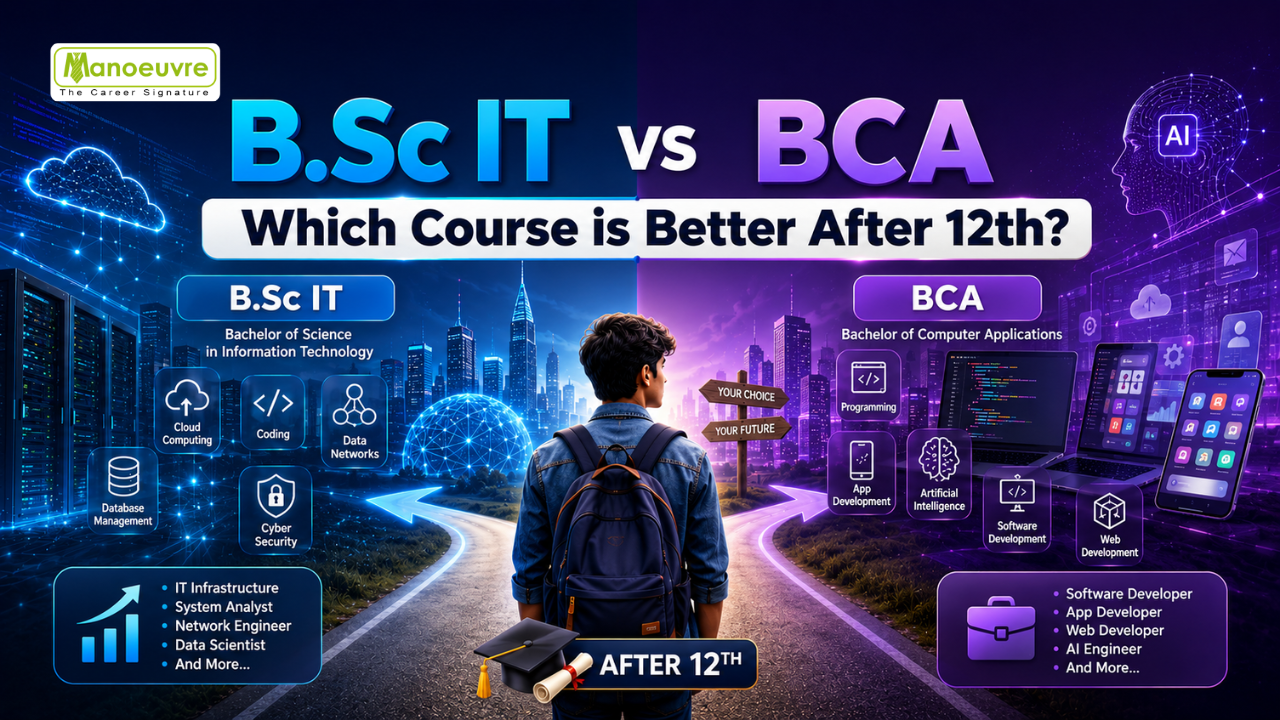
B.Sc IT vs BCA: Which Course is Better After 12th? Complete Career Guide If you've just finished Class 12 and you're eyeing a career in tech, there's a good chance you've run into this exact dilemma: BCA or B.Sc IT? It's one of the most common questions students ask, and honestly, it's a fair one. India's IT sector isn't slowing down anytime soon, and with fields like AI, cybersecurity, cloud computing, and data science expanding every year, picking the "right" starting point can feel like a high-stakes decision.Here's the thing, though — both courses are solid. They just take you down different paths. This guide breaks down what each course actually involves, how they differ in terms of subjects and skills, what kind of jobs you can expect afterward, and how to figure out which one fits you better. First, What Exactly Is BCA? BCA, or Bachelor of Computer Applications, is a three-year degree built around software development and programming. Think coding-heavy coursework — you'll be writing programs, building applications, working with databases, and getting hands-on with web and mobile development throughout the course.It's a great fit if you genuinely enjoy sitting down and solving problems through code, or if the idea of building an app or website from scratch sounds exciting rather than intimidating.Typical career paths after BCA include roles like software developer, web developer, mobile app developer, and IT consultant — basically, jobs where you're actively creating software. And What About B.Sc IT? B.Sc IT (Bachelor of Science in Information Technology) is also a three-year program, but the focus shifts. Instead of centering everything on writing software, this course dives into how technology infrastructure actually functions — networking, databases, cybersecurity, cloud systems, and the broader mechanics of how organizations keep their systems running and secure.If you're more curious about how networks talk to each other, how systems stay protected from threats, or how cloud infrastructure is managed, this course tends to align better with those interests than pure software development does. Quick Side-by-Side Comparison AspectBCAB.Sc ITFull NameBachelor of Computer ApplicationsBachelor of Science in Information TechnologyDuration3 years3 yearsCore FocusProgramming & software developmentIT systems & infrastructureTeaching StyleHands-on, project-drivenTheory-heavy with applied componentsAmount of CodingHighModerateMath InvolvementModerateOften higher prioritySuits Students Who...Want to build softwareWant to work with networks, systems, security Getting In: Eligibility Every institute sets its own bar, but broadly speaking:For BCA, you'll need to have cleared 10+2 from a recognized board, meet whatever minimum marks the college sets, and in some cases have studied Math or Computer Science in school. A number of universities also run entrance exams for admission.For B.Sc IT, the base requirement is the same — Class 12 completion — but Math tends to matter more here, with several institutions making it a preferred or even mandatory subject. Some colleges go purely by merit, others by entrance test scores.Bottom line: always double-check the specific admission rules for the colleges you're targeting, since they can vary quite a bit. What You'll Actually Study BCA coursework typically covers programming languages like C, C++, Java, and Python, along with data structures, database management, software engineering principles, operating systems, web and mobile app development, computer networks, and a basic introduction to AI. Essentially, you're constantly building and coding throughout the degree.B.Sc IT coursework leans into information systems, computer networks, database administration, cybersecurity, cloud computing, network security, Linux administration, operating systems, and data analytics. You come out with a much deeper understanding of how enterprise-level IT systems actually operate. So, Which One Involves More Coding? If your end goal is to become a developer, this question probably matters most to you. Generally speaking, BCA wins here — it's structured around continuous programming practice, with students regularly building websites, desktop tools, and mobile apps as part of the coursework.B.Sc IT still includes programming, but it's not the centerpiece. The emphasis shifts toward networking, database systems, and infrastructure-related subjects instead. So if writing code is what excites you most, BCA is likely the stronger match. Skills You'll Walk Away With From BCA, expect to build skills in programming, software development, problem-solving, application design, database handling, web development, mobile app creation, and software testing.From B.Sc IT, you'll pick up skills around network administration, cybersecurity, cloud computing, database management, system administration, IT support, infrastructure management, and information security.Both are technical, in-demand skill sets — they just point in different directions. Where Each Degree Can Take You Career-Wise BCA graduates often land roles such as software developer, web developer, mobile app developer, full stack developer, software tester, technical support engineer, database programmer, or UI developer — all centered around designing and maintaining software.B.Sc IT graduates tend to move into positions like network engineer, system administrator, database administrator, cybersecurity analyst, cloud support engineer, IT infrastructure engineer, system analyst, or technical support specialist — roles focused on keeping enterprise systems running smoothly and securely. What About Salary? Here's something worth knowing upfront: pay isn't really determined by which degree you hold. It comes down to your skills, certifications, internship experience, and the company you join.Career StageBCAB.Sc ITFresher₹3.5–6 LPA₹3.5–6 LPA3–5 Years Experience₹6–10 LPA₹6–10 LPAExperienced Professional₹12 LPA+₹12 LPA+As you can see, the ranges are nearly identical — so don't pick your course based on expected salary alone. Planning to Study Further? After BCA, popular next steps include an MCA, MBA, M.Sc in Computer Science, a PG diploma in Data Science, or specialized AI programs. MCA in particular is a common choice for students who want to go deeper into software development.After B.Sc IT, students often pursue an M.Sc in Information Technology, MCA, M.Sc in Cyber Security, an MBA, or certification-based tracks in cloud computing and data analytics — all useful for carving out a specialization in a growing tech niche. Boosting Your Job Prospects While Still in College Just having the degree on paper isn't enough anymore — recruiters want to see real, applied experience too.If you're in BCA, try to:● Build your own software projects on the side● Maintain an active GitHub with real code● Learn current frameworks that employers actually use● Take part in coding contests● Do internships whenever possible● Keep practicing data structures and algorithmsIf you're in B.Sc IT, consider:● Getting certified in CCNA, CompTIA, AWS, or Microsoft Azure● Getting real hands-on time with networking setups● Learning Linux administration properly● Trying out cybersecurity labs and simulations● Interning in IT support or infrastructure teams● Building practical cloud computing skillsThese extras can make a noticeable difference when you're job hunting later. How to Actually Decide Don't just go with whatever's trending — go with what genuinely interests you.Lean toward BCA if you:● Genuinely enjoy programming● Picture yourself as a software developer● Like the idea of building apps and websites● Learn best through hands-on projects● Want to eventually work at a software product companyLean toward B.Sc IT if you:● Find the "how systems work" side of tech more interesting● Are drawn to networking and cybersecurity● Want exposure to cloud technologies● Enjoy the idea of managing IT infrastructure● Prefer system administration over writing code all dayNeither course is objectively "better" — it really comes down to what kind of work you can see yourself doing long-term. Wrapping UpBoth BCA and B.Sc IT open solid doors into India's tech industry, just via different routes. BCA suits people who want to code and build software; B.Sc IT suits people drawn to networks, infrastructure, cloud systems, and security.Whichever path you take, the degree itself is only part of the story — internships, certifications, and hands-on project work are what really shape your career outcomes. Pick the course that matches your natural curiosity, and put in the consistent effort to build real skills alongside it. Frequently Asked Questions1. Which is better after 12th — B.Sc IT or BCA? It really depends on where you see yourself. Go with BCA for software development, or B.Sc IT if networking, cybersecurity, and infrastructure appeal to you more.2. Does BCA involve more coding than B.Sc IT? Yes, generally. BCA is more programming-intensive and software-focused overall.3. Which course pays better? Starting salaries are quite similar for both. What really moves the needle is your skill set, internships, certifications, and the company you end up joining.4. Can someone with a B.Sc IT degree do an MCA later? Yes, most universities allow this, as long as you meet their specific eligibility requirements.5. Is Math compulsory for these courses? It varies by institution, but many colleges do prefer or require Math — particularly for B.Sc IT.6. Which course is better suited for a cybersecurity career? B.Sc IT tends to give you a stronger foundation in networking and systems security, making it a more natural fit for cybersecurity roles.7. Can a B.Sc IT graduate become a software developer? Absolutely — with solid coding practice, personal projects, and internships, B.Sc IT graduates can transition into development roles just fine.8. Which course has better long-term career scope? Both hold strong potential given the ongoing demand in software, cloud, AI, cybersecurity, and digital transformation. Your outcomes will depend more on continuous skill-building than on which of the two you choose.

13 Jul 2026
0 comments
Top 10 BCA Colleges in Maharashtra through MAH BCACET Are you planning to pursue a Bachelor of Computer Applications (BCA) and searching for the right college in Maharashtra? With technology becoming a major part of almost every industry, BCA has emerged as a popular undergraduate option for students interested in computers, software, programming, and IT careers.But choosing a college is often more confusing than choosing the course itself.Should you select a college in Mumbai or Pune? Is a high cut-off college always better? How does your admission category affect your chances? And most importantly, which colleges should you include in your preference list?Several colleges across Maharashtra provide undergraduate programs in computer applications and technology-related fields. However, admission competition can vary significantly from one college to another and even across different categories within the same institute.To make your research easier, this comprehensive guide covers the top 10 BCA colleges in Maharashtra, along with category-wise cut-off data and useful insights to help you make a better college decision. Why Choose BCA as a Career Option? Before exploring the college list, it is important to understand why students are increasingly considering BCA after Class 12.BCA is generally suitable for students who are interested in computers and want to build their knowledge of programming, software applications, databases, web technologies, and information systems.The technology sector is no longer limited to traditional software companies. Banks, educational institutions, healthcare organisations, e-commerce businesses, consulting firms, and even government departments depend on technology professionals.After completing BCA, students may explore career opportunities in software development, web development, technical support, database management, data analytics, testing, and other IT-related fields.Some graduates also choose higher education programmes such as MCA or other technology and management courses to further develop their skills.However, your college experience can play an important role in developing academic knowledge and practical exposure. This is why researching colleges before admission is worth the effort. Quick Overview of Top 10 BCA Colleges in Maharashtra Here are the colleges covered in this guide:RankCollege NameLocation1B K Birla CollegeMaharashtra2Rajarshi Shahu CollegeTathawade, Pune3Thakur College of Engineering & TechnologyKandivali, Mumbai4Abasaheb Garware CollegePune5Pillai College of ArtsNavi Mumbai6Guru Nanak Khalsa CollegeMatunga, Mumbai7Modern CollegeShivajinagar, Pune8B K Shroff CollegeMumbai9Vidya Bharati MahavidyalayaAmravati10DTSS College of CommerceMalad, MumbaiNow, let's explore each college and understand its category-wise admission competition. 1. B K Birla College B K Birla College is a multi-faculty educational institution focused on modern education and academic development. For students comparing colleges through previous admission scores, the institute stands out because of its high cut-offs across several categories.B K Birla College Category-Wise Cut OffCategoryCut OffGOPEN95.80%LOPENS97.06%GSC89.96%LSC93.90%GST74.37%LST89.96%GOBCS86.37%LOBC63.40%EWS81.92%TFWS93.90%The General Open score stands at 95.80%, while the LOPENS category reaches 97.06%. These figures indicate a high level of admission competition.Students considering B K Birla College should compare their scores with the exact category applicable to them rather than relying only on the open-category figure. 2. Rajarshi Shahu College Rajarshi Shahu College, situated in Tathawade, Pune, offers an academic setting with a strong emphasis on technology-based learning. Pune itself is a preferred educational destination for many students, particularly those interested in technical and professional programmes.Rajarshi Shahu College Category-Wise Cut OffCategoryCut OffGOPEN93.36%LOPENS93.08%GSC86.37%LSC87.49%GOBCS83.64%LOBC89.73%EWS56.49%TFWS96.40%One of the most noticeable figures is the TFWS cut-off of 96.40%. It is higher than the GOPEN score of 93.36%.This shows that students should not assume that every special seat category will have lower competition. Seat availability and demand can significantly influence the closing score. 3. Thakur College of Engineering & Technology Thakur College of Engineering & Technology, commonly known as TCET, is located in Kandivali, Mumbai. The institute provides a technology-oriented academic environment, making it an option for students interested in computer and technical education.Thakur College Category-Wise Cut OffCategoryCut OffGOPEN92.70%LOPENS94.84%TFWS94.43%MI42.91%The LOPENS category records 94.84%, while TFWS stands at 94.43%. The General Open score is 92.70%.For Mumbai-based students, college location may also be an important consideration. Daily travel time, connectivity, and academic schedules should be evaluated along with admission scores. 4. Abasaheb Garware College Abasaheb Garware College is an established educational institution in Pune. The college is known for its academic environment and laboratory infrastructure.Students from different admission categories can compare multiple cut-off figures available for the institute.Abasaheb Garware College Category-Wise Cut OffCategoryCut OffGOPEN91.92%LOPENS92.86%GSC84.93%LSC85.49%GST79.17%LST59.06%GOBCS82.21%LOBC85.02%The General Open score is 91.92%, while the Ladies Open State category stands at 92.86%.A clear variation can be seen across categories. Therefore, students should always check category-specific admission data before deciding whether a college is within their expected score range. 5. Pillai College of Arts Students searching for colleges in Navi Mumbai may consider Pillai College. The institution has a multidisciplinary academic environment covering commerce, liberal arts, science, and other educational areas.Pillai College Category-Wise Cut OffCategoryCut OffGOPEN91.28%LOPENS93.16%TFWS94.43%MI51.83%The General Open cut-off is 91.28%, whereas the TFWS score reaches 94.43%.For students living in Navi Mumbai, choosing a suitable college closer to home may also help reduce daily travel time. However, academic facilities and overall course suitability should remain important parts of the decision. 6. Guru Nanak Khalsa College Guru Nanak Khalsa College is an established institution in Matunga, Mumbai. Its long academic presence makes it a recognised name among students researching higher education options in the city.Guru Nanak Khalsa College Category-Wise Cut OffCategoryCut OffGOPEN91.28%LOPENS91.04%TFWS92.18%MI65.09%The General Open and Ladies Open State scores are quite close at 91.28% and 91.04%, respectively. TFWS records a slightly higher figure of 92.18%.Students considering Mumbai colleges should compare not just cut-offs but also location, travel convenience, and the academic environment. 7. Modern College Pune Located in Shivajinagar, Modern College is another Pune-based institution included in the list. The available admission data covers several categories, making it easier for students to compare relevant cut-off trends.Modern College Pune Category-Wise Cut OffCategoryCut OffGOPEN91.04%LOPENS92.18%GSC81.84%LSC83.64%GST24.71%GOBCS79.17%GVJS65.60%GSEBC74.37%The GOPEN cut-off is 91.04%, while LOPENS stands at 92.18%.The variation across categories is an important reminder that a single general cut-off cannot represent admission chances for every student. 8. B K Shroff College B K Shroff College is located in Mumbai's western suburbs and focuses on commerce and professional education.For students living in western Mumbai, location can be one of the practical factors influencing their college preference.B K Shroff College Category-Wise Cut OffCategoryCut OffGOPEN86.37%LOPENS88.39%TFWS83.64%MI39.87%The General Open cut-off stands at 86.37%, while LOPENS records 88.39%.Compared with some colleges at the beginning of this list, the open-category score is lower. This may help students build a more balanced college preference list based on their expected admission range. 9. Vidya Bharati MahavidyalayaWhile Mumbai and Pune receive considerable attention from students, Maharashtra has educational institutions in several other regions as well.Vidya Bharati Mahavidyalaya is associated with higher education and research in the Amravati region.Vidya Bharati Mahavidyalaya Category-Wise Cut OffCategoryCut OffGOPEN84.93%LOPENH88.70%TFWS92.86%MI24.71%The General Open score is 84.93%, whereas TFWS reaches 92.86%.Students from Amravati and nearby areas may compare the college with other institutions based on location, academic preferences, and admission category. 10. DTSS College of Commerce DTSS College of Commerce is situated in Malad, Mumbai. The institution focuses on commerce and professional education and is another option for students exploring colleges in Mumbai.DTSS College Category-Wise Cut OffCategoryCut OffGOPEN83.78%LOPENS80.04%TFWS80.04%MI74.37%The GOPEN score stands at 83.78%. Both the LOPENS and TFWS categories record a cut-off of 80.04%.Students with scores below the 90% range should avoid limiting their college search. Comparing multiple institutions can help create a more practical preference list. Comparison of Top BCA Colleges in Maharashtra Here is a quick comparison based on the available General Open cut-off data.College NameGOPEN Cut OffB K Birla College95.80%Rajarshi Shahu College93.36%Thakur College of Engineering & Technology92.70%Abasaheb Garware College91.92%Pillai College of Arts91.28%Guru Nanak Khalsa College91.28%Modern College Pune91.04%B K Shroff College86.37%Vidya Bharati Mahavidyalaya84.93%DTSS College of Commerce83.78%B K Birla College records the highest GOPEN score among the colleges compared, followed by Rajarshi Shahu College and Thakur College.However, a high cut-off should not be treated as the only indicator of the right college. How to Choose the Best BCA College in Maharashtra?Every student has different academic goals and practical requirements. A college suitable for one student may not necessarily be the right option for another.Before finalising your BCA college, consider the following factors:● Course curriculum: Check the subjects, programming languages, and technology-related topics covered in the programme.● Computer labs: Practical learning is important for computer applications, so laboratory infrastructure should be considered.● Internship exposure: Industry experience can help students understand how technical skills are applied in professional environments.● Placement opportunities: Review the type of companies and job roles associated with the college.● Location: Daily travel can have a major impact on your college routine.● Fees: Compare tuition and other educational expenses with your budget.● Higher education plans: Students planning to pursue MCA or another postgraduate programme should consider their long-term academic goals.Cut-off data can help shortlist colleges, but the final decision should consider the overall learning environment. How Should You Prepare Your BCA College Preference List?One common mistake students make is arranging colleges only according to popularity.Instead, divide your options into three groups: ambitious, competitive, and safer choices.Ambitious choices are colleges where previous cut-offs are slightly above your score. Admission may be challenging, but such institutes can still be included higher in your preference list.Competitive choices are colleges where your score is close to previous admission trends. These institutes should form an important part of your selection strategy.Safer choices generally have previous cut-offs below your score. Including suitable alternatives can help create a balanced list.Remember that category-wise scores can vary significantly. Always compare the figure relevant to your category. Why Do College Cut Offs Change?Previous cut-offs are useful, but they do not guarantee admission in the next academic year.College closing scores may change due to the number of applicants, total available seats, category-wise seat distribution, student preferences, and vacancies during different admission rounds.For example, if a particular college receives significantly more first-preference applications, its cut-off may increase. Similarly, available seats in later rounds can affect closing scores.Therefore, students should use previous figures to understand competition rather than treating them as fixed admission marks. Is BCA the Right Course for You?BCA can be a suitable option if you are genuinely interested in computers and willing to continuously learn new technologies.Programming and IT fields evolve quickly. Simply completing a degree may not be enough. Students should focus on building practical skills, working on projects, improving problem-solving abilities, and understanding new technologies.If you enjoy learning about software, websites, applications, databases, or computer systems, BCA may provide a foundation for further study and technology-focused career paths. Final ThoughtsChoosing from the top BCA colleges in Maharashtra requires more than checking which institute has the highest cut-off.B K Birla College records strong competition in the available General Open data, while Rajarshi Shahu College, Thakur College, Abasaheb Garware College, Pillai College, Guru Nanak Khalsa College, and Modern College also show competitive admission figures.Students should carefully compare their category, expected score, preferred location, academic facilities, and future career plans before finalising a college.Most importantly, do not prepare your preference list based only on what your friends are choosing. Research each college, understand your priorities, and make a decision that supports your academic and career goals.Note: The category-wise cut-off figures mentioned in this article are based on the provided college data. Admission scores may change depending on the year, category, seat availability, and admission round. Students should check the latest official admission information before making a final decision. Frequently Asked Questions (FAQs) 1. Which are the top BCA colleges in Maharashtra?Top BCA colleges include B K Birla College, Thakur College, Pillai College, Modern College Pune, and Guru Nanak Khalsa College.2. Which BCA college has the highest cut-off in Maharashtra?B K Birla College has the highest GOPEN cut-off of 95.80% based on the available data.3. What is the eligibility for BCA admission in Maharashtra?Students generally need to pass Class 12 from a recognised board and meet the college's BCA admission criteria.4. Is BCA a good course after 12th?Yes, BCA is a popular course for students interested in computers, programming, software, and IT careers.5. How to choose the best BCA college in Maharashtra?Compare BCA cut-offs, placements, fees, curriculum, college location, and internship opportunities.6. Do BCA college cut-offs change every year?Yes, BCA cut-offs may change based on applicants, available seats, category, and admission rounds.7. Can I get BCA admission with less than 90% in Maharashtra?Yes, several BCA colleges in Maharashtra have cut-offs below 90%, depending on the category and seat availability.
Featured Blogs
 MBA Entrance
 LAW 5years Entrance
 LAW 3years Entrance
 MCA Entrance
 CUET PG Entrance
 BBA Entrance
 BCA Entrance
 Hotel-Management
 B.ED Entrance