

24 Jul 2026
0 comments
MBA CET CAP Round 2026 Choice Filling and College Preference The Centralized Admission Process (CAP) for MAH MBA CET 2026 CAP Round 1 is the first seat allotment round for MBA and MMS admissions in Maharashtra, managed by the CET Cell. Candidates log in to the CAP portal, select and rank their preferred college-programme combinations, and seats are allotted based on merit, category, eligibility, seat availability and preference order.You can choose from both MBA and MMS programmes in the same option form.Before filling your preferences, consider:● MAH MBA CET percentile● Category and eligibility● Previous-year cutoff trends● College reputation and placements● Fees, ROI and location ● Your willingness to join the collegeKey Points:● Up to 300 MBA/MMS choices can be added.● Rank colleges in your true order of preference.● Once the window closes, the submitted preference list cannot be edited.● More genuine and acceptable choices can improve your chances of a favourable allotment. MBA CET 2026 CAP Round 1 Option Form Filling Dates MAH MBA CET CAP Round 1 Choice Filling starts on 28th July. EventsStart DateEnd DateOption/Choice Form Filling28-07-2026 30-07-2026 Provisional Seat Allotment02-08-2026 Seat Acceptance03-08-2026 05-08-2026 Admission Confirmation03-08-2026 05-08-2026 MBA CET CAP round 1-3-6 rule : Auto Freeze Rule Explained When filling out your preference form across rounds, keep the CAP Round new rules 1-3-6 Rule in mind to prevent getting locked into an unwanted college automatically:● CAP Round 1 (Rule of 1): If you get allotted your 1st preference, it automatically becomes Auto-Freeze. You cannot go for betterment in Round 2 and must secure the seat.● CAP Round 2 (Rule of 3): If you get allotted any of your top 3 preferences, the system auto-freezes the seat.● CAP Round 3 (Rule of 6): If you get allotted any of your top 6 preferences, it will auto-freeze.● CAP Round 4: There is no betterment option in Round 4. Any college allotted must be accepted. How to Fill the MBA CET CAP Round 1 Option Form? The general process for filling the CAP Option Form involves the following steps:Step 1: Log In to the Official CAP PortalVisit the official Maharashtra CET Cell portal and log in using your MAH MBA CET application credentials.Step 2: Open the CAP Round 1 Option FormNavigate to the relevant CAP section and select the option form for MBA/MMS admissions.Step 3: Browse Eligible Colleges and ProgrammesReview the available college-programme combinations and identify the options you are eligible for.Step 4: Add Your Preferred ChoicesAdd colleges and programmes that you are genuinely willing to join.Remember that MBA and MMS options can be considered together in the preference list, depending on the choices available to you.Step 5: Arrange Your PreferencesArrange all selected colleges in your actual order of preference.Your most preferred college should be placed first, followed by your second preference, third preference and so on.Step 6: Review the Complete ListBefore submitting, carefully check:● College name● Programme name● Preference order● Category eligibility● Fees● Location● Your willingness to accept the collegeStep 7: Submit and Save ConfirmationSubmit your final preference list before the deadline and save the confirmation details for future reference. Best MAH MBA CET CAP Choice Filling Strategy 2026 Check the points for choice filling strategy and how to give college preferences in MBA CET Cap Round 1 involves the following steps:Dream → Aspirational → Match → Safe → BackupThis approach helps you target your preferred colleges while ensuring you have realistic and safe admission options.1. Dream CollegesPlace the colleges you genuinely want to study at the top of your preference list, regardless of whether your percentile is slightly below the previous year's cutoff.Based on the previous CAP cutoff trends, dream colleges may include:● JBIMS – 99.94● SIMSREE – 99.76● Welingkar (WeSchool) – 99.58● St. Xavier's – 98.90● PUMBA – 98.97Example:If your percentile is 99.40, JBIMS (99.94) and SIMSREE (99.76) may still be your dream choices. Place them at the top because CAP cutoffs can vary every year depending on seat availability and merit movement.2. Aspirational CollegesThese are colleges where your percentile is close to the previous year's closing cutoff. Your chances depend on factors like category, CAP rounds, vacancies, and overall competition.Example 1 (98.70 percentile):Your aspirational colleges could be:● PUMBA – 98.97● St. Xavier's – 98.90● SIES College of Management Studies – 98.95Your percentile is close enough that admission may be possible if the cutoff changes slightly. 3. Match CollegesMatch colleges are those where your percentile is reasonably competitive based on previous-year trends.Example (95.50 percentile):Suitable match colleges could include:● Rizvi Institute – 94.92● Alkesh Dinesh Mody Institute – 95.49● VESIM – 95.90 (slightly ambitious but close)Similarly, a candidate with 98 percentile can consider colleges such as:● Indira College of Engineering & Management – 97.91● COEP Technological University – 99.05 (slightly aspirational)● Chetana's Institute – 98.51● MET Institute of Management – 98.34 4. Safe CollegesSafe colleges are those where your percentile is comfortably above the previous year's cutoff and where you would genuinely be happy to take admission.Example (95.50 percentile):Safe options may include:● Thakur Institute – 95.09● St. Francis Institute of Management & Research – 94.33● Fr. C. Rodrigues Institute – 93.13● Indira Global School Of Business – 95.42Since your percentile is higher than these previous closing cutoffs, your chances of admission are comparatively stronger. 5. Backup OptionsBackup colleges should be institutions you are willing to join if higher preferences are unavailable. Do not add colleges simply to increase the number of choices. Top MBA Colleges Cut Off Category Wise Through MAH MBA CET 2026 Checkout the mah mba cet 2026 cut off based on 2025 CAP data, subject to change.Colleges ProgrammeCityOpenSCSTOBCJBIMSMMSMumbai99.9499.5197.3399.81SIMSREEMMSMumbai99.7698.8596.0899.62WeSchoolMMSMumbai99.5898.4193.9399.30St. Xavier's Mumbai98.90---S.I.E.S. College of Mgt StudiesMMSNavi Mumbai98.95---PUMBAMBAPune98.9797.5191.5198.55COEP Technological UniversityMBAPune99.0597.8692.1398.52Chetana InstituteMBAMumbai98.5196.8987.8597.68MET's Institute of Mgt.MMSMumbai98.3496.1379.3097.17Indira College of Eng. & Mgt.MBAPune97.9196.2188.8897.55 Category-Wise CAP Preference Strategy Category can influence the college options available to candidates.● OBC CandidatesOBC closing percentiles are typically 3–8 points lower than Open. Include the same top colleges in your preferences to improve your chances. .● SC and ST CandidatesCheck category-specific closing trends and include your preferred colleges where you are eligible. Reserved-category closing trends can differ significantly from Open-category trends.● EWS CandidatesEWS seats are available at many government-aided colleges. Closing percentiles are generally lower than Open, but candidates must have a valid EWS income and asset certificate issued by the competent authority. .● Maharashtra Domicile and All India CandidatesMaharashtra domicile candidates are eligible for State Quota seats, while non-domicile candidates compete for All India seats with higher closing percentiles. If you have Maharashtra domicile, upload your valid domicile certificate on the CAP portal before filling your preferences. . Common Mistakes to Avoid ● Filling Too Few ChoicesIf you are willing to consider more colleges, create a broader preference list.● Ranking Only by CutoffA lower cutoff does not automatically mean a college is better. Consider placements, fees and ROI.● Putting a Safe College Above Your Dream CollegeAlways rank your genuine preference first.● Ignoring Fees and ROICompare the total investment with expected career outcomes.● Ignoring LocationConsider accommodation, travel and living expenses before selecting a college.● Making Category or Document ErrorsVerify your category, eligibility and supporting documents carefully.● Not Reviewing Your Preference OrderReview the entire list before submission. The preference order matters because the system considers the highest preference for which you qualify. MAH MBA CET 2026 CAP Round 1 Option Form Final Checklist Before submitting your option form, make sure you:✅ Check your MAH MBA CET 2026 percentile and category.✅ Review previous-year closing percentile trends.✅ Place your dream colleges at the top.✅ Add aspirational colleges.✅ Add realistic match colleges.✅ Include sufficient safe options.✅ Rank colleges according to genuine preference.✅ Check MBA vs MMS programme preference.✅ Compare fees and ROI.✅ Consider location and accommodation costs.✅ Check category-wise eligibility.✅ Verify all college-programme combinations.✅ Review the complete preference list.✅ Submit before the deadline.

24 Jul 2026
0 comments
MAH BBA CET Classes in Borivali The demand for Bachelor of Business Administration (BBA) courses has grown significantly in recent years, making entrance exams like the MAH BBA CET increasingly competitive. Students aiming to secure admission to reputed BBA colleges often begin their preparation months in advance to build strong concepts and improve their problem-solving skills.If you are searching for MAH BBA CET Classes in Borivali, you will find several coaching options that offer structured preparation, regular practice sessions, and expert guidance. However, choosing the right classes is important because the quality of coaching can have a direct impact on your preparation and confidence.This guide explains why students join coaching classes, what features to look for, and how to make the most of your preparation. What is the MAH BBA CET? The Maharashtra Bachelor of Business Administration Common Entrance Test (MAH BBA CET) is a state-level entrance examination conducted for admission to undergraduate management programmes offered by participating colleges across Maharashtra.The examination evaluates students on different aptitude-based subjects rather than only academic knowledge. Candidates are expected to demonstrate analytical thinking, logical reasoning, language skills, and general awareness while solving questions within a limited time.Since competition continues to increase every year, systematic preparation becomes essential for achieving a good score. Why Join MAH BBA CET Classes in Borivali? Many students initially prepare on their own but later realise that competitive exams require more than textbook knowledge. Coaching classes provide a structured study plan that keeps students focused and consistent throughout their preparation.Borivali has become one of Mumbai's preferred education hubs because it is well connected through road and rail transport. Students from Kandivali, Dahisar, Malad, Goregaon, Mira Road, and nearby areas often choose coaching institutes in Borivali due to their accessibility and availability of experienced faculty.Joining classroom coaching can help students:● Learn concepts in a systematic manner● Practice exam-level questions regularly● Improve speed and accuracy● Stay motivated through scheduled classes● Receive guidance whenever doubts arise● Develop effective exam strategies What Should Good MAH BBA CET Classes Offer? Every coaching institute has its own teaching style and training methodology. Before enrolling, students should evaluate the overall learning experience instead of focusing only on advertisements or fees.Some important features include:Experienced FacultyTeachers should simplify difficult concepts and explain different approaches to solving aptitude questions. Experienced mentors can also share useful strategies that save valuable time during the examination.Updated Study MaterialQuality coaching institutes provide comprehensive study material covering all important topics according to the latest examination pattern.Study material should include:● Concept notes● Practice questions● Topic-wise exercises● Previous years' questions● Revision worksheets Regular Mock TestsMock tests are one of the most important parts of preparation.They help students:● Understand the actual exam pattern● Improve time management● Build confidence● Identify weak areas● Reduce examination anxietyPerformance analysis after every test enables students to work on specific sections that require improvement. Doubt-Solving SessionsEvery student learns differently. Dedicated doubt-solving sessions ensure that concepts are completely understood before moving on to advanced topics.Regular interaction with faculty also helps students remain confident throughout their preparation journey. Subjects Covered in MAH BBA CET Classes A well-designed coaching programme generally covers every section of the examination with equal importance.Quantitative AptitudeThis section focuses on numerical ability and problem-solving skills.Common topics include:● Percentages● Ratio and Proportion● Profit and Loss● Time and Work● Time, Speed and Distance● Number System● Simple and Compound Interest● Data Interpretation Logical ReasoningReasoning questions assess analytical and decision-making abilities.Topics generally include:● Seating Arrangement● Coding-Decoding● Blood Relations● Direction Sense● Syllogisms● Puzzles● Series● Statement-Based Questions English LanguageThis section measures language proficiency and comprehension.Students usually prepare:● Grammar● Vocabulary● Reading Comprehension● Sentence Rearrangement● Error Detection● Synonyms and Antonyms General AwarenessCandidates should stay updated with important national and international events along with basic static General Knowledge relevant to competitive examinations. How to Choose the Right MAH BBA CET Classes in Borivali Selecting the right coaching institute requires careful research. Instead of choosing the nearest option, students should compare multiple factors before making a decision.Consider the following:● Faculty experience● Batch size● Previous student feedback● Quality of study material● Number of mock tests conducted● Doubt-solving support● Classroom environment● Accessibility from your locationParticipating in a demo session allows students to evaluate the teaching style before taking admission. Self-Study Along with Coaching Coaching classes provide direction, but consistent self-study plays an equally important role in success.Students should:● Revise classroom notes daily.● Solve practice questions regularly.● Attempt sectional tests every week.● Analyse mistakes after mock tests.● Improve weak topics before moving ahead.● Read newspapers to strengthen current affairs.A balanced combination of classroom learning and independent practice usually delivers the best results. Career Opportunities After MAH BBA CET Clearing the MAH BBA CET opens the door to undergraduate management programmes offered by various colleges in Maharashtra.A BBA degree can lead to career opportunities in fields such as: ● Marketing● Finance● Human Resources● Business Analytics● Banking● Sales● Operations● EntrepreneurshipMany graduates also pursue higher education such as MBA, PGDM, or specialised management programmes to expand their career opportunities. Why Borivali is a Preferred Location for BBA CET Preparation Borivali has become a popular destination for students preparing for competitive examinations due to its excellent connectivity and educational infrastructure.Students from different parts of Mumbai and nearby suburbs can easily commute to Borivali, making it a convenient choice for regular classroom learning. The availability of multiple coaching institutes also allows aspirants to compare teaching methods, batch timings, and facilities before making a decision. Conclusion Choosing the right MAH BBA CET Classes in Borivali is an important step towards effective preparation. A coaching institute should not only cover the syllabus but also help students build confidence, improve time management, and develop problem-solving skills through regular practice.If you are planning to begin your preparation, compare different coaching options based on faculty, study material, mock tests, and student support. Institutes like Manoeuvre Education also offer structured guidance, practice sessions, and mentorship for students preparing for management entrance examinations, helping them prepare with greater confidence.This combination of the right coaching, consistent self-study, and regular mock test practice can significantly improve your chances of performing well in the MAH BBA CET and securing admission to a reputed BBA college FAQs – MAH BBA CET Classes in Borivali 1. When should I join MAH BBA CET classes?It is best to start your preparation in Class 11 or early in Class 12 to build strong concepts and practice regularly.2. What subjects are covered in MAH BBA CET coaching?Most coaching classes cover Quantitative Aptitude, Logical Reasoning, English Language, General Awareness, and Computer Basics.3. Are mock tests important for MAH BBA CET preparation?Yes, mock tests improve your speed, accuracy, time management, and overall exam confidence.4. How do I choose the right MAH BBA CET classes in Borivali?Look for experienced faculty, updated study material, regular mock tests, doubt-solving support, and positive student reviews.5. Can I prepare for MAH BBA CET without coaching?Yes, but coaching provides structured guidance, expert mentorship, and regular practice that can make preparation more effective.6. Why choose Manoeuvre Education for MAH BBA CET coaching in Borivali?Manoeuvre Education offers expert faculty, structured study plans, regular mock tests, and personalized mentoring for exam preparation.7. Does Manoeuvre Education provide study material and mock tests?Yes, students receive comprehensive study material along with sectional tests and full-length mock exams.8. How can I enroll in MAH BBA CET classes at Manoeuvre Education?You can visit the Borivali centre or register through the official Manoeuvre Education website to join the latest batch.

23 Jul 2026
0 comments
Best CLAT Coaching in Borivali Preparing for the Common Law Admission Test (CLAT) is the first step towards securing admission to India's top National Law Universities (NLUs). Since the competition increases every year, students need a preparation strategy that combines conceptual learning, regular practice, and expert guidance. While self-study is important, joining a reputed coaching institute helps students prepare in a more structured and disciplined manner.If you are looking for CLAT Coaching in Borivali, Manoeuvre Education provides a comprehensive learning environment designed to help students excel in CLAT and other law entrance examinations. With experienced faculty, updated study material, regular mock tests, and personal mentoring, students receive complete support throughout their preparation journey. Why Choose CLAT Coaching in Borivali? Choosing a nearby coaching institute offers several advantages. Students can attend regular classroom sessions without spending excessive time travelling, remain consistent with their preparation, and easily participate in doubt-solving sessions, mock tests, and counselling.A quality CLAT coaching programme helps students:● Understand the latest CLAT exam pattern and syllabus● Build strong fundamentals in every subject● Improve reading speed and comprehension● Develop logical and analytical thinking● Learn effective time management techniques● Practice exam-level questions regularly● Track progress through detailed performance analysisA structured preparation plan ensures students remain focused throughout their CLAT journey. What Makes Manoeuvre Education the Best CLAT Coaching in Borivali? Selecting the right coaching institute is one of the most important decisions during CLAT preparation. At Manoeuvre Education, students receive much more than classroom teaching. The institute follows a student-centric approach that combines conceptual learning with continuous practice and individual mentoring.Some of the key highlights include:● Experienced and qualified faculty● Comprehensive study material● Regular classroom practice● Full-length CLAT mock tests● Section-wise performance analysis● Personal mentoring sessions● Doubt-solving support● Online and offline learning optionsThis complete preparation ecosystem enables students to stay confident throughout their exam preparation. CLAT Coaching Classes in Borivali with Experienced Faculty Faculty members play a significant role in competitive exam preparation. Experienced mentors help students understand concepts in a simple manner while teaching smart techniques to solve questions quickly and accurately.At Manoeuvre Education, faculty members guide students throughout the preparation process by:● Explaining difficult concepts with practical examples● Teaching shortcut methods wherever applicable● Providing personalised feedback● Helping students improve accuracy● Sharing effective examination strategiesStudents also receive motivation and career guidance whenever required. Comprehensive CLAT Study Material for Complete Preparation Good study material saves valuable preparation time.Instead of searching multiple books and online resources, students receive carefully prepared learning material covering every section of the examination.The study resources generally include:● Concept notes● Topic-wise practice questions● Sectional assignments● Previous year question discussions● Current affairs updates● Revision material● Practice workbooksThe content is updated according to the latest CLAT examination pattern, ensuring students prepare with relevant resources. CLAT Mock Tests and Performance Analysis Mock tests are one of the most effective tools for CLAT preparation.Regular mock examinations help students become familiar with the actual examination environment while improving speed, accuracy, and confidence.The benefits of mock tests include:● Better time management● Improved question selection● Higher accuracy● Reduced examination stress● Better understanding of strengths and weaknesses● Performance benchmarking against other aspirantsDetailed performance analysis after every mock test helps students identify topics that require additional attention. Personal Mentorship for CLAT Aspirants Every student learns differently.Some students require additional guidance in Legal Reasoning, while others may need support in Current Affairs or Quantitative Techniques.Personal mentoring helps students:● Create realistic study plans● Improve weak subjects● Maintain preparation consistency● Resolve doubts quickly● Stay motivated throughout preparationIndividual attention often makes a significant difference in competitive examinations. CLAT Preparation Strategy Followed at Manoeuvre Education A well-planned preparation strategy is essential for success in CLAT.Students are encouraged to follow a systematic approach that includes:Build Strong ConceptsThe preparation begins with strengthening the fundamentals of every subject before moving towards advanced practice.Practice Every DayDaily practice improves familiarity with different question types and increases confidence.Read Newspapers RegularlyReading newspapers improves English comprehension, vocabulary, and current affairs knowledge simultaneously.Revise FrequentlyRevision helps students retain concepts and minimise mistakes during the examination.Attempt Mock TestsRegular mock tests allow students to evaluate their preparation level and improve their examination strategy. Online and Offline CLAT Coaching in Borivali Every student has different learning preferences.To provide flexibility, Manoeuvre Education offers both classroom coaching and online learning support. Students can revise lectures, practice questions, and continue preparation even when they cannot attend physical classes.This hybrid learning model helps students maintain consistency throughout their preparation. Additional Support Beyond Classroom Learning Success in CLAT requires continuous practice beyond classroom sessions.Students are encouraged to:● Solve previous year question papers● Practice reading comprehension daily● Improve vocabulary● Stay updated with current affairs● Analyse mistakes after every mock test● Follow a disciplined study scheduleThese habits help students gradually improve their overall performance. Why Students Prefer Manoeuvre Education for CLAT Preparation? Students choose Manoeuvre Education because of its commitment to quality learning and personalised guidance.Some reasons include:● Experienced mentors● Interactive classroom sessions● Small batch sizes for better attention● Regular tests and assessments● Updated study material● Continuous doubt-solving● Career counselling support● Friendly learning environmentThe institute focuses not only on academic preparation but also on building confidence and examination temperament. Who Should Join Our CLAT Coaching Programme? The programme is suitable for:● Class 11 students starting early preparation● Class 12 students preparing alongside board examinations● Gap-year aspirants● Students aiming for National Law Universities● Candidates preparing for multiple law entrance examinationsEarly preparation gives students sufficient time to master every subject without unnecessary pressure. Conclusion Finding the right coaching institute can have a significant impact on your CLAT preparation journey. A structured curriculum, experienced faculty, regular mock tests, quality study material, and personal mentoring create a strong foundation for success.If you are searching for the Best CLAT Coaching in Borivali, Manoeuvre Education offers everything required to prepare confidently for CLAT. From concept building and practice sessions to performance analysis and expert guidance, students receive complete academic support at every stage of their preparation. With dedication, consistent effort, and the right mentorship, achieving your dream of studying at a top National Law University becomes an achievable goal. FAQ’s 1. Which is the Best CLAT Coaching in Borivali?Manoeuvre Education is one of the Best CLAT Coaching in Borivali, offering expert faculty, regular mock tests, quality study material, and personalised guidance.2. Why should I join CLAT Coaching in Borivali?Joining CLAT Coaching in Borivali helps you prepare with a structured study plan, expert mentoring, and regular practice, making your preparation more focused.3. When should I start preparing for CLAT?The ideal time to start is in Class 11 or early Class 12. Starting early gives you enough time to build concepts and practise consistently.4. Does Manoeuvre Education conduct CLAT mock tests?Yes. Students get regular sectional tests and full-length CLAT mock tests to improve speed, accuracy, and confidence.5. Is online CLAT coaching available?Yes. Manoeuvre Education offers both online and classroom coaching, so you can choose the learning mode that suits you best.6. What subjects are covered in the CLAT coaching programme?The course covers English, Legal Reasoning, Logical Reasoning, Current Affairs, and Quantitative Techniques as per the latest CLAT syllabus.7. Can Class 11 and 12 students join CLAT Coaching in Borivali?Yes. Students from both Class 11 and Class 12 can join and begin their CLAT preparation early.8. How do I enroll for CLAT Coaching in Borivali?Simply contact Manoeuvre Education, visit the centre, or fill out the enquiry form on the website to get started.
21 Jul 2026
0 comments
CLAT 2027 Exam Day Instructions: Complete Guidelines for a Hassle-Free Exam Preparing for the Common Law Admission Test (CLAT) 2027 is not just about mastering Legal Reasoning, English, Current Affairs, Logical Reasoning, and Quantitative Techniques. Your performance on the examination day also depends on how well you follow the official instructions issued by the Consortium of National Law Universities (NLUs).Many deserving candidates experience unnecessary stress because they arrive late, forget essential documents, carry prohibited items, or are unaware of the examination centre rules. Such avoidable mistakes can affect your confidence even before the exam begins.This detailed guide covers everything you need to know about the CLAT Exam Day Guidelines, including reporting time, entry procedures, security checks, dress code, accepted identity proofs, Documents to Carry on CLAT Exam Day, permitted and prohibited items, examination hall rules, and important do's and don'ts. Following these instructions will help you stay relaxed, complete all formalities smoothly, and focus entirely on your exam. CLAT 2027 Exam Day Highlights ParticularDetailsExam NameCommon Law Admission Test (CLAT) 2027Conducting BodyConsortium of National Law UniversitiesExam ModeOffline (Pen and Paper Based Test)Duration2 HoursEntry to Exam HallAs per reporting time mentioned on Admit CardMandatory DocumentsAdmit Card and Valid Photo IDElectronic GadgetsStrictly ProhibitedNegative Marking0.25 Marks for Every Incorrect AnswerOfficial Websiteconsortiumofnlus.ac.in Note: Candidates should always refer to the latest official notification and admit card instructions issued by the Consortium before the examination. Why Should You Follow CLAT Exam Day Instructions? The Consortium issues detailed exam day guidelines to ensure that every candidate gets a fair and transparent examination environment. Ignoring these rules can lead to unnecessary delays, denial of entry, cancellation of candidature, or disciplinary action.Following the instructions helps you:● Complete verification without hassle.● Avoid last-minute panic.● Reach your allotted examination room comfortably.● Prevent disqualification due to prohibited items.● Stay calm and focused throughout the examination.Simple preparation before leaving home can save you from unnecessary stress on the examination day. Reporting Time for CLAT 2027 One of the key CLAT exam-day guidelines is to arrive at your assigned examination centre before the reporting time mentioned on your admit card. Candidates should ideally reach the examination centre 60 to 90 minutes before the reporting time. This gives enough time for document verification, frisking, biometric attendance (if applicable), and locating the allotted examination room.Avoid planning your journey based only on map applications. Unexpected traffic, adverse weather, or unfamiliar roads can cause delays in reaching the exam centre. Why Reporting Early Is ImportantReporting early allows you to:● Complete security formalities comfortably.● Avoid long queues.● Find your allotted classroom without rushing.● Relax before the examination begins.Candidates reaching after the gate closes are generally not allowed to enter the examination centre. Important Things to Do Before Leaving Home Preparing one day before the examination is equally important.Use the following checklist:✔ Download the latest admit card.✔ Print two or three copies.✔ Keep your original photo ID ready.✔ Arrange transparent pens if permitted.✔ Keep passport-size photographs ready.✔ Check the examination centre location.✔ Plan your travel route.✔ Sleep early.✔ Keep comfortable clothes ready.✔ Set multiple alarms.A little planning can help you start the examination day with confidence. Documents to Carry on CLAT Exam Day Applicants should bring all the essential documents specified on their official admit card. Failure to produce any required document may result in denial of entry.Below are the important documents you should carry.1. CLAT 2027 Admit CardEntry to the examination centre is permitted only with a valid admit card. Before printing, verify:● Your name● Roll number● Photograph● Signature● Examination centre● Reporting time● Exam dateIf you notice any discrepancy, contact the Consortium immediately.It is advisable to carry two or three printed copies as a backup. 2. Valid Government Photo Identity ProofEvery candidate must carry one original government-issued identity proof. Accepted identity proofs generally include:Accepted Photo ID ProofsAadhaar CardPassportPAN CardDriving LicenceVoter IDGovernment-issued Photo Identity CardThe information on the photo ID must exactly correspond with the details mentioned on the admit card. Photocopies or scanned copies are generally not accepted unless specifically mentioned. 3. Passport Size PhotographsSome examination centres may ask candidates to carry additional passport-size photographs for verification purposes.Carry at least two recent colour photographs. 4. PwD Certificate (If Applicable)Candidates applying under the PwD category should carry:● Disability Certificate● Scribe Approval Letter (if applicable)● Any other supporting document mentioned by the Consortium 5. Other DocumentsIf the Consortium releases any additional instructions before the examination, candidates should carry those documents as well.Always read the latest notification carefully. ID Proofs in CLAT 2027 Exam Day Identity verification is one of the first steps after reaching the examination centre.Candidates should ensure that:● The ID proof is original.● The photograph is clearly visible.● The document is valid.● The name matches the admit card.● There are no damaged portions hiding important details.If your name has changed due to legal reasons, carry supporting documents wherever applicable. CLAT Exam Prohibited and Permitted Items The Consortium follows strict security procedures. Carrying prohibited items may lead to disciplinary action.Permitted ItemsProhibited ItemsAdmit CardMobile PhonesOriginal Photo IDSmart WatchesTransparent PenBluetooth DevicesPassport-size PhotographEarphonesTransparent Water BottleCalculatorsApproved Medical ItemsBooks & NotesPwD DocumentsWallets Bags Laptops Tablets Cameras USB Drives Electronic Gadgets Rough SheetsElectronic devices are generally not allowed inside the examination hall, even if they are switched off If you accidentally carry such items, you may have to deposit them outside the examination centre at your own risk. Dress Code in CLAT Exam Although CLAT does not usually prescribe a strict dress code like some national entrance examinations, candidates should wear simple and comfortable clothing to facilitate smooth security checks.Recommended Dress for Boys● Plain Shirt or T-shirt● Comfortable Trousers● Simple Jeans● Light FootwearAvoid:● Jackets with multiple pockets● Heavy belts● Caps● Metallic accessories Recommended Dress for GirlsCandidates are advised to wear:● Simple Kurti● Plain Top● Leggings or Salwar● Comfortable FootwearAvoid wearing:● Heavy jewellery● Bangles● Fashion accessories● Smart watches● Metallic ornamentsCandidates wearing religious attire should report early as additional security verification may take extra time. Security Check Before Entry Before entering the examination hall, every candidate must complete the mandatory security screening process.This process generally includes:● Verification of the admit card.● Identity proof verification.● Frisking by security personnel.● Photograph matching.● Biometric attendance (if applicable).● Verification of permitted items.Candidates are expected to cooperate with the examination staff throughout the verification process.Any attempt to bypass the security procedure or carry unauthorized items may result in denial of entry. What Happens After Security Verification? Once the verification process is complete, candidates are directed to their allotted examination rooms. At this stage, it is important to carefully follow the instructions given by the invigilators and ensure that you are seated at the correct desk. Before the examination begins, there are several important guidelines related to attendance, question paper distribution, answer sheet handling, and exam hall discipline that every candidate must understand. Important Instructions Inside the Examination Hall After entering your allotted examination room, carefully locate your assigned seat and settle down calmly. Do not change your seat unless instructed by the invigilator. Once seated, keep your admit card and identity proof readily available for verification.Before the examination starts, listen carefully to every announcement made by the invigilator. These instructions are important and help ensure a smooth examination process for all candidates.Follow these important guidelines inside the examination hall:● Occupy only the seat allotted to you.● Do not open the question booklet until instructed.● Verify that your question booklet is properly sealed and not damaged.● Check your roll number and other details printed on the answer sheet.● Immediately report any discrepancy to the invigilator.● Maintain complete silence throughout the examination.● Do not communicate with other candidates in any manner.● Raise your hand if you require assistance instead of leaving your seat without permission.Following these instructions helps maintain the integrity of the examination and prevents unnecessary confusion. OMR Sheet Guidelines for CLAT 2027 Since CLAT is conducted in an offline mode, candidates are required to mark their responses on an Optical Mark Recognition (OMR) answer sheet.Before filling the OMR sheet:● Read all instructions carefully.● Ensure that your booklet number matches the details provided.● Verify your roll number and other personal information.● Fill the required details carefully without overwriting.● Use only the pen permitted by the examination authority.● Completely darken the appropriate answer circle.● Avoid multiple markings for a single question.● Keep the OMR sheet in good condition and avoid folding, tearing, or damaging it. ● Do not make unnecessary marks or write anything outside the designated areas.Remember that the OMR sheet is machine-evaluated. Improper marking may affect the evaluation of your answers. Time Management Tips During the CLAT Exam Managing your time efficiently is essential for achieving the best possible score in the CLAT exam. Since CLAT is a time-bound examination, candidates should attempt questions strategically instead of spending too much time on difficult ones.Here are a few practical tips:● Begin with the section you are most comfortable with.● Read comprehension passages carefully before answering.● Avoid getting stuck on a single question.● Keep an eye on the remaining time.● Reserve the last 10–15 minutes to review your answers.● Attempt only those questions where you can make an informed choice, keeping the negative marking in mind.Staying calm and managing your time wisely can significantly improve your overall performance. Bell-wise Exam Schedule (Indicative) Although the exact timings will be mentioned in the official admit card, candidates can generally expect the following sequence on the examination day:ActivityExpected TimelineReporting at Examination CentreAs mentioned on Admit CardSecurity Check & VerificationBefore entry into the exam hallSeating of Candidates30–45 minutes before the examDistribution of Question Booklets & OMR SheetsBefore commencement of the examImportant Instructions by InvigilatorJust before the examination startsStart of ExaminationAs per official scheduleEnd of ExaminationAfter 2 hoursAlways follow the instructions announced by the invigilator, even if they differ slightly from the expected schedule. Instructions for PwD Candidates Candidates applying under the Persons with Disabilities (PwD) category should carefully follow the special instructions issued by the Consortium of NLUs.PwD candidates should:● Arrive at your designated examination centre well before the scheduled reporting time. ● Carry the original disability certificate.● Bring scribe approval documents, if applicable.● Follow the seating arrangements assigned by the examination authority.● Cooperate during document verification.Any relaxation, compensatory time, or other facilities will be provided only in accordance with the official CLAT guidelines. Medical Guidelines for CLAT Exam Day Candidates with medical conditions should carry only those medicines or medical devices that have been approved by the examination authority.If you require any special medical assistance:● Inform the examination authority in advance, if required.● Carry relevant medical documents.● Cooperate with the security staff during verification.Avoid carrying any medication or item that has not been permitted under the official instructions. CLAT Exam Malpractices and Penalties The Consortium of National Law Universities follows a strict policy against unfair practices. Any candidate found violating the examination rules may face severe consequences.The following actions are considered malpractice:MalpracticePossible ConsequenceCarrying mobile phones or electronic devicesCancellation of candidaturePossession of study material inside the examination hallDisqualificationCommunicating with other candidatesDisciplinary actionImpersonationPermanent debarment and legal actionCopying answersCancellation of examinationTampering with the OMR sheetEvaluation may be cancelledRefusing security checksDenial of entryCreating disturbance inside the examination hallRemoval from the examination centreCandidates should remember that even an unintentional violation of the rules may lead to disciplinary action. Therefore, it is always advisable to read the official instructions carefully before the examination day. Common Mistakes to Avoid on CLAT Exam Day Many candidates lose valuable time or face unnecessary stress due to avoidable mistakes.Avoid the following:● Reaching the examination centre late.● Forgetting the admit card or photo ID.● Carrying prohibited electronic gadgets.● Wearing uncomfortable clothing.● Ignoring the reporting time.● Filling incorrect details on the OMR sheet.● Spending too much time on difficult questions.● Discussing answers with other candidates during the examination.● Panicking if a question seems difficult.Avoiding these mistakes can help you stay focused and perform your best. Tips to Stay Calm Before the Examination A relaxed mind can significantly improve concentration and decision-making.Here are a few tips to help you stay composed:● Get adequate sleep the night before the exam.● Eat a light and nutritious breakfast.● Reach the examination centre early.● Avoid discussing difficult topics with other candidates.● Carry all required documents in a transparent folder.● Take deep breaths before the examination begins.● Trust your preparation and stay positive.Remember, confidence comes from consistent preparation and a calm mindset. Final Exam Day Checklist Before leaving your home, ensure you have the following:✅ CLAT 2027 Admit Card✅ Original Government Photo ID✅ Two Passport-size Photographs (if required)✅ Transparent Ballpoint Pens (if permitted)✅ Transparent Water Bottle (if allowed)✅ PwD Documents (if applicable)✅ Medical Documents (if applicable)✅ Verified Examination Centre Address✅ Sufficient Travel TimeKeeping this checklist ready the previous night can save you from unnecessary stress on the examination day. Conclusion Appearing for CLAT 2027 is the result of months of dedicated preparation, and your efforts deserve a smooth and stress-free examination experience. Being familiar with the CLAT exam guidelines beforehand can help you prevent common exam-day issues, including missing important documents, carrying restricted items, or arriving late at the test centre. Make it a habit to read your admit card thoroughly, verify the reporting time, keep all necessary documents ready, and follow every instruction given by the invigilators. Staying calm, arriving early, and complying with the examination guidelines will help you focus entirely on solving the paper with confidence. Frequently Asked Questions (FAQs) 1. What documents are mandatory on the CLAT 2027 exam day?Candidates must carry their CLAT 2027 admit card and an original government-issued photo identity proof. PwD candidates should also carry the required disability-related documents. 2. Which photo IDs are accepted for CLAT 2027?Generally accepted identity proofs include Aadhaar Card, Passport, PAN Card, Voter ID, Driving Licence, and other valid government-issued photo IDs. Candidates should verify the accepted documents mentioned on the official admit card. 3. Can I carry a mobile phone inside the CLAT examination hall?No. Mobile phones, smartwatches, Bluetooth devices, earphones, calculators, and other electronic gadgets are strictly prohibited inside the examination hall. 4. Is there any dress code for CLAT 2027?While CLAT does not usually prescribe a strict dress code, candidates should wear simple and comfortable clothing. Heavy jewellery, metallic accessories, and smart wearables should be avoided. 5. What happens if I reach the examination centre late?Candidates who arrive after the entry gate closes may not be allowed to enter the examination centre. It is advisable to reach at least 60 to 90 minutes before the reporting time. 6. Can I carry food or water to the examination centre?A transparent water bottle is generally allowed if mentioned in the official instructions. Food items are usually not permitted unless required for medical reasons and approved by the examination authority. 7. What should I do if I find an error on my OMR sheet or question booklet?Immediately inform the invigilator. Do not attempt to make corrections yourself unless instructed by the examination staff. 8. Are rough sheets provided during the CLAT examination?Candidates should follow the instructions issued by the Consortium regarding rough work. Do not carry your own rough sheets or notebooks into the examination hall. 9. What are the consequences of using unfair means during CLAT?Using unfair means, carrying prohibited items, impersonation, or communicating with other candidates can lead to cancellation of candidature, disqualification, or legal action, depending on the nature of the violation.
20 Jul 2026
0 comments
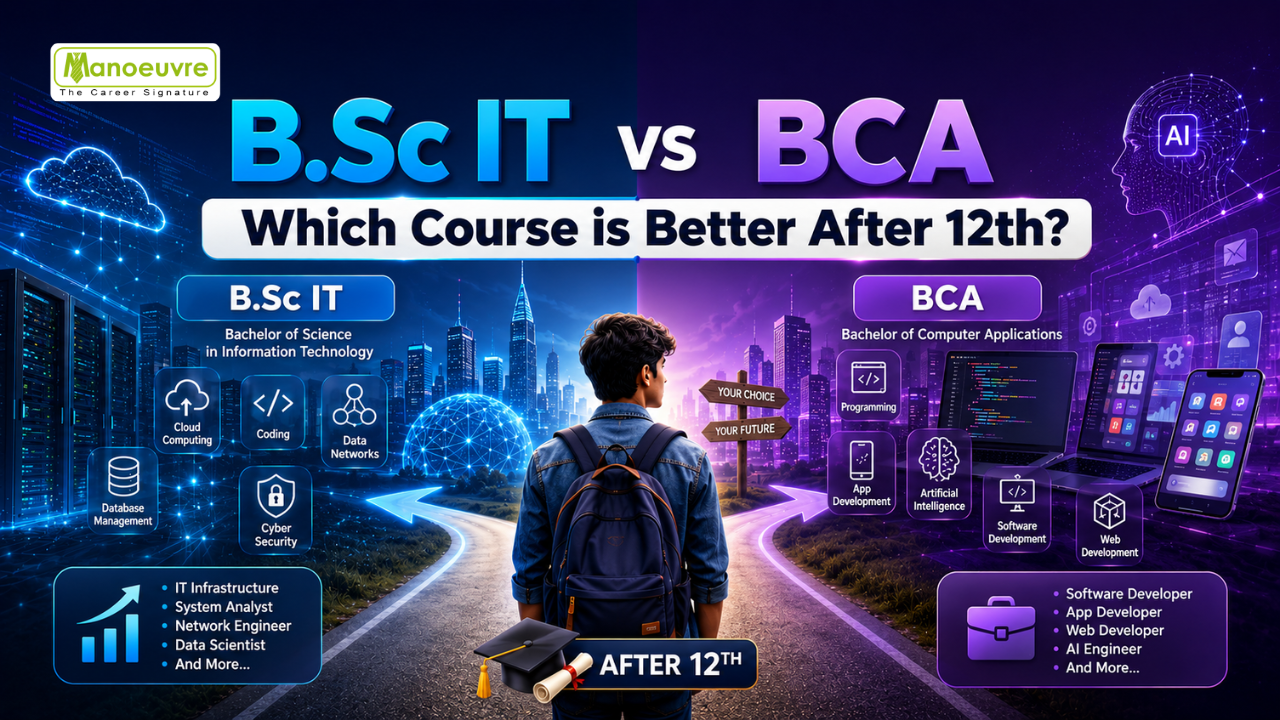
B.Sc IT vs BCA: Which Course is Better After 12th? Complete Career Guide If you've just finished Class 12 and you're eyeing a career in tech, there's a good chance you've run into this exact dilemma: BCA or B.Sc IT? It's one of the most common questions students ask, and honestly, it's a fair one. India's IT sector isn't slowing down anytime soon, and with fields like AI, cybersecurity, cloud computing, and data science expanding every year, picking the "right" starting point can feel like a high-stakes decision.Here's the thing, though — both courses are solid. They just take you down different paths. This guide breaks down what each course actually involves, how they differ in terms of subjects and skills, what kind of jobs you can expect afterward, and how to figure out which one fits you better. First, What Exactly Is BCA? BCA, or Bachelor of Computer Applications, is a three-year degree built around software development and programming. Think coding-heavy coursework — you'll be writing programs, building applications, working with databases, and getting hands-on with web and mobile development throughout the course.It's a great fit if you genuinely enjoy sitting down and solving problems through code, or if the idea of building an app or website from scratch sounds exciting rather than intimidating.Typical career paths after BCA include roles like software developer, web developer, mobile app developer, and IT consultant — basically, jobs where you're actively creating software. And What About B.Sc IT? B.Sc IT (Bachelor of Science in Information Technology) is also a three-year program, but the focus shifts. Instead of centering everything on writing software, this course dives into how technology infrastructure actually functions — networking, databases, cybersecurity, cloud systems, and the broader mechanics of how organizations keep their systems running and secure.If you're more curious about how networks talk to each other, how systems stay protected from threats, or how cloud infrastructure is managed, this course tends to align better with those interests than pure software development does. Quick Side-by-Side Comparison AspectBCAB.Sc ITFull NameBachelor of Computer ApplicationsBachelor of Science in Information TechnologyDuration3 years3 yearsCore FocusProgramming & software developmentIT systems & infrastructureTeaching StyleHands-on, project-drivenTheory-heavy with applied componentsAmount of CodingHighModerateMath InvolvementModerateOften higher prioritySuits Students Who...Want to build softwareWant to work with networks, systems, security Getting In: Eligibility Every institute sets its own bar, but broadly speaking:For BCA, you'll need to have cleared 10+2 from a recognized board, meet whatever minimum marks the college sets, and in some cases have studied Math or Computer Science in school. A number of universities also run entrance exams for admission.For B.Sc IT, the base requirement is the same — Class 12 completion — but Math tends to matter more here, with several institutions making it a preferred or even mandatory subject. Some colleges go purely by merit, others by entrance test scores.Bottom line: always double-check the specific admission rules for the colleges you're targeting, since they can vary quite a bit. What You'll Actually Study BCA coursework typically covers programming languages like C, C++, Java, and Python, along with data structures, database management, software engineering principles, operating systems, web and mobile app development, computer networks, and a basic introduction to AI. Essentially, you're constantly building and coding throughout the degree.B.Sc IT coursework leans into information systems, computer networks, database administration, cybersecurity, cloud computing, network security, Linux administration, operating systems, and data analytics. You come out with a much deeper understanding of how enterprise-level IT systems actually operate. So, Which One Involves More Coding? If your end goal is to become a developer, this question probably matters most to you. Generally speaking, BCA wins here — it's structured around continuous programming practice, with students regularly building websites, desktop tools, and mobile apps as part of the coursework.B.Sc IT still includes programming, but it's not the centerpiece. The emphasis shifts toward networking, database systems, and infrastructure-related subjects instead. So if writing code is what excites you most, BCA is likely the stronger match. Skills You'll Walk Away With From BCA, expect to build skills in programming, software development, problem-solving, application design, database handling, web development, mobile app creation, and software testing.From B.Sc IT, you'll pick up skills around network administration, cybersecurity, cloud computing, database management, system administration, IT support, infrastructure management, and information security.Both are technical, in-demand skill sets — they just point in different directions. Where Each Degree Can Take You Career-Wise BCA graduates often land roles such as software developer, web developer, mobile app developer, full stack developer, software tester, technical support engineer, database programmer, or UI developer — all centered around designing and maintaining software.B.Sc IT graduates tend to move into positions like network engineer, system administrator, database administrator, cybersecurity analyst, cloud support engineer, IT infrastructure engineer, system analyst, or technical support specialist — roles focused on keeping enterprise systems running smoothly and securely. What About Salary? Here's something worth knowing upfront: pay isn't really determined by which degree you hold. It comes down to your skills, certifications, internship experience, and the company you join.Career StageBCAB.Sc ITFresher₹3.5–6 LPA₹3.5–6 LPA3–5 Years Experience₹6–10 LPA₹6–10 LPAExperienced Professional₹12 LPA+₹12 LPA+As you can see, the ranges are nearly identical — so don't pick your course based on expected salary alone. Planning to Study Further? After BCA, popular next steps include an MCA, MBA, M.Sc in Computer Science, a PG diploma in Data Science, or specialized AI programs. MCA in particular is a common choice for students who want to go deeper into software development.After B.Sc IT, students often pursue an M.Sc in Information Technology, MCA, M.Sc in Cyber Security, an MBA, or certification-based tracks in cloud computing and data analytics — all useful for carving out a specialization in a growing tech niche. Boosting Your Job Prospects While Still in College Just having the degree on paper isn't enough anymore — recruiters want to see real, applied experience too.If you're in BCA, try to:● Build your own software projects on the side● Maintain an active GitHub with real code● Learn current frameworks that employers actually use● Take part in coding contests● Do internships whenever possible● Keep practicing data structures and algorithmsIf you're in B.Sc IT, consider:● Getting certified in CCNA, CompTIA, AWS, or Microsoft Azure● Getting real hands-on time with networking setups● Learning Linux administration properly● Trying out cybersecurity labs and simulations● Interning in IT support or infrastructure teams● Building practical cloud computing skillsThese extras can make a noticeable difference when you're job hunting later. How to Actually Decide Don't just go with whatever's trending — go with what genuinely interests you.Lean toward BCA if you:● Genuinely enjoy programming● Picture yourself as a software developer● Like the idea of building apps and websites● Learn best through hands-on projects● Want to eventually work at a software product companyLean toward B.Sc IT if you:● Find the "how systems work" side of tech more interesting● Are drawn to networking and cybersecurity● Want exposure to cloud technologies● Enjoy the idea of managing IT infrastructure● Prefer system administration over writing code all dayNeither course is objectively "better" — it really comes down to what kind of work you can see yourself doing long-term. Wrapping UpBoth BCA and B.Sc IT open solid doors into India's tech industry, just via different routes. BCA suits people who want to code and build software; B.Sc IT suits people drawn to networks, infrastructure, cloud systems, and security.Whichever path you take, the degree itself is only part of the story — internships, certifications, and hands-on project work are what really shape your career outcomes. Pick the course that matches your natural curiosity, and put in the consistent effort to build real skills alongside it. Frequently Asked Questions1. Which is better after 12th — B.Sc IT or BCA? It really depends on where you see yourself. Go with BCA for software development, or B.Sc IT if networking, cybersecurity, and infrastructure appeal to you more.2. Does BCA involve more coding than B.Sc IT? Yes, generally. BCA is more programming-intensive and software-focused overall.3. Which course pays better? Starting salaries are quite similar for both. What really moves the needle is your skill set, internships, certifications, and the company you end up joining.4. Can someone with a B.Sc IT degree do an MCA later? Yes, most universities allow this, as long as you meet their specific eligibility requirements.5. Is Math compulsory for these courses? It varies by institution, but many colleges do prefer or require Math — particularly for B.Sc IT.6. Which course is better suited for a cybersecurity career? B.Sc IT tends to give you a stronger foundation in networking and systems security, making it a more natural fit for cybersecurity roles.7. Can a B.Sc IT graduate become a software developer? Absolutely — with solid coding practice, personal projects, and internships, B.Sc IT graduates can transition into development roles just fine.8. Which course has better long-term career scope? Both hold strong potential given the ongoing demand in software, cloud, AI, cybersecurity, and digital transformation. Your outcomes will depend more on continuous skill-building than on which of the two you choose.

18 Jul 2026
0 comments
Hotel Management International Opportunities: A Complete Career Guide The hospitality industry has always been global by nature, but today it offers more mobility than ever before. A degree or diploma in hotel management no longer limits graduates to jobs in their home country. Instead, it opens doors to five-star resorts in the Middle East, cruise liners crossing oceans, boutique properties in Europe, and luxury chains across Asia-Pacific. If you are considering this field, or already hold a qualification and want to work abroad, this guide walks you through what international hotel management careers actually look like, where the opportunities are strongest, and how to prepare yourself for them. Why Hospitality Careers Travel Well Hotels, resorts, and hospitality groups operate on a universal set of standards, whether the property is in Dubai, Singapore, or Zurich. Guest service, housekeeping operations, food and beverage management, and front-office procedures follow similar frameworks across brands. This consistency means that skills learned in one country transfer easily to another, making hospitality one of the most exportable professions in the world.Large hotel chains also actively encourage internal mobility. Someone trained at a property in India, for example, can apply for an opening at a sister property in Qatar or Thailand without needing to start from scratch. This built-in flexibility is one of the biggest draws for students choosing hotel management as a career path. Popular Destinations for Hospitality Professionals Certain regions consistently attract talent because of their booming tourism sectors and expanding hotel infrastructure.Middle East (UAE, Qatar, Saudi Arabia): The Gulf region has seen massive investment in luxury hospitality, driven by tourism diversification and major events. Dubai and Abu Dhabi remain top choices for professionals seeking tax-free salaries and fast career progression.Southeast Asia (Singapore, Thailand, Indonesia): Known for its blend of business and leisure travel, this region offers strong demand for skilled staff in resort management, spa operations, and guest relations.Europe (Switzerland, UK, France): Home to some of the world's most prestigious hotel schools, Europe remains a benchmark for classical hospitality training and fine-dining service standards.Cruise Lines: Working aboard cruise ships offers a unique international experience, combining travel with hospitality work across multiple countries within a single contract.Australia and New Zealand: These markets value hands-on experience and offer clear pathways from entry-level roles to management positions. Common Roles Available Internationally Hotel management graduates are not limited to front-desk positions. The industry offers a wide spread of specializations, each with its own international demand.● Front Office Management – overseeing guest check-in, reservations, and concierge services● Food and Beverage Management – running restaurants, bars, banquets, and catering operations within a property● Housekeeping Management – maintaining cleanliness standards and coordinating large support teams● Sales and Revenue Management – setting pricing strategy and driving occupancy through market analysis● Event and Banquet Coordination – planning weddings, conferences, and corporate functions● Culinary and Kitchen Management – leading kitchen brigades in hotel restaurants● Guest Relations and Customer Experience – handling VIP guests and resolving service issuesEach of these paths has its own growth trajectory, and many professionals move between departments before settling into a specialization. Skills That Employers Look For International hotel groups tend to prioritize a specific mix of technical knowledge and interpersonal ability when hiring across borders.Communication and Language Skills: English is the standard working language in most international hotels, but knowing a second or third language significantly improves employability, especially in Europe and the Middle East.Cultural Adaptability: Working with colleagues and guests from diverse backgrounds requires patience, openness, and the ability to adjust service styles to different cultural expectations.Technical Proficiency: Familiarity with property management systems (PMS), booking platforms, and point-of-sale software is now a baseline expectation rather than a bonus skill.Leadership Under Pressure: Hospitality is a fast-paced, guest-facing industry, and supervisory roles demand composure during high-volume periods like holidays or large events.Financial Literacy: Understanding budgets, occupancy reports, and revenue metrics helps professionals move into management tracks more quickly. Educational Pathways Most international employers look for a recognized qualification, though the exact requirement varies by role and region.● Bachelor's Degree in Hotel Management or Hospitality Administration: A common entry point, typically covering operations, finance, marketing, and human resources within a hospitality context.● Diploma or Certificate Programs: Shorter, skill-focused courses that can fast-track entry into operational roles.● Postgraduate Specializations: Useful for those aiming at senior management, revenue strategy, or hotel consulting roles later in their career.● Internships and Practical Training: Nearly every reputable hospitality program includes supervised internships, which often serve as the actual gateway to international job offers.Choosing a school with strong industry placement partnerships can matter more than the brand name of the institution itself, since many first international postings come through campus recruitment or internship conversions. How to Build Toward an International Career Getting a foreign hospitality job rarely happens through a single application. It is usually the result of a gradual, deliberate process.Start with a strong internship. Many hotel groups recruit management trainees directly from internship pools, particularly in luxury chains that run structured graduate programs.Gain domestic experience first. A year or two of hands-on operational experience in your home country builds the practical foundation that international employers expect before offering relocation.Target hotel groups with global footprints. Large chains with properties across multiple countries make internal transfers far easier than trying to join an unfamiliar company abroad from scratch.Understand visa and work permit requirements. Every country has different sponsorship rules for hospitality workers, and researching this early avoids wasted time applying to roles you may not legally qualify for.Build a portfolio of measurable achievements. Rather than listing job duties, highlight outcomes such as guest satisfaction scores, upsell revenue, or team performance improvements, since these numbers translate well across borders. Challenges to Expect International hospitality careers are rewarding, but they come with real trade-offs worth planning for.● Long and irregular hours, especially during peak seasons or major events● Homesickness and cultural adjustment, particularly in the first year abroad● Contract-based employment in some regions, which offers less long-term security than a permanent role● Variable compensation structures, where base pay may be modest but supplemented by accommodation, meals, and service chargesBeing aware of these realities in advance helps professionals set expectations and choose destinations that match their personal priorities, whether that's higher pay, better work-life balance, or faster promotion timelines. Final Thoughts A career in hotel management offers one of the clearest paths to working internationally, backed by an industry that values transferable skills and rewards adaptability. Whether your interest lies in luxury resort operations, cruise hospitality, or corporate hotel management, the opportunities extend far beyond domestic borders. Success in this field comes down to building a solid operational foundation, staying flexible about location, and continuously developing the interpersonal and technical skills that hospitality employers value everywhere in the world.With the right preparation, a hotel management qualification can become a passport to a truly global career. FAQ’S 1. What are the best countries for hotel management jobs abroad?The UAE, Qatar, Singapore, Switzerland, and Thailand are among the top destinations for international hotel management jobs, thanks to strong tourism growth and expanding luxury hospitality sectors.2. Do I need a hotel management degree to work internationally?Most global hotel chains prefer candidates with a bachelor's degree or diploma in hotel management or hospitality administration, though relevant work experience can sometimes substitute for formal education in operational roles.3. How much can you earn in international hotel management careers?Salaries vary widely by region and role, but international hotel management jobs, especially in the Middle East and Europe, often include tax-free income, accommodation, meals, and service charge bonuses on top of base pay.4. What qualifications help you get hotel management jobs abroad?A recognized hospitality degree, hands-on internship experience, proficiency in property management systems, and strong communication skills are the qualifications international employers value most.5. Which hotel management roles are most in demand globally?Front office management, food and beverage management, revenue management, and event coordination are among the most in-demand hotel management roles across international hotel groups.6. Is work experience required before applying for hotel jobs overseas?Yes, most international hotel groups prefer candidates with at least one to two years of domestic hospitality experience before considering them for overseas placements or management trainee programs.7. Can hotel management graduates work on cruise ships?Yes, cruise line hospitality careers are a popular international path for hotel management graduates, offering roles in guest services, food and beverage, and housekeeping management across multiple countries.8. What visa requirements apply to international hotel management careers?Visa and work permit rules vary by country, so it's important to research individual sponsorship requirements early, since hotel groups typically handle visa processing for confirmed job offers rather than for open applications.
Featured Blogs
 MBA Entrance
 LAW 5years Entrance
 LAW 3years Entrance
 MCA Entrance
 CUET PG Entrance
 BBA Entrance
 BCA Entrance
 Hotel-Management
 B.ED Entrance