

10 Sep 2026
0 comments
Best MBA CET Online Classes in Maharashtra for Effective Exam PreparationPreparing for the MBA CET requires more than simply completing the syllabus. The exam tests speed, accuracy, logical thinking and the ability to make quick decisions under time pressure. Since a large number of questions need to be attempted within a limited duration, students need a preparation approach that combines concept building with consistent practice.For students looking for MBA CET online classes in Maharashtra, online learning can provide a structured way to prepare from home while accessing live teaching, practice material, mock tests and doubt-solving support. The right programme can also help students maintain consistency and identify areas that need improvement throughout their preparation. Understanding the MBA CET Exam The Maharashtra MBA CET, conducted by the State Common Entrance Test Cell, Maharashtra, is an important entrance examination for admission to MBA and MMS programmes offered by participating institutes.The examination primarily assesses a candidate's ability in areas such as logical reasoning, abstract reasoning, quantitative aptitude and verbal ability/reading comprehension. Unlike exams where students can spend considerable time on individual questions, MBA CET preparation requires an emphasis on speed because of the exam's question-intensive format.This makes regular timed practice an important part of preparation.Students should therefore focus on three things:● Understanding the concepts tested in each section● Developing question-solving speed● Improving accuracy through regular analysis Why Choose Online Preparation for MBA CET? Online preparation has become a practical option for students who want flexibility without compromising on structured learning. Instead of travelling to a classroom, students can attend sessions from wherever they are and continue their preparation alongside college or other commitments.A well-designed online course can provide:● Live interactive classes● Recorded sessions for revision● Topic-wise study material● Sectional and full-length mock tests● Doubt-solving support● Performance analysis● Regular practice assignments● Guidance for improving speed and accuracyThe advantage is not simply convenience. A structured online programme can bring all the major parts of preparation together, allowing students to follow a planned routine instead of relying on scattered resources. What Should You Look for in MBA CET Online Coaching? Not every online course follows the same teaching approach. Before enrolling, students should compare the features that directly influence their preparation.Experienced FacultyThe quality of teaching plays an important role in entrance exam preparation. Faculty should be able to explain concepts clearly while also introducing efficient methods for solving questions within a limited time.For MBA CET, this is particularly relevant because students often need to learn how to recognise question patterns and select the quickest suitable approach.Complete Syllabus CoverageA course should cover the major topics required for the examination rather than concentrating only on commonly asked areas.Students should check whether the programme provides systematic coverage of:● Logical Reasoning● Abstract Reasoning● Quantitative Aptitude● Verbal Ability● Reading ComprehensionComplete coverage gives students enough time to identify their strengths and work on weaker areas before the examination.Regular Mock TestsMock tests are one of the most useful tools for MBA CET preparation. They allow students to experience a timed examination environment and understand how they perform under pressure.However, simply taking tests is not enough. Students should review their attempts and identify:● Questions that consumed excessive time● Repeated calculation or conceptual errors● Topics with low accuracy● Questions that could have been solved faster● Sections where time allocation needs improvementThis analysis gradually turns mock-test practice into measurable improvement.Doubt-Solving SupportStudents may understand a concept during a class but face difficulties when applying it to unfamiliar questions. Accessible doubt-solving support can prevent these issues from becoming recurring weaknesses.A good online learning setup should make it reasonably easy for students to clarify concepts, understand alternative approaches and move forward with their practice. How to Prepare for MBA CET Effectively Joining an online course is only one part of preparation. Students also need a consistent study routine.Start with the Syllabus and Exam PatternBegin by understanding the sections, question types and overall structure of the examination. This helps you divide your preparation time according to the areas that require the most attention.Avoid starting preparation by randomly solving questions. Build a basic roadmap first.Strengthen Your FundamentalsBefore concentrating heavily on speed, make sure your fundamentals are clear. In quantitative aptitude, revise essential mathematical concepts. For reasoning, become familiar with common question patterns. In verbal ability and reading comprehension, focus on understanding language, vocabulary and passages.Strong fundamentals reduce the time required to solve questions later.Practise with a TimerSpeed is developed through repeated timed practice. Once you are comfortable with a topic, start solving sets within a fixed duration.Initially, prioritise accuracy. As your confidence improves, gradually reduce the time available for each set.This approach is more effective than trying to solve every question quickly from the beginning.Take Sectional TestsSectional tests help students understand their performance in individual areas. If your reasoning score is strong but quantitative aptitude accuracy is low, your preparation can be adjusted accordingly.Keeping a simple record of scores can help you track improvement over several weeks.Attempt Full-Length MocksOnce the basics and individual topics are reasonably strong, introduce full-length mock examinations into your routine.After every mock, spend time analysing the result. Your objective should not only be to see your score but to understand why marks were lost. Self-Study vs Online MBA CET Classes Both self-study and online coaching can work, but the right choice depends on how independently a student can plan and maintain preparation.FactorSelf-StudyOnline ClassesStudy scheduleFully self-managedStructured scheduleFaculty guidanceLimitedRegular guidanceDoubt solvingSelf-researchDedicated supportStudy materialNeeds to be arrangedUsually providedMock testsMust be sourced separatelyGenerally integratedPerformance trackingSelf-managedOften supported through analysisFlexibilityHighHighStudents who already have a strong preparation strategy may prefer self-study. Those who find it difficult to organise resources, maintain consistency or evaluate their performance may benefit from a structured online programme. How Manoeuvre Education Can Support Your PreparationFor students comparing online MBA CET coaching, Manoeuvre Education provides a structured learning environment focused on entrance-exam preparation. The approach combines live classes, practice, mock tests and guidance so that students can work on both conceptual understanding and exam performance.The useful part of such a setup is the ability to keep learning and practice connected. Instead of completing lessons separately and searching for practice resources elsewhere, students can follow a more organised preparation process and use performance feedback to decide what to work on next.This can be particularly helpful as the examination approaches, when students need to shift from learning concepts to improving speed, accuracy and question selection. Common Mistakes to Avoid During MBA CET Preparation Even students who study regularly can lose marks because of an inefficient preparation strategy.Some common mistakes include:● Collecting too many study resources instead of completing selected material● Ignoring weaker sections● Taking mock tests without analysing mistakes● Focusing only on speed and neglecting accuracy● Leaving revision until the final weeks● Practising without a fixed schedule● Spending too much time on difficult questions during testsA simple, consistent preparation plan is usually more useful than constantly changing study methods. Final Thoughts Effective MBA CET preparation is a combination of the right concepts, regular practice, mock-test analysis and disciplined time management. Students should choose a preparation method that fits their learning style while providing enough opportunities to practise and measure progress.For students considering MBA CET online preparation, a structured course can reduce the effort involved in organising resources and create a more consistent path from learning concepts to improving actual test performance. The key is to remain regular, analyse mistakes honestly and keep adjusting the preparation strategy based on results. Frequently Asked Questions 1. Are online classes effective for MBA CET preparation?Yes. Online classes can provide structured lessons, expert guidance, study material, regular practice and mock tests. They are especially useful for students who prefer flexible learning from home.2. How many months are enough to prepare for MBA CET?The required preparation time depends on your existing aptitude level and target score. Starting a few months in advance generally provides enough time for learning concepts, practising questions, taking mocks and revising.3. What subjects should I prepare for MBA CET?Preparation should cover Logical Reasoning, Abstract Reasoning, Quantitative Aptitude, Verbal Ability and Reading Comprehension. Students should give additional practice time to sections where their accuracy is comparatively low.4. How can I improve my speed for the MBA CET exam?Regular timed practice is one of the best ways to improve speed. Solve topic-wise and sectional sets with a timer, review questions that took too long and learn to identify which questions should be attempted first.5. Are mock tests necessary for MBA CET?Yes. Mock tests help students become familiar with the examination environment, improve time management and assess their preparation. Analysing mistakes after each test is equally important.6. Can I prepare for MBA CET through online coaching while attending college?Yes. Online coaching can make preparation easier to manage alongside college because students can attend classes from home and follow a planned study schedule without spending time travelling to a coaching centre.7. What should I consider before choosing an MBA CET online course?Check the faculty experience, syllabus coverage, quality of study material, live classes, mock-test frequency, doubt-solving support and performance analysis. The course should also provide a structured preparation plan rather than only recorded content.8. Can I prepare for MBA CET without coaching?Yes. Self-study is possible if you can follow a consistent timetable, arrange reliable study material, practise regularly and analyse your performance. Coaching can be useful for students who want structured guidance and ongoing academic support.

09 Sep 2026
0 comments
Top MBA Marketing Colleges in Mumbai: Fees, Placements & Admission Choosing the right management programme becomes easier when you know what you want to do after graduation. If marketing interests you, Mumbai offers several options, including MBA, MMS and PGDM programmes with marketing specialisations, majors or electives.The top MBA marketing colleges in Mumbai differ in their programme structure, entrance requirements, fees and placement opportunities. This guide will help you understand these options and what to consider before applying. What Is an MBA? MBA stands for Master of Business Administration. It is a postgraduate management programme that develops knowledge of business functions such as marketing, finance, human resources, operations, strategy and analytics.An MBA usually combines classroom learning with case studies, presentations, projects, internships and industry interaction. Depending on the institute, students may choose a specialisation, major or electives during the course. MBA Specialisations MBA programmes are available across several areas. Some of the common specialisations include:● Marketing● Finance● Human Resources● Operations● Business Analytics● International Business● Information Technology● EntrepreneurshipMarketing is a suitable option for students who enjoy understanding customers, building brands, developing business strategies and working on sales or market growth. What Is an MBA in Marketing? An MBA in Marketing focuses on how businesses understand customers, position products and build strategies to reach their target markets.Depending on the programme, students may study subjects such as consumer behaviour, brand management, sales management, digital marketing, product management, market research and marketing analytics.It is also important to understand that not every institute uses the exact title MBA in Marketing. Some offer marketing as a specialisation or major within a broader management programme, while others have a dedicated marketing-focused course. Top MBA Marketing Colleges in Mumbai Mumbai offers several management institutes where students can pursue an MBA, MMS or PGDM and build expertise in marketing. The programmes differ in structure, specialisation options and entrance requirements, so students should compare them based on their career goals. Rank College Programme / Marketing Option Location Entrance Route 1 SPJIMR Mumbai PGDM Andheri West CAT / GMAT 2 IIM Mumbai (formerly NITIE) MBA Powai CAT 3 IIT Bombay - SJMSOM MBA Powai CAT 4 JBIMS Mumbai MMS - Marketing Specialisation Churchgate MAH MBA CET 5 NMIMS School of Business Management MBA Vile Parle West NMAT 6 BITSoM MBA Kalyan CAT / GMAT / GRE 7 K J Somaiya Institute of Management MBA / MBA - Marketing Communications Vidyavihar GMAT / CAT / NMAT / CMAT / XAT 8 Welingkar (WeSchool) PGDM - Marketing Major Matunga CMAT / ATMA / GMAT / CAT / XAT 9 Vivekanand Business School PGDM - Marketing Chembur MAH MBA CET / CMAT / XAT / CAT / ATMA / MAT 10 SIMSREE MMS - Marketing Specialisation Churchgate MAH MBA CET Entrance requirements can vary by programme and admission year. Check official notifications for admission requirements before submitting your application. SPJIMR MumbaiSPJIMR’s two-year PGDM is known for its practical approach to management education. Students focus on marketing, consulting, finance, and strategy. PGDM admissions consider CAT and GMAT scores along with the institute’s selection process.IIM Mumbai (formerly NITIE)IIM Mumbai offers a two-year MBA that covers major business functions, including marketing. The institute carries forward the legacy of NITIE under the IIM system. Candidates are shortlisted through CAT and the institute’s admission process.IIT Bombay - SJMSOMSJMSOM at IIT Bombay offers a two-year MBA covering different aspects of business management. Marketing forms part of the academic curriculum, along with areas such as strategy and finance. CAT is the entrance route for the programme.JBIMS MumbaiJBIMS offers a two-year MMS programme with students studying different areas of management, including marketing. It is one of the prominent management institutes in Mumbai, with admission through the Maharashtra admission process and MAH MBA CET.NMIMS School of Business ManagementThe two-year MBA at NMIMS SBM Mumbai covers core areas such as marketing, finance, operations and strategy. Admission to the MBA is based on NMAT followed by the institute’s selection procedure.BITSoMBITSoM offers a two-year MBA with a broad business curriculum. Students can build their interests in fields such as marketing, strategy, finance and entrepreneurship. The institute considers CAT, GMAT, or GRE scores. K J Somaiya Institute of ManagementK J Somaiya offers a two-year MBA along with an MBA in Marketing Communications. The programmes give students a mix of general management knowledge and specialised learning. The institute accepts several management entrance exams, depending on the programme.Welingkar (WeSchool)WeSchool offers full-time PGDM programmes in Mumbai, with Marketing available as a major in its flagship PGDM. Students can choose from multiple entrance routes, including CAT, XAT, GMAT and CMAT.Vivekanand Business SchoolVivekanand Business School offers a two-year PGDM with Marketing as a specialisation. The course combines management fundamentals with marketing-focused learning. CAT, XAT, CMAT, MAT, ATMA and MAH MBA CET scores are among the accepted routes.SIMSREESIMSREE offers a two-year MMS programme covering key areas of management, including marketing. Admission is through the Maharashtra management admission process, with MAH MBA CET being a key entrance route. Fees & Placements Fees and admission requirements vary considerably across institutes. Students should also remember that a qualifying percentile is not always the same as the final competitive cut-off, as some institutes use academic performance, entrance scores, interviews and other factors during selection. College Programme Fees Average CTC SPJIMR Mumbai PGDM - Core ₹24.86 Lakh* ₹33.75 LPA IIM Mumbai MBA - Core ₹21 Lakh* ₹31.4 LPA IIT Bombay – SJMSOM MBA - Core ₹15.55 Lakh ₹28.16 LPA JBIMS Mumbai MMS - Core ₹4.22 Lakh ₹26.1 LPA NMIMS SBM MBA Core ₹13.5 Lakh/year* ₹24.60 LPA BITSoM MBA - Core ₹28.35 Lakh (2026-28) ₹21.00 LPA (2023-25) K J Somaiya MBA Core ₹17.13 Lakh (2026-28) ₹12.69 Lakh Welingkar PGDM - Core ₹15 Lakh* ₹11.70 LPA Vivekanand Business School PGDM - Marketing ₹9.50 Lakh* ₹7.12 LPA SIMSREE MMS - Core ₹69,000/year 15.10 LPA Note: The fees, admission criteria and placement figures in the table are taken from different academic years and placement batches, as the latest published data varies by institute. Additional charges, fee structures and admission requirements may also change from year to year. For the latest and exact information, students should refer to the respective institute’s official website before applying. MBA vs PGDM in MarketingAn MBA is generally awarded as a postgraduate management degree, while a PGDM is a diploma programme offered by an autonomous management institute.When comparing PGDM marketing colleges with MBA institutes, students should look beyond the programme title. Curriculum, institute recognition, faculty, internships, industry exposure, placements and entrance requirements can have a greater impact on the overall experience. MBA Marketing Admission & EligibilityEligibility depends on the institute, but most full-time MBA and PGDM programmes require a bachelor's degree from a recognised university along with a specified minimum percentage.The admission process generally involves:1. Checking eligibility requirements.2. Selecting the appropriate entrance examination.3. Appearing for the examination.4. Applying to shortlisted institutes.5. Meeting the institute's shortlisting criteria.6. Appearing for interviews, group discussions or written assessments where applicable.7. Completing the admission process after selection.Students should check the official admission page of each college because requirements can differ significantly. Can You Study MBA Marketing Without CAT? Yes. CAT is not the only entrance examination accepted for management programmes.Depending on the institute, students may apply through examinations such as MAH MBA CET, XAT, CMAT, NMAT, SNAP, MAT, ATMA or GMAT.For example, SPJIMR accepts CAT and GMAT for its PGDM, while other institutes have their own combination of accepted examinations. Therefore, shortlist the colleges first and then identify the entrance exams you need to prepare for. Career Options After MBA in Marketing An MBA in marketing can open opportunities across industries such as FMCG, retail, technology, e-commerce, banking, media, consulting and consumer services.Some common roles include:● Marketing Manager● Brand Manager● Digital Marketing Manager● Product Marketing Manager● Sales Manager● Business Development Manager● Marketing Analyst● Market Research Analyst● Category Manager● Customer Relationship ManagerYour first role can depend on the institute, recruitment process, internships, skills and the industry you enter. MBA Marketing vs MBA HR: Which Is Better? There is no single answer because both specialisations lead to different career paths. Marketing HR Focuses on customers, brands and markets Focuses on people and organisations Careers in marketing, sales and brand functions Careers in recruitment, HR and L&D Useful for analytical and creative thinking Useful for communication and people management Closely connected with business growth Closely connected with employee and organisational development If you enjoy customers, brands and business growth, marketing may be a better fit. If you are more interested in people, workplace culture and organisational development, HR may suit you better. MBA Marketing Preparation in Few Phases Phase 1: Understand the ExamStart by checking the syllabus, pattern, sections, marking scheme and time limit of your target examination.Phase 2: Build the BasicsStrengthen fundamental concepts in quantitative aptitude, reasoning, verbal ability and data interpretation, depending on the exam.Phase 3: Practise Topic-WiseSolve questions by topic and keep a record of recurring mistakes. This makes it easier to identify areas that need more attention.Phase 4: Take Sectional TestsTimed sectional tests help improve accuracy and speed while showing which sections still require work.Phase 5: Attempt Full-Length MocksOnce your basics and topic-wise practice are in place, start taking complete mock tests under exam-like conditions.Phase 6: Analyse and ReviseDo not stop at checking your score. Review wrong answers, questions that took too long and questions you could not attempt. Use the analysis to adjust your preparation. Common Mistakes to Avoid During MBA Preparation● Starting preparation without understanding the exam pattern● Ignoring weaker sections● Studying concepts without enough question practice● Taking mock tests but not analysing them● Repeating the same mistakes● Spending excessive time on difficult questions● Ignoring revision● Following an unrealistic study schedule● Preparing for several exams without understanding their differences● Focusing only on speed instead of balancing speed with accuracyA consistent study routine combined with practice, mock tests and regular analysis can make preparation more effective. How to Choose Among MBA Marketing Colleges in Mumbai Mumbai gives students several options when it comes to management education and marketing-related careers. The best colleges for MBA in marketing are not necessarily identical for every student, because programmes, entrance routes, fees and career opportunities differ.Before applying, understand the programme structure, check the admission requirements and compare the opportunities available after graduation. Once your target colleges and entrance exams are clear, structured preparation can help you work towards your preferred management institute. Frequently Asked Questions About MBA Marketing Colleges 1. What does an MBA degree mean?MBA stands for Master of Business Administration. It is a postgraduate management programme covering areas such as marketing, finance, HR, operations and strategy.2. Is 70% good in MBA?A 70% score can be a good academic result, but MBA admissions and career outcomes depend on several factors, including entrance scores, institute, skills, internships and placement performance.3. Is MBA very costly?The cost of an MBA varies considerably between institutes and programmes. Students should compare tuition fees and other expenses before selecting a programme.4. What is MBA in marketing?MBA in Marketing is a management specialisation focused on customers, brands, sales, market research, digital marketing, products and marketing strategy.5. Which college is best for MBA marketing?There is no single college that is best for everyone. IIM Mumbai, SPJIMR, IIT Bombay-SJMSOM, JBIMS, NMIMS and other institutes offer different programme structures and career opportunities.6. Can I study MBA without a CAT?Yes. Depending on the institute, students can use exams such as MAH MBA CET, XAT, CMAT, NMAT, SNAP, MAT, ATMA or GMAT.7. Which MBA is better, HR or marketing?Marketing can suit students interested in customers, brands and business growth, while HR may be more suitable for students interested in people management and organisational development.

08 Sep 2026
0 comments
MBA Colleges Under 5 Lakhs in India: Fees & ROIAn MBA does not always have to come with a high fee. Several reputed institutes in India offer management programmes with total fees below ₹5 lakh, making them a practical option for students looking for affordable MBA programs and good career opportunities.Some of these institutes are known for their strong placement records and low tuition fees, while others offer specialised programmes through national or state-level entrance exams. Before choosing a college, students should compare MBA college fees, entrance requirements, programme structure, placement opportunities and the overall return on investment.Here is a look at some of the best MBA colleges under 5 lakhs in India. MBA Eligibility Criteria The eligibility criteria can vary between institutes, but the basic requirements for most full-time MBA programmes include:● A bachelor's degree from a recognised university.● A minimum of 50% marks in graduation for General category candidates in many institutes.● Relaxation in minimum marks may be available for reserved categories as per institute or university rules.● Students appearing for their final-year graduation examinations may also be eligible, subject to the respective institute's conditions.● Some colleges require candidates to qualify for a specific entrance examination.Students should always check the latest admission notification of the college before applying because eligibility requirements can change. MBA Entrance Exams Admission to low-fee MBA colleges is generally based on national, state or institute-level entrance examinations. Some of the major exams accepted by the colleges listed below include:● CAT: Accepted by institutes such as FMS Delhi, IMS BHU, UBS Chandigarh and DFS Delhi.● MAH MBA CET: Used for admission to Maharashtra management institutes such as SIMSREE and PUMBA.● JMI admission process: Jamia Millia Islamia follows its own admission procedure for its MBA programme.● CAT-based admission: TISS Mumbai's flagship HRM & LR programme uses CAT scores for admission.The accepted exam can differ by programme and admission year, so candidates should check the current admission notification before applying. Top MBA Colleges under 5 Lakhs in India The following list includes 10 well-known institutes where the relevant management programme has fees below ₹5 lakh based on the latest available fee information. Fees can change and may not include hostel, mess, examination, admission or other additional charges.CollegeLocationFeesEntrance ExamFMS, New DelhiDelhi₹2.43 lakh approx.CATJamia Millia IslamiaNew Delhi₹53,750 approx.JMI Admission ProcessDSE, DelhiDelhi₹1.08 lakh approx.CATUBS, ChandigarhChandigarh₹47,890 approx.*CATDFS, DelhiDelhi₹1 lakh approx.CATIMS BHUVaranasi₹1.20 Lakh approx.CATSIMSREE (MMS)Mumbai₹1.36 lakh approx.MAH MBA CET / CAT / CMAT / XATTISS, MumbaiMumbai₹2.03 lakh approx.CATPUMBA, PunePune₹1.64 lakh approx.MAH MBA CET / CAT / CMATDoMS, NIT TrichyTiruchirappalli₹3.17 lakh approx. CATNote: The fees mentioned above are the plain programme fees based on the latest available information. They may not include additional fees or charges such as hostel, mess, examination, registration, library and other institutional expenses. Fee structures may also change for a new academic year. Students should check the respective institute's official website for the latest and complete fee structure before applying or taking admission. FMS Delhi If you are looking for an MBA with a relatively low fee but strong placement opportunities, FMS Delhi is a college worth considering. It is part of the University of Delhi and is well known for its placement record.As per the FMS MBA 2026-28 bulletin, the semester fee is around ₹60,818. For four semesters, the total comes to approximately ₹2.43 lakh. The fee structure may change, so students should check the latest details before admission.Admission to the full-time MBA programme is through CAT. FMS recorded an average CTC of ₹32.27 LPA and a median CTC of ₹29.59 LPA in its 2024-26 final placement report.With a comparatively low programme fee and a high average CTC, FMS offers a strong MBA fees and average package combination for students focused on value for money. Jamia Millia Islamia Jamia Millia Islamia (JMI), New Delhi, can be a good option for students who want to pursue an MBA without spending a large amount on tuition fees. The MBA programme is offered through the Department of Management Studies and is completed over four semesters.As per the university's 2026-27 prospectus, the MBA fee is ₹26,875 per year. This makes the programme fee approximately ₹53,750 for two years. Students should check the latest fee structure as the amount may change for a new academic session.JMI also provides placement opportunities through its Department of Management Studies. Recent placement data reports an average CTC of around ₹10.8 LPA.With its low programme fee and decent placement outcome, JMI is worth considering when comparing MBA colleges with low fees. IMS BHUThe Institute of Management Studies (IMS), Banaras Hindu University (BHU), is another option for students looking for affordable MBA colleges in India. The institute offers MBA and MBA-IB programmes, both of which are completed over two years.The regular programme fee is around ₹30,000 per semester. For four semesters, this comes to approximately ₹1.20 lakh. Hostel and mess expenses are not included in this amount, so students should keep these additional costs in mind while planning their budget.IMS BHU also has a good placement record. The institute reports an average package of ₹11.4 LPA, while the highest package has reached ₹35 LPA.For students who want to keep their MBA fees low while studying at a well-known university, IMS BHU can be a practical option to consider. SIMSREE Sydenham Institute of Management Studies, Research and Entrepreneurship Education (SIMSREE), Mumbai, is a good option for students looking for a management programme with relatively low fees.It is important to note that SIMSREE's flagship programme is Master of Management Studies (MMS), not MBA. The two-year full-time MMS programme has a fee of ₹67,000 along with ₹2,000 library fees per year, which comes to approximately ₹1.38 lakh for two years.SIMSREE also has a strong placement record. Its placement information reports an average salary of ₹15.10 LPA and a highest salary of ₹22.50 LPA, with more than 80 companies participating in the placement process.For students who are open to pursuing an MMS instead of an MBA, SIMSREE can be considered for its combination of relatively low fees and placement opportunities. PUMBAThe Department of Management Sciences (PUMBA), Savitribai Phule Pune University, is another option for students looking for an affordable MBA college in Pune.PUMBA offers a two-year MBA programme with fees that are well below ₹5 lakh. The current fee is approximately ₹1.64 lakh, making it a relatively budget-friendly option for students who want to pursue an MBA.The institute also has a good placement record. According to its official placement report for the 2022-24 batch, the average CTC was ₹11.23 LPA. The top 10% of students recorded an average CTC of ₹15.4 LPA.With its comparatively low MBA fees and placement outcomes, PUMBA can be considered by students looking for a value-for-money MBA option in Pune. ROI of MBA Colleges under 5 Lakh ROI, or return on investment, is an important factor when comparing MBA fees and placement. A college with a lower fee and a strong average package can reduce the financial burden and potentially help students recover their education cost faster.The table below includes all 10 colleges in the list. Placement figures are based on the latest publicly available information identified for the respective institute; where a comparable average package could not be reliably established, it has not been estimated.CollegeApprox. FeesAverage Package / Placement FigureROIFMS Delhi₹2.43 lakh₹32.27 LPAExcellentJamia Millia Islamia₹53,750₹10.8 LPAExcellentDSE, Delhi₹1.08 lakh₹13.92 LPAExcellentUBS, Chandigarh₹47,890 approx.Mean ₹12.95 LPAExcellentDFS, Delhi₹1 lakh approx.₹15.50 LPAExcellentIMS BHU₹1.20 lakh₹11.4 LPAExcellentSIMSREE₹1.38 lakh approx.₹15.10 LPAExcellentTISS, Mumbai₹2.04 lakh₹28.69 LPA*ExcellentPUMBA, Pune₹1.64 lakh approx.₹11.23 LPAVery GoodDoMS, NIT Trichy₹3.17 lakh approx.Median ₹8.70 LPAGood* TISS Mumbai's figure relates to its M.A. in Human Resource Management & Labour Relations, not an MBA programme.Note: Fees and placement figures may change by academic year and placement batch. Additional charges may also apply. Students should check the respective institute's official website for the latest details. The figures show why MBA college fees and average package should be considered together instead of looking at fees alone. Career Opportunities after MBA An MBA can open opportunities across different business functions depending on the specialisation and skills developed during the programme. Some common career areas include:● Finance: Financial Analyst, Investment Analyst, Credit Analyst and Corporate Finance roles.● Marketing: Marketing Executive, Brand Manager, Sales Manager and Business Development roles.● Human Resources: HR Manager, Talent Acquisition Specialist and HR Business Partner roles.● Operations: Operations Manager, Supply Chain Analyst and Process Manager roles.● Consulting: Business Consultant, Strategy Analyst and Management Consultant roles.● Business Analytics: Business Analyst, Data Analyst and Analytics Consultant roles.The actual salary depends on the institute, specialisation, candidate profile, previous experience and hiring company. How to Choose the Best MBA College under 5 Lakhs? Check the Total MBA FeesDo not compare only the tuition fee. Check whether examination fees, hostel charges, deposits, study material and other institutional charges are included.Compare Entrance Exam RequirementsCheck which entrance exam is accepted by the college. A strong CAT score may be required for some institutes, while others accept state-level or institute-specific examinations.Compare Average PackageLook at the latest placement report instead of relying only on the highest salary. The MBA fees and average package give a better idea of potential ROI.Check the Programme and SpecialisationLook at the curriculum and available specialisations. Finance, marketing, HR, operations and analytics can lead to different career paths.Consider Location and Living ExpensesA low-fee college in a costly city can still result in higher overall expenses. Include accommodation, food, travel and other living costs when calculating your budget. Are MBA Colleges under 5 Lakhs Worth It? Yes, MBA colleges under 5 lakh fees can be worth considering, especially when the institute has a strong placement record and recognised degree.The key is not simply finding the cheapest MBA. Students should look for a combination of reasonable MBA fees, good academics, entrance exam opportunities, placement support and career outcomes.Institutes such as FMS Delhi, JMI, IMS BHU, DFS, DSE, SIMSREE and PUMBA demonstrate that a lower fee does not automatically mean lower career opportunities. However, students should always verify the latest fee and placement report before taking admission. FAQs About MBA Colleges under 5 Lakhs 1. Which MBA is the cheapest?There is no single cheapest MBA for everyone because fees vary by institute, programme and category. Colleges such as JMI, DFS, DSE and UBS have historically offered management programmes at very low fees.2. What are the best MBA colleges in India under ₹5 lakh?Some of the well-known options include FMS Delhi, Jamia Millia Islamia, DSE, UBS Chandigarh, DFS, IMS BHU, SIMSREE, TISS, PUMBA and DoMS NIT Trichy. However, programme type and current fees should be checked before applying.3. Can I study MBA without a CAT?Yes. Not every MBA college requires CAT. Some institutes accept exams such as MAH MBA CET, CMAT, XAT or their own admission process. However, several of the highly competitive low-fee institutes in this list use CAT.4. Is MBA difficult or easy?An MBA is manageable if you stay consistent with academics, presentations, projects, case studies and examinations. The difficulty can vary depending on the programme and specialisation.5. Which is one of the best low-fee MBA colleges in India?FMS Delhi is one of the strongest choices for students looking for a low-fee MBA with excellent placement outcomes. Its current fee is approximately ₹2.43 lakh for the full-time programme, while its 2024-26 average CTC was ₹32.27 LPA.6. Can I do an MBA in 1 lakh?Yes. Some universities and institutes offer MBA programmes with total tuition fees close to or below ₹1 lakh. JMI, DFS, DSE and UBS are examples from this list where the programme fee is around this range, although additional expenses may apply.

07 Sep 2026
0 comments
IPM vs MBA: Compare Courses, Fees, Colleges & CareersChoosing between an IPM and an MBA can be confusing, especially for students who are finishing Class 12 and already know they want a career in management. Both routes can lead to careers in consulting, finance, marketing, operations, analytics and general management, but the journey is quite different.An IPM lets you enter management education immediately after Class 12. An MBA, on the other hand, comes after graduation and gives you more time to explore your interests before specialising.So, IPM vs MBA is not really a question of which degree is universally better. The better choice depends on where you are in your education, how certain you are about management and which colleges you can realistically target. IPM vs MBA: Quick ComparisonBefore deciding between the two, it helps to understand how IPM and MBA differ in terms of eligibility, duration, entrance exams and career path. FactorIPMMBAEntry pointAfter Class 12After graduationDurationUsually 5 yearsUsually 2 yearsMain entrance examsIPMAT, JIPMAT and institute-specific routesCAT, XAT, NMAT, SNAP, CMAT, MAH MBA CET and othersDegree structureIntegrated UG + PG managementPostgraduate management programmeWork experienceNot requiredNot always requiredEligibilityClass 12 or equivalent, subject to institute-specific criteriaBachelor’s degree, subject to institute-specific criteriaBest suited forStudents certain about management after Class 12Graduates wanting management education or specialisationThe biggest advantage of IPM is that you do not have to complete a separate bachelor's degree before moving into management education. At IIM Indore, for example, the programme is divided into a three-year foundation stage followed by two years focused on management. Which IIMs Offer IPM?The IPM landscape has expanded considerably. Some of the important options for students in 2026 include:IIMIPM Admission Route2026 Fee InformationSelectionIIM IndoreIPMAT₹7.04 lakh/year* IPMAT + PI IIM RohtakIPMAT Rohtak₹6.86 lakh/year* IPMAT + PI + academicsIIM JammuJIPMAT₹6.77 lakh/year* JIPMAT + academics IIM Bodh GayaJIPMAT₹5.65 lakh/year* JIPMAT-based admissionIIM RanchiIPMAT Indore₹5.85 lakh/year* IPMAT + PI + academicsIIM ShillongIPMAT Indore₹3.81 lakh/year* IPMAT + PI + academics IIM Bodh Gaya's official 2026 admission portal confirms that its IPM 2026-31 admission policy, JIPMAT information and fee structure are separate from its MBA admissions.IIM Indore IPM IPM Indore is a five-year programme divided into 15 terms, with the first three years focused on foundation courses and the later years on management education.For 2026-27, the first-year fee is ₹7.04 lakh, including the course fee and applicable deposits. Admission is through IPMAT followed by a Personal Interview (PI). The final selection gives 65% weightage to the Aptitude Test Score and 35% to PI.IIM Indore also publishes combined PGP and IPM placement reports, providing official placement data for the programme.IIM Rohtak IPM*₹6,22,045 programme fee + ₹64,000 additional charges in Year 1. For Years 2 and 3, the additional charges are ₹34,000, making the amount ₹6.56 lakh/year. Mess charges are additional. Years 4–5 are charged at the prevailing PGP fee. IIM Rohtak IPM is a five-year integrated management programme for students after Class 12. For 2026-31, the programme fee is ₹6,22,045 per year for the first three years, with additional charges and mess fees. Years 4 and 5 are charged as per the prevailing PGP fee.Admission is through IPMAT Rohtak followed by a Personal Interview. The final selection considers IPMAT (55%), PI (15%), Class 10 (10%) and Class 12 (20%).IIM Jammu IPM*Year 1: ₹6,77,424; Year 2: ₹6,77,424; Year 3: ₹6,83,424. Years 4-5 are charged as per the prevailing MBA fee. Mess charges are additional.IIM Jammu IPM is a five-year integrated programme for students after Class 12. For 2026-31, the fee for the first three years is around ₹6.77 lakh per year, with a slight increase in the third year.Admission is through JIPMAT, with 70% weightage to JIPMAT, 15% to Class 10 marks and 15% to Class 12 marks. The selection process doesn't include interviews. IIM Bodh Gaya IPMIIM Bodh Gaya IPM is a five-year integrated programme. The first three years follow the BBA curriculum, while the final two years follow the prevailing MBA structure.For the 2026–31 batch, the fee is ₹5.65 lakh per year for the first three years, excluding applicable additional charges. The fee for Years 4 and 5 will be as per the MBA fee applicable for 2029–31.Admission is through JIPMAT, with selection based on the institute's prescribed JIPMAT-based merit process.IIM Ranchi IPMIIM Ranchi IPM is a five-year integrated BBA-MBA programme. For the 2026–31 batch, the first three years have a total fee of ₹17.55 lakh, while mess expenses are charged separately. Years 4 and 5 will follow the MBA fee applicable at that time.Admission is through IPMAT Indore. IIM Ranchi uses IPMAT for shortlisting, followed by a Personal Interview and academic profile for final selection.IIM Shillong IPMIIM Shillong IPM is a five-year integrated management programme for students after Class 12. For the 2026–31 batch, the fee is ₹3.81 lakh per year for the first three years, excluding applicable additional charges. Years 4 and 5 will follow the prevailing PGP fee.Admission is through IPMAT Indore, followed by a Personal Interview and academic assessment. The final selection considers IPMAT (30%), PI (50%), Class 10 (10%) and Class 12 (10%). What Is IPMAT? IPMAT is an entrance examination used for admission to undergraduate-level integrated management programmes. The exact admission route differs between institutes.For example, IIM Rohtak conducts its own IPM Aptitude Test. Its 2026 paper has Quantitative Ability, Logical Reasoning and Verbal Ability, with 40 questions in each section. The test is 120 minutes long and carries negative marking.IIM Ranchi, meanwhile, accepts the IPMAT conducted by IIM Indore.Students therefore should not assume that preparing for one IPMAT automatically means every IIM IPM has exactly the same admission process. What About an MBA? An MBA normally starts after graduation. This gives students a wider choice of MBA courses and entrance examinations.Major MBA entrance exams are: ● CAT● XAT● NMAT● SNAP● CMAT● MAH MBA CETFor students targeting Maharashtra colleges, MBA CET usually refers to MAH MBA/MMS CET. Students can also use CAT and other national-level examinations depending on the institute. Top MBA Colleges in India The MBA route gives students access to a wider range of management institutes. Some popular options include:CollegeLocationEntrance ExamApprox. FeesCAT Cut-off*IIM AhmedabadAhmedabadCAT₹27.5 lakh95 percentileIIM BangaloreBengaluruCAT₹26 lakh85 percentileIIM CalcuttaKolkataCAT—85 percentileIIM MumbaiMumbaiCAT₹25 lakh85 percentileSPJIMRMumbaiCAT / GMAT₹24.86 lakh (Indian) / ₹34.78 lakh (International)85 percentile*CAT cut-offs may vary across different categories, and the actual shortlisting percentile may be higher than the minimum qualifying cut-off. *Fees are indicative and may vary by institute. Additional charges such as deposits, accommodation, mess, or other applicable fees may be payable separately.*These are official qualifying/shortlisting thresholds, not guaranteed admission cut-offs. The actual percentile required to receive a call can be considerably higher.Unlike IPM, where the number of participating institutes is limited, an MBA aspirant can target several colleges through exams such as CAT, XAT, NMAT, SNAP, CMAT and MAH MBA CET. IPM vs MBA: Admission ProcessThe admission process differs quite a bit between IPM and MBA. While the entrance exam is important for both, colleges may also consider academic performance, Personal Interview (PI), Written Ability Test (WAT), Common Admission Process (CAP) or other selection criteria. IPM Admission ProcessFor IPM, students apply after Class 12 and appear for the entrance exam accepted by their target institute.Typical route:Class 12 → IPMAT/JIPMAT → Shortlisting → PI/Selection Criteria → Final AdmissionThe exact process depends on the IIM. For example, IIM Indore considers the IPMAT score along with the institute's selection criteria, while IIM Rohtak uses its aptitude test followed by a Personal Interview and academic performance. IIM Jammu and IIM Bodh Gaya use JIPMAT for their IPM admissions. MBA Admission ProcessMBA admission usually starts with an entrance exam after graduation. The process can involve several stages:Graduation → CAT/XAT/NMAT/SNAP/CMAT/MAH MBA CET → Shortlisting → WAT/GD/PI/CAP → Final SelectionThe stages depend on the college. For example, IIMs may use Personal Interviews and Written Ability Tests, while some IIMs conduct a Common Admission Process (CAP) for participating institutes. Other B-schools may conduct their own PI or selection rounds.Your entrance score is therefore not always the only factor. Academic record, work experience, interview performance and other components can also influence the final selection, depending on the institute.This is why students should check the admission policy of their target college instead of preparing only for the entrance exam. IPM vs MBA: Which One Should You Choose? IPM may suit you if:● You are currently in Class 11 or 12.● You are already quite certain that management is the field you want.● You want to enter an IIM immediately after school.● You prefer an integrated five-year academic route.● You are comfortable committing to management education early.MBA may be better if:● You are still exploring career options.● You want to study another subject before management.● You want a wider choice of colleges.● You may want work experience before pursuing management.● You want to choose your specialisation after completing graduation.There is also one more practical advantage to the MBA route: you are not locked into one management institute at age 17 or 18. You can complete graduation, prepare for CAT or another MBA entrance exam and then decide among a much larger set of colleges. IPM vs MBA: Which Is Better?For a student who is certain about management after Class 12 and gets into a strong IPM, IPM can be an excellent route. IIM Indore, IIM Rohtak, IIM Jammu, IIM Ranchi, IIM Bodh Gaya and IIM Shillong give students different ways to enter integrated management education.But if you want flexibility, a different undergraduate background, the possibility of work experience or access to a much larger pool of top MBA colleges in India, graduation followed by an MBA is usually the more flexible choice.So the real question is not "Is IPM better than MBA?"It is:Do you want to start management right after Class 12, or keep options open for later? That is the decision students should make before choosing between IPM and MBA. FAQs 1. What does MBA degree mean?MBA stands for Master of Business Administration. It is a postgraduate management degree covering areas such as marketing, finance, HR and operations.2. Is MBA very costly?MBA fees depend on the college. Top institutes can charge ₹20 lakh or more, while other colleges may be considerably more affordable.3. Is MBA difficult or easy?MBA is manageable with consistent study. Case studies, presentations, projects and group work are a regular part of the course.4. What is an IPM course?IPM stands for Integrated Programme in Management. It is generally a five-year management programme that students can join after Class 12.5. Which is better, MBA or IPM?IPM suits students who are certain about management after Class 12. MBA offers more flexibility after graduation.6. Is IPM equivalent to MBA?It depends on the institute. IPM combines undergraduate and postgraduate management education, but the final qualification varies by programme.7. Which college is best for IPM?IIM Indore is one of the most established IPM options. IIM Rohtak, IIM Jammu, IIM Bodh Gaya, IIM Ranchi and IIM Shillong are also options to consider.8. Is IPMAT the same as CAT?No. They are different entrance examinations with different eligibility requirements, patterns and admission processes.
04 Sep 2026
0 comments
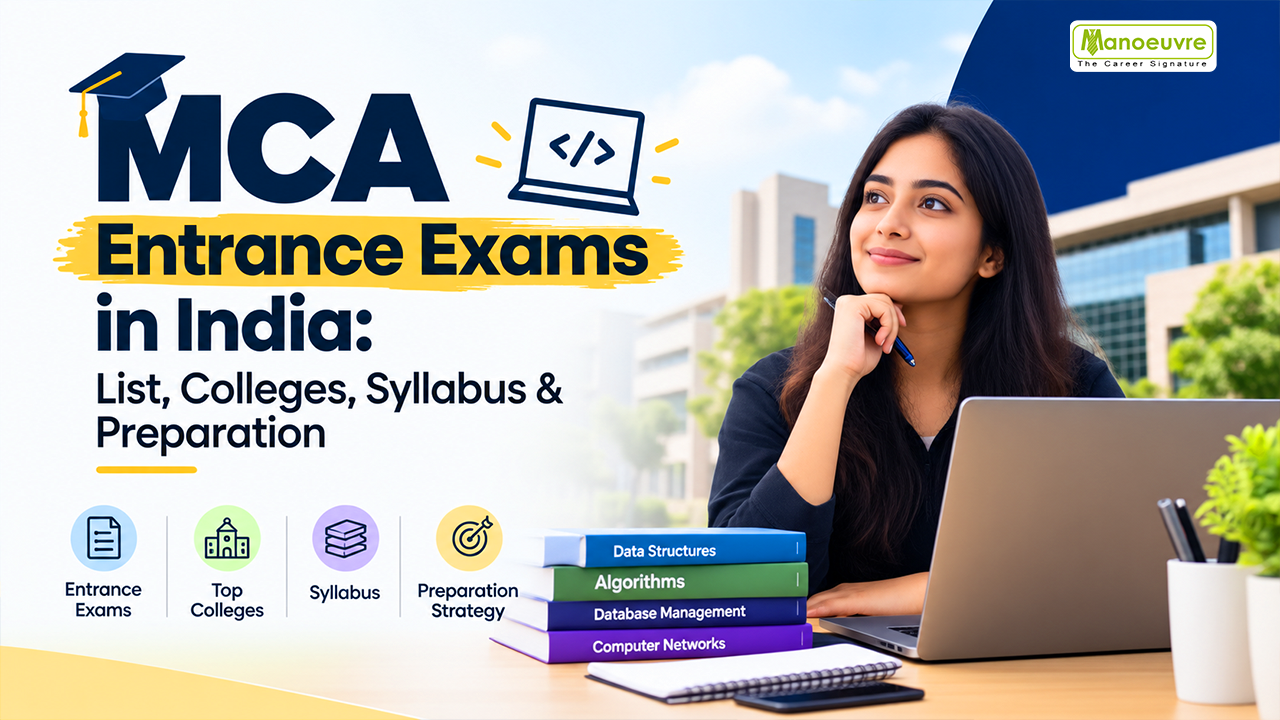
MCA Entrance Exams in India: List, Colleges, Syllabus & Preparation Choosing an MCA programme is not only about finding a good college. For many students, the first step is deciding which entrance exam to take. Different universities and institutes follow different admission routes, so there is no single examination that applies to every MCA college in India.Some of the major options include NIMCET, CUET PG and MAH MCA CET, along with university-specific MCA admissions at institutions such as the University of Delhi, Banaras Hindu University and Jawaharlal Nehru University. There are a few more university-level admission routes as well, but these are among the important options students should know about.This guide covers the top MCA entrance exams in India, colleges accepting their scores, syllabus, eligibility, preparation strategy and admission process. What is an MCA Entrance Exam? An MCA entrance exam is a test used by universities or institutions to select students for admission to the Master of Computer Applications (MCA) programme. Depending on the institution, the examination may test mathematics, reasoning, computer knowledge, English or subject-specific knowledge.The admission route is not the same everywhere. For example, NIMCET is used for MCA admission at participating NITs and IIITs, while CUET PG is used by several universities, including JNU and BHU for their MCA admissions. MAH MCA CET is used for MCA admissions across eligible institutions in Maharashtra. List of MCA Entrance Exams in India Students looking for an MCA entrance exam have several options. The following are some of the major exams and admission routes worth considering:Exam / Admission RouteConducting Body / UniversityMajor Admission OptionsNIMCETNITsParticipating NITs and IIITsCUET PGNTAParticipating universitiesDelhi UniversityUniversity of DelhiDU MCABanaras Hindu UniversityBHUBHU MCAJawaharlal Nehru UniversityJNUJNU MCAMAH MCA CETMaharashtra CET CellEligible MCA institutes in MaharashtraThese are not the only possible routes for MCA admission, but they cover several important national, university-level and state-level opportunities. Top MCA Entrance Exams in India 1. NIMCETThe NIT MCA Common Entrance Test (NIMCET) is a major entrance examination for students targeting MCA programmes at participating NITs and IIITs. It is particularly relevant for students looking for an NIT MCA entrance exam.Colleges accepting NIMCET score include:NIT TiruchirappalliNIT WarangalNIT DelhiNIT KurukshetraMNNIT AllahabadNIMCET scores are used for admission to participating NITs and IIITs under the NIMCET admission process.2. CUET PGThe Common University Entrance Test (CUET PG), conducted by the National Testing Agency, is a national-level entrance exam for postgraduate admissions. For MCA-related admissions, the Computer Science and Information Technology paper (SCQP09) is relevant.Universities accepting CUET PG for MCA include:University of DelhiBanaras Hindu UniversityJawaharlal Nehru UniversityOther participating universities offering MCAThe exact universities and programmes accepting CUET PG scores can vary, so students should check the relevant admission requirements before applying.3. Delhi University MCA AdmissionThe University of Delhi offers a two-year full-time MCA programme through its Department of Computer Science. MCA admission is conducted through the university's prescribed postgraduate admission process, with CUET PG being the entrance route for the programme.Department:Department of Computer ScienceStudents targeting DU should check the latest eligibility requirements and admission guidelines before applying.4. Banaras Hindu UniversityBanaras Hindu University (BHU) offers a two-year MCA programme through its Department of Computer Science. Admission is based on CUET PG, followed by the university's postgraduate admission process.Department:Department of Computer ScienceStudents should check the latest BHU admission notification for eligibility, programme requirements and application procedures.5. Jawaharlal Nehru UniversityJawaharlal Nehru University (JNU) offers an MCA programme through the School of Computer and Systems Sciences. Admission is through CUET PG, with the relevant Computer Science and Information Technology paper being SCQP09.Department:School of Computer and Systems SciencesEligibility requirements may include a relevant bachelor's degree and Mathematics, depending on the admission criteria.6. MAH MCA CETMAH MCA CET is a state-level entrance examination for MCA admissions in Maharashtra. It is conducted by the Maharashtra State CET Cell and is accepted by eligible government, university, aided and unaided MCA institutes in the state.The exam is a key option for students looking for an MCA college in Maharashtra.Colleges accepting MAH MCA CET score include:Veermata Jijabai Technological Institute (VJTI), MumbaiSardar Patel Institute of Technology (SPIT), MumbaiK J Somaiya Institute of Technology, MumbaiVishwakarma Institute of Technology (VIT), PuneThakur Institute of Management Studies, Career Development & Research, MumbaiThe list of participating colleges and programme-wise admission rules can vary, so candidates should check the applicable admission process before applying. MCA Entrance Exam Pattern The pattern depends on the examination you choose. Like - The examination pattern of MAH MCA CET 2026 comprises 4 sections which are Mathematics & Statistics, Logical/Abstract Reasoning, English Comprehension & Verbal Ability and Computer Concepts. In this case, there are 100 questions carrying 200 marks, the duration is 90 minutes long and there is no penalty for wrong answers.ExamMain AreasModeNegative MarkingNIMCETMathematics, reasoning, computer awareness, EnglishOnlineAs per official patternCUET PGSubject-specific knowledgeCBTAs per current NTA patternMAH MCA CETMathematics, reasoning, English, computersOnlineNoSince examination patterns can change, always check the latest notification before beginning preparation. MCA Entrance Exam Syllabus There is some overlap between different exams, but there is no single MCA entrance exam syllabus that applies everywhere.MathematicsCommon areas include:AlgebraArithmeticProbability and statisticsCoordinate geometryCalculusSet theoryPermutations and combinationsLogical and Analytical ReasoningPreparation may include:SeriesPuzzlesLogical relationshipsAnalytical situationsPattern-based questionsComputer ConceptsDepending on the examination, topics can include:Computer fundamentalsOperating systemsData structuresComputer architectureProgrammingData representationEnglishSome exams may test:GrammarVocabularyReading comprehensionSentence correctionVerbal abilityFor example, the MAH MCA CET syllabus specifically includes mathematics and statistics, reasoning, English and computer concepts. CUET PG's SCQP09 paper is subject-specific and covers areas including mathematics, reasoning and computer science. Colleges Accepting MCA Entrance Exam Scores Your choice of entrance examination should ideally start with the college you want.Target InstitutionEntrance Exam / RouteParticipating NITs and IIITsNIMCETUniversity of DelhiCUET PGBanaras Hindu UniversityCUET PGJawaharlal Nehru UniversityCUET PGEligible Maharashtra MCA institutesMAH MCA CETThe list of participating institutions and accepted examinations can change, so candidates should verify the admission rules for the specific year and programme. Which MCA Entrance Exam Should You Choose? There is no single best MCA entrance exam for everyone.If your priority is an MCA at participating NITs or IIITs, NIMCET is the obvious exam to consider. Students targeting DU, BHU or JNU should look closely at CUET PG and the respective university admission process. Those targeting MCA colleges across Maharashtra should consider MAH MCA CET.A simple approach is to shortlist colleges first and exams second. This prevents you from preparing for an examination that does not lead to the institutions you actually want. MCA Entrance Exam Eligibility Eligibility varies between examinations and universities. In general, candidates need a bachelor's degree, but the required subjects and minimum marks can differ.For example, MAH MCA CET 2026 requires a graduation degree with the prescribed marks and preferably Mathematics at the 10+2 or graduation level. Final-year students can also appear.NIMCET and university-specific admissions have their own eligibility conditions, so students should not assume that meeting one exam's criteria automatically makes them eligible for another. MCA Admission Process The usual admission journey looks like this:Check eligibility and target colleges.Select the relevant entrance exam.Complete registration.Appear for the examination.Check the result or score.Apply through the relevant counselling or university admission portal.Participate in seat allocation or merit-based selection.Complete document verification and fee payment.The exact process differs. For instance, NIMCET uses online counselling after the entrance test, while BHU requires candidates to participate in its postgraduate admission process after CUET PG. MCA Entrance Exams Preparation Start by understanding the exact exam you are targeting. Don't prepare from a generic book and assume it will cover everything.Build your basics in mathematics, reasoning and computer concepts first. Then move to topic-wise practice and timed tests. Once your fundamentals are comfortable, start taking full-length mocks.Most importantly, analyse your mocks. A mock test is useful only when you understand why you got questions wrong, which topics consume too much time and where your accuracy drops.Previous-year papers are equally useful because they show you the type of questions you are likely to face. Common Mistakes to Avoid Preparing for MCA entrance exams becomes easier when you have a clear plan and know what to avoid. Some common mistakes can affect both your preparation and admission chances.Choosing an exam without checking which colleges accept itPreparing from an outdated syllabusIgnoring mathematics requirementsTaking mock tests without analysing themSpending too long on difficult questionsApplying without checking eligibilityMissing counselling or admission deadlinesAvoiding these mistakes can help you use your preparation time more effectively and stay on track throughout the admission process. Career Options After MCA An MCA can lead to several technology-focused career paths. Depending on your skills and interests, common options include software development, web development, database management, cybersecurity, cloud technology, data-related roles and IT consulting.Your career options will depend not only on the MCA degree but also on your technical skills, projects, internships and practical experience. Final Thoughts The right MCA entrance exam depends on where you want to study. NIMCET is important for students targeting participating NITs and IIITs, while CUET PG opens opportunities at universities such as DU, BHU and JNU. MAH MCA CET is a key option for MCA admissions in Maharashtra.Rather than applying for every exam available, start by making a shortlist of the MCA colleges you want. Then check their eligibility, accepted entrance exam and admission process. Once you've figured that out, your prep strategy becomes way more focused. Frequently Asked Questions 1. What is the MCA degree for?MCA is a postgraduate programme focused on computer applications, software, programming and related areas of information technology. It can prepare students for careers across the technology sector.2. Which entrance exam is for MCA?Major options include NIMCET, CUET PG and MAH MCA CET. Some universities also have specific admission routes. The right exam depends on the MCA college or university you want to target.3. Is CET compulsory for MCA?No. CET is not compulsory for every MCA programme. Different institutions use different admission routes, including NIMCET, CUET PG and MAH MCA CET.4. Is MCA easy or tough?MCA itself is manageable if you have a good foundation in mathematics, programming and computer concepts. The difficulty depends on your background, the programme and the entrance examination you are targeting.5. Who is eligible for the NIMCET exam?NIMCET has its own eligibility requirements covering the qualifying degree, marks and Mathematics-related requirements. Candidates should check the latest NIMCET information brochure before applying.6. Is MCA 2 years or 3 years in NIT?For the 2026 admission cycle, the NIMCET participating institutes describe the MCA programme as a three-year postgraduate programme.7. How many attempts are allowed for NIMCET?Candidates should refer to the latest NIMCET information brochure for the applicable attempt and eligibility rules for that admission cycle.8. What is the MCA CET exam?MAH MCA CET is a Maharashtra state-level entrance examination conducted for admission to eligible MCA institutes in the state. The 2026 exam covered Mathematics & Statistics, Logical/Abstract Reasoning, English, and Computer Concepts. 9. Is the MCA course available in DU?Yes. The University of Delhi offers a two-year MCA programme through its Department of Computer Science.

03 Sep 2026
0 comments
Top Career Options After MBA: Jobs, Salary & Opportunities Completing an MBA is a big milestone, but it does not mean everyone has to follow the same career path. One graduate may want to join an MNC, another may prefer consulting, while someone else may want to prepare for a government role or continue with higher studies.Your career options after MBA depend on several things, including your specialisation, college, academic record, skills, internships, work experience and the kind of work you actually enjoy. So, instead of looking at MBA as a qualification that leads to one particular job, it is better to look at the different routes available after graduation. What Can You Do After an MBA? Broadly, there are two choices: start working or pursue higher studies.Start a Job After MBAIf you want to gain professional experience, you can apply for roles in the private or government sector.The private sector includes:● MNCs● Consulting firms● Banks and financial institutions● FMCG companies● Technology companies● E-commerce businesses● Startups● Manufacturing and retail companiesGovernment opportunities can be found in areas such as banking, financial regulation, development finance, insurance and public-sector organisations, depending on the recruitment rules for the particular post.Go for Higher StudiesAn MBA can also be followed by further education. Students interested in research or academics can consider a PhD in Management or a related discipline.Others may choose professional certifications or specialised programmes in areas such as finance, analytics, project management, technology or human resources. The important thing is to have a reason for continuing your education. Another qualification makes sense when it helps you move towards a specific career goal. Career Options After MBA in the Private Sector The private sector offers some of the widest MBA job opportunities. Your specialisation and skills will usually influence the roles you can target.Management ConsultingConsultants work with businesses to solve problems, improve performance and make strategic decisions. The work can involve market research, financial analysis, operations, technology or organisational strategy.FinanceMBA Finance graduates can explore corporate finance, financial analysis, banking, investment-related roles, risk management and other financial services positions.Marketing and Brand ManagementMarketing professionals work on customer research, campaigns, branding, product positioning, sales strategy and market growth.Human ResourcesHR roles cover recruitment, employee engagement, talent management, learning and development, compensation and organisational planning.Business AnalyticsBusiness analysts use data to understand business performance and support decision-making. An MBA combined with strong analytical and data skills can be useful for this career.Operations and Supply ChainOperations professionals work on improving processes, managing supply chains, logistics, production and overall business efficiency.Product ManagementProduct managers work between customers, business teams, design and technology teams to develop and improve products. This is a popular career path in technology and digital businesses.Sales and Business Development These roles involve finding new customers, managing relationships, developing business and meeting revenue targets. MBA Career Opportunities in MNCs MNCs are another major destination for management graduates. Companies operating across technology, consulting, FMCG, finance, healthcare, retail and other industries hire people for different business functions. For example, Accenture's India careers platform lists opportunities across strategy and consulting, technology, operations, AI and analytics, supply chain, marketing and sales. Its current India job listings also show roles where MBA/PGDM qualifications are relevant, including consulting and capital-markets positions. Other well-known MNCs where MBA graduates may find relevant roles include: ● McKinsey & Company - consulting and strategy ● Boston Consulting Group - consulting and business strategy ● Deloitte - consulting, advisory and business services ● Accenture - consulting, technology, operations and strategy ● Amazon - product, operations, business development and corporate roles ● Microsoft - business, product and strategy-related roles ● Google - business strategy, sales, partnerships and other functions However, the exact qualification requirements vary from one vacancy to another. An MBA alone does not guarantee an MNC role. Companies also consider skills, experience, academic performance and the requirements of the position. Government Jobs for MBA Graduates An MBA can also be useful for certain government and public-sector careers, but the route is different from private placements.Reserve Bank of IndiaRBI recruits for different streams and positions. Depending on the notification, management graduates can be eligible for certain specialist or general positions. For example, RBI's recruitment information has included MBA/PGDM Finance as an accepted qualification for specific specialist streams.SEBIThe Securities and Exchange Board of India recruits officers through its Grade A recruitment process. Graduates with relevant management, finance and other qualifications can explore the streams specified in individual recruitment notifications.NABARDThe National Bank for Agriculture and Rural Development offers opportunities in banking, rural development, finance and related areas. Eligibility depends on the post and the qualification specified in the recruitment notification.SIDBIThe Small Industries Development Bank of India works in development finance and MSME banking. MBA graduates can look at recruitment notifications for management, banking, finance and related positions where their qualification is accepted.Public-Sector CompaniesSome government-owned companies recruit management graduates for specific executive or management-trainee positions. Depending on the organisation and notification, MBA/PGDM graduates may find opportunities in areas such as HR, marketing, operations or management.Examples of organisations worth tracking include:● NTPC● ONGC● Power Grid Corporation of India● Coal India● Indian Oil Corporation● Bharat Electronics LimitedThe exact qualification differs by recruitment cycle. Therefore, students should always check the official notification before assuming that an MBA is sufficient for a particular PSU position.Public-Sector Banking MBA graduates can also explore opportunities in public-sector banking. Depending on the recruitment route, roles may be available in general banking as well as specialist areas such as marketing, HR, finance, digital banking and operations. Higher Studies After MBA If you do not want to start working immediately, higher studies can be another option.PhD in ManagementThis is suitable for students interested in research, teaching or academic careers.Professional CertificationsA certification can help you build deeper expertise in your chosen area. For example, a finance graduate may pursue an additional finance qualification, while someone interested in analytics may build skills in data and business intelligence.Specialised ProgrammesYou can also take specialised programmes in areas such as digital transformation, analytics, technology management, project management or entrepreneurship. The idea should be to add a useful skill or specialisation rather than simply collecting another certificate. MBA Specialisations and Career Options Your specialisation can influence your first job and the industries you target. MBA Specialisation Possible Career Areas MBA Finance Banking, Financial Analysis, Corporate Finance MBA Marketing Marketing, Sales, Brand Management MBA HR Recruitment, HR Management, Talent Management MBA Operations Operations, Supply Chain, Logistics MBA Business Analytics Business Analysis, Analytics, Business Intelligence MBA IT IT Consulting, Technology Management, Product Roles MBA International Business International Business, Trade, Global Sales Your specialisation is important, but it does not completely decide your career. Internships, additional skills and professional experience can help you move into related areas. MBA Salary: What Can You Expect? There is no fixed MBA salary. Two graduates with the same degree can receive very different offers. Your college, marks, specialisation, skills, internships, previous work experience, communication ability, interview performance and the company you join can all affect your starting package. The role itself also makes a major difference. Job Role Typical Career Area Management Consultant Consulting Financial Analyst Finance Marketing Manager Marketing Business Analyst Analytics HR Manager Human Resources Operations Manager Operations Product Manager Product & Technology Sales Manager Sales & Business Development Academic marks can matter during campus placements because some recruiters set minimum academic requirements. However, marks are not the only factor behind career growth. Practical skills, problem-solving, communication, leadership and professional experience become increasingly important as you progress. MBA Colleges With Strong Placement Packages If salary and placement opportunities are important to you, the college you choose for your MBA matters. Here are some examples using official 2025 placement data: College Average/Mean Salary Highest Reported Salary IIM Ahmedabad ₹35.50 LPA* mean Reported using MEP rather than conventional CTC IIM Kozhikode ₹28.18 LPA mean CTC ₹81 LPA XLRI ₹31.40 LPA average ₹1.10 crore international SPJIMR ₹32 LPA average ₹89 LPA international IIM Lucknow ₹32.3 LPA mean ₹75 LPA domestic **IIM Ahmedabad’s placement figures are based on Maximum Earning Potential (MEP) and not Cost to Company (CTC).Based on official 2025 placement reports, leading B-schools reported strong MBA packages. IIM Ahmedabad recorded a ₹35.50 LPA mean salary, IIM Kozhikode ₹28.18 LPA, XLRI ₹31.40 LPA and SPJIMR ₹32 LPA average salary. IIM Lucknow reported median salaries of ₹32.3 lakh and ₹31 lakh across its major programmes. These numbers should be treated as placement-report figures, not guaranteed salaries. A student's actual offer depends on their profile, role, recruiter, academic performance, skills and placement process. Top Recruiters That Hire MBA Graduates MBA recruiters come from almost every major business sector.Consulting● McKinsey & Company● Boston Consulting Group● Bain & Company● Deloitte● EY● PwC● KPMG● AccentureTechnology● Amazon● Microsoft● Google● Accenture● Other technology and digital companiesBanking and Finance● Major private-sector banks● International banks● Investment banks● Financial services companies● Insurance and fintech companiesFMCG and Consumer BusinessesLarge consumer companies recruit MBA graduates for marketing, sales, finance, supply chain and general management roles.E-commerce and RetailE-commerce and retail companies recruit for product management, category management, operations, marketing, sales and business development. Recruiter lists differ by college and placement year. For example, IIM Kozhikode's 2025 report recorded 169 total recruiters, while SPJIMR's 2025 placement process involved 86 participating companies. PGDM vs MBA Salary: Does the Qualification Matter? An MBA and PGDM are different programme formats, but the qualification name alone does not determine your salary.When comparing PGDM vs MBA salary, look at the institute, programme recognition, curriculum, placement record, specialisation, internships, skills and career opportunities. A strong programme with good industry exposure can be more valuable than choosing a course simply because it has "MBA" or "PGDM" in its name. How to Choose the Right Career After MBA? There is no single best career after MBA.Before choosing a job or higher-study option, ask yourself:● Which area did I enjoy during my MBA?● Does my specialisation match the role?● What are my strongest skills?● Do I want a corporate, government or entrepreneurial career?● Am I more interested in money, stability, learning or leadership opportunities?● Does the job offer a clear path for growth?● Will this role help me develop useful skills? Your first job does not have to define your entire career. What matters is choosing an opportunity that gives you a good starting point and helps you build towards the career you eventually want. Frequently Asked Questions 1. What does an MBA degree mean? MBA stands for Master of Business Administration. It is a postgraduate management qualification that covers areas such as finance, marketing, HR, operations and business strategy. 2. What is the average MBA salary? There is no fixed MBA salary. It depends on the college, job role, specialisation, marks, skills, internships, work experience, employer and interview performance. 3. Is MBA very costly? MBA fees vary widely depending on the institute and programme. Students should compare fees with placement records, scholarships, education-loan options and overall career opportunities. 4. Is the MBA a 2-year course? A traditional full-time MBA in India is generally a two-year programme. Executive, part-time, online and other formats can have different durations. 5. What is the career after an MBA? MBA graduates can work in consulting, finance, marketing, HR, operations, analytics, technology, product management, sales, banking and several other areas. 6. What are the job opportunities after an MBA? Job opportunities after MBA are available in MNCs, consulting firms, banks, technology companies, FMCG, e-commerce, startups, government organisations and public-sector institutions, depending on the candidate's qualification and profile. 7. How can I get a job in RBI after an MBA? You need to apply for an RBI position for which you meet the stated eligibility requirements. RBI has different recruitment streams and qualifications, so check the official notification for the particular post you want to pursue.
Featured Blogs
 MBA Entrance
 LAW 5years Entrance
 LAW 3years Entrance
 MCA Entrance
 CUET PG Entrance
 BBA Entrance
 BCA Entrance
 Hotel-Management
 B.ED Entrance