MBA Entrance
 LAW 5years Entrance
 LAW 3years Entrance
 MCA Entrance
 CUET PG Entrance
 BBA Entrance
 BCA Entrance
 Hotel-Management
 B.ED Entrance
- August 21, 2026
- |
-
0 comments
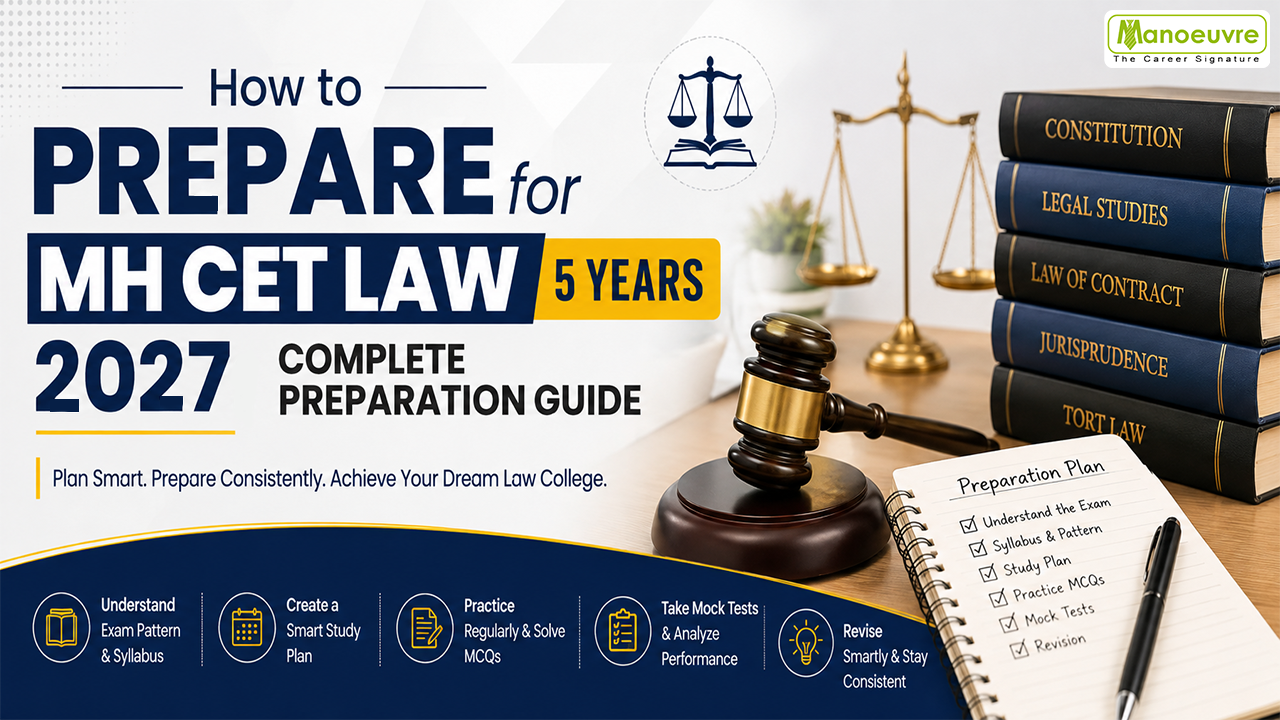
If you're planning to appear for MH CET Law 5 Years 2027, starting your preparation early can give you a significant advantage. The examination serves as the entrance test for admission to 5-year integrated LLB programmes offered by government, government-aided, and private law colleges throughout Maharashtra.
Scoring well requires more than simply completing the syllabus. You need a clear understanding of the exam pattern, regular practice, strong legal aptitude, and effective time management.
This complete MH CET Law 5 Years 2027 preparation guide covers everything you need to know—from the syllabus and study plan to recommended books, mock tests, previous-year papers, and common mistakes to avoid.

Understanding the exam pattern and overall structure is the first step towards effective MH CET Law 5 Years 2027 preparation.
Particulars | Details |
Exam Mode | Online (CBT) |
Duration | 2 Hours |
Total Questions | 120 MCQs |
Maximum Marks | 120 |
Marking Scheme | +1 mark for each correct answer |
Negative Marking | No |
Since there is no negative marking, attempting all questions is generally recommended after using the process of elimination wherever necessary.
The MH CET Law 5 Years syllabus is divided into five major sections. A balanced preparation strategy should cover every section rather than focusing only on one subject.
Section | Key Topics |
Legal Aptitude & Legal Reasoning | Legal principles, constitutional concepts, contracts, torts, legal awareness |
General Knowledge & Current Affairs | Indian polity, history, economics, national and international events |
Logical & Analytical Reasoning | Coding-decoding, blood relations, puzzles, syllogisms, seating arrangements |
English | Reading comprehension, grammar, vocabulary, sentence correction |
Mathematical Aptitude | Percentages, ratios, averages, profit and loss, simple arithmetic |
Legal Aptitude & Legal Reasoning carries significant weight in the exam, so building strong concepts and practising regularly is essential.
Many students begin their preparation without a proper plan, which can lead to incomplete syllabus coverage and insufficient revision.
A more effective strategy is to organise your preparation into three structured stages.
Begin by strengthening your core concepts instead of attempting a large number of questions.
● Complete and understand the syllabus.
● Learn basic legal terminology.
● Improve grammar and vocabulary.
● Revise fundamental mathematical concepts.
● Read newspapers regularly for current affairs.
Once your fundamentals are clear, move towards topic-wise practice.
● Solve sectional tests.
● Improve logical reasoning speed.
● Practice reading comprehension every day.
● Revise legal principles regularly.
● Maintain concise current affairs notes.
The final stage should focus on exam simulation and revision.
● Attempt full-length mock tests.
● Analyse every mistake.
● Identify and improve weak areas.
● Work on time management.
● Revise important GK and legal concepts.
A structured approach helps you complete the syllabus while leaving sufficient time for revision and mock-test practice.
Legal Aptitude & Legal Reasoning is a high-weightage section of the MH CET Law 5 Years exam and requires both conceptual understanding and regular practice.
Instead of simply memorising laws, focus on understanding legal principles and applying them to practical situations. Questions may require you to analyse a principle and apply it to a given set of facts.
● Study basic constitutional concepts.
● Learn important legal maxims.
● Practice principle-fact questions.
● Solve previous-year legal reasoning questions.
● Revise important legal vocabulary regularly.
This section rewards consistent daily preparation rather than last-minute studying.
Focus on important areas such as:
● Indian Constitution and polity
● Important government schemes
● Awards and honours
● Sports events
● National and international events
● Science and technology developments
Reading a quality newspaper for 20–30 minutes every day can help improve your awareness of current events.
Accuracy is more important than attempting every difficult puzzle. Build your fundamentals first and gradually increase your solving speed.
Important topics include:
● Number and letter series
● Syllogisms
● Direction sense
● Blood relations
● Coding-decoding
● Critical reasoning
● Puzzles
● Seating arrangements
Practise timed question sets regularly to gradually improve both your solving speed and accuracy.
The English section primarily tests your comprehension and language skills.
Focus on:
● Reading comprehension
● Error detection
● Vocabulary
● Synonyms and antonyms
● Sentence improvement
● Grammar rules
Reading newspaper editorials and quality articles regularly can also help improve reading speed and comprehension.
The Mathematics section is generally based on fundamental arithmetic concepts.
Important topics include:
● Percentages
● Ratio and proportion
● Averages
● Time and work
● Profit and loss
● Simple interest
● Compound interest
● Basic arithmetic
Solving 15–20 mathematics questions each day can gradually enhance both calculation speed and accuracy.
The following 90-day study plan can help students preparing alongside school or college.
Time Period | Primary Focus |
Days 1–30 | Complete concepts and basic practice |
Days 31–60 | Sectional tests and previous-year questions |
Days 61–75 | Full-syllabus revision |
Days 76–90 | Mock tests and performance analysis |
A consistent daily study routine of 3–5 hours is generally more effective than irregular long-hour study sessions.
Choosing the right study material is an important part of MH CET Law preparation. Rather than referring to multiple books for different subjects, it is more effective to use a structured resource that covers the complete syllabus and provides enough practice for the exam.
Manoeuvre's Law Entrance Books & E-Books are created for law entrance aspirants and cover key areas such as Legal Aptitude, Logical Reasoning, English, GK & Current Affairs, previous-year questions, and practice exercises in one comprehensive resource.
Mock tests are one of the most valuable components of MH CET Law 2027 preparation because they allow you to apply your knowledge under exam-like conditions.
● Improves speed and accuracy.
● Identifies weak sections.
● Builds exam confidence.
● Improves time management.
● Familiarises you with the CBT format.
● Helps develop an effective question-attempt strategy.
After every mock test, spend sufficient time analysing your mistakes, rather than simply checking your score.
You don’t need
expensive or complicated material in Class 11. Keep it simple.
Recommended resources:
For Reading
● The Hindu /
Indian Express
● Editorial blogs
For GK
● Monthly current
affairs PDFs
● Yearly compendiums later
For Practice
● Basic reasoning
books
● CLAT beginner material
● Previous year questions
Remember — depth matters more than quantity.
After completing every mock test, ask yourself:
● Which section consumed the most time?
● Were the mistakes conceptual or careless?
● Which topics require further revision?
● How many questions were left unattempted?
● Did my accuracy improve compared with previous tests?
● Which questions took too long to solve?
Maintaining a mistake notebook can help you identify recurring errors and prevent them from being repeated.
Solving previous-year papers is an important part of MH CET Law preparation. They help students understand the nature and difficulty level of questions.
Previous-year papers can help you understand:
● Question difficulty
● Frequently tested topics
● Section-wise question distribution
● Time required for different sections
● Types of legal reasoning questions
Try solving previous-year papers in a timed and distraction-free environment to replicate actual exam conditions.
A simple and realistic daily routine is easier to follow consistently.
Activity | Suggested Duration |
Newspaper & Current Affairs | 30 minutes |
Legal Aptitude | 60 minutes |
Logical Reasoning | 45 minutes |
English Practice | 30 minutes |
Mathematics | 30 minutes |
Revision | 30–45 minutes |
You can adjust these timings according to your school, college, or other commitments.
Many students lose marks because of avoidable preparation mistakes rather than a lack of knowledge.
Avoid these common mistakes:
● Ignoring legal reasoning until the last month.
● Skipping current affairs preparation.
● Solving questions without analysing mistakes.
● Practising only easy topics.
● Attempting too few mock tests.
● Not revising completed topics.
● Frequently changing books and study resources.
● Ignoring time management until the final stage.
Consistency and regular revision generally produce better results than continuously studying new topics without revisiting previously completed material.
While self-study can work well for many students, some aspirants benefit from structured coaching and expert guidance.
A well-structured preparation programme can provide:
● Topic-wise classroom learning
● Study material aligned with the syllabus
● Regular mock tests
● Doubt-solving sessions
● Performance tracking
● Previous-year paper practice
● Structured revision
The right guidance can help students maintain discipline and follow a systematic preparation strategy throughout the year.
During the final few weeks before the examination, focus more on revision, practice, and accuracy rather than trying to learn everything from scratch.
● Revise important legal principles instead of starting too many new topics.
● Take a full-length mock test every 2–3 days.
● Read concise current affairs notes daily.
● Revise important grammar rules and vocabulary.
● Review your mistake notebook.
● Practise time management.
● Avoid unnecessary changes to your preparation strategy.
● Get adequate sleep before the examination.
● Stay calm and avoid last-minute stress.
A calm, focused, and consistent revision strategy can be more effective than excessive studying during the final week.

Start by understanding the exam pattern and syllabus. Build your fundamentals section-wise, then gradually move towards topic-wise practice, sectional tests, mock tests, and revision.
The difficulty level can vary from year to year. Students who develop strong legal reasoning, logical aptitude, English, mathematical fundamentals, and current affairs knowledge through consistent practice can prepare effectively for the examination.
Aim to attempt at least 20–30 full-length mock tests before the examination, along with regular sectional tests. More important than the number of tests is analysing your performance after each one.
As per the exam pattern outlined above, there is no negative marking. Each correctly answered question carries one mark.
Legal Aptitude & Legal Reasoning is one of the key sections of the examination. However, students should maintain balanced preparation across all five sections because a strong overall score requires consistent performance throughout the paper.
Preparing for MH CET Law 5 Years 2027 requires a combination of conceptual clarity, regular practice, current affairs awareness, mock-test analysis, and effective time management.
Start early, follow a structured study plan, practise consistently, and regularly analyse your performance. Rather than trying to study everything at once, focus on building strong fundamentals and improving your accuracy and speed step by step.
With disciplined preparation and consistent revision, you can approach the MH CET Law 5 Years 2027 examination with greater confidence and readiness.
Latest Blog