MBA Entrance
 LAW 5years Entrance
 LAW 3years Entrance
 MCA Entrance
 CUET PG Entrance
 BBA Entrance
 BCA Entrance
 Hotel-Management
 B.ED Entrance

- October 21, 2026
- |
-
0 comments
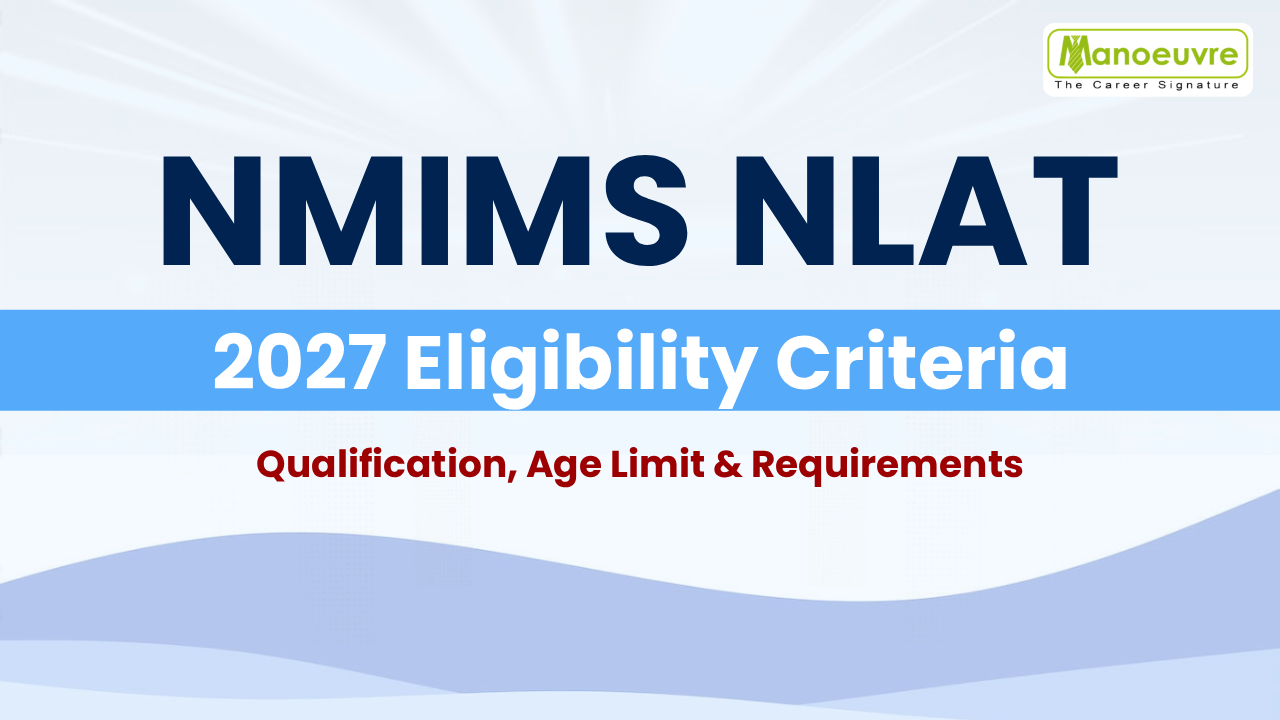
Before applying for the NMIMS NLAT 2027, candidates should check whether they satisfy the academic and other admission conditions. NLAT functions as the qualifying examination for entry into NMIMS School of Law's five-year B.A., LL.B. (Honours) and B.B.A., LL.B. (Honours) integrated degree pathways.
The basic requirement is straightforward: candidates must have completed 10+2 or an equivalent examination with at least 50% aggregate marks. However, NMIMS has additional rules concerning subject-wise performance, age, IB and Cambridge qualifications, aggregate calculation, and marksheet requirements.
Note: Eligibility details are based on 2026 data. Check the official NMIMS website for updated NLAT 2027 criteria when announced.

Here is a quick overview of the main NLAT exam eligibility requirements:
The two integrated law programmes have a duration of five years.
For NMIMS NLAT 2027, candidates need to have passed Class 12/10+2 or an equivalent qualification.
The important conditions are:
● Minimum 50% aggregate marks in 10+2 or equivalent.
● All subjects taken and appeared for must be passed.
● The qualifying examination must have been completed in a single attempt, as prescribed.
● Any mandatory subject applicable to the programme must be successfully completed.
● The qualification must be from a recognized examining board or equivalent institution.
Therefore, simply reaching the 50% overall threshold is not enough if a candidate has failed or has an ungraded result in an applicable subject.
NMIMS NLAT provides admission to two integrated law courses:
The B.A., LL.B. programme combines law with areas of humanities, while B.B.A., LL.B. brings management-related subjects into the integrated law curriculum.
The age rule is particularly important for candidates who are older than the usual undergraduate applicant.
Candidates above 25 years of age can apply for the B.A. LL.B. and B.B.A. LL.B. programmes under the NLAT examination category.
The NMIMS admission handout separately specifies a maximum age requirement of 25 years for other programmes covered under the same admission framework.
One common mistake is assuming that NMIMS will calculate eligibility using the best four or five subjects.
It does not.
For boards such as State Boards, CBSE and ICSE, candidates must provide the aggregate marks for all subjects they have taken, opted for and appeared in.
No. The best-of-four, best-of-five, best-of-six or best-of-seven method is not used for confirming eligibility.
Candidates should therefore calculate their percentage using the complete set of applicable subjects appearing on their official academic record.
Students from CBSE, ICSE and other recognized boards need to follow the aggregate calculation rule specified by NMIMS.
Remember these points:
● Include all subjects taken and appeared for.
● Do not use only the highest-scoring subjects.
● Every applicable subject should be passed.
● The aggregate percentage is checked during admission and document verification.
● A fail or ungraded subject can affect eligibility, subject to the specific board provisions.
This makes it important to check the marksheet carefully before submitting the application.
Students from the International Baccalaureate (IB) Board have additional equivalence requirements.
The prescribed requirements include:
● At least 24 grades/credits
● 3 subjects at Higher Level (HL)
● 3 subjects at Standard Level (SL)
● Extended Essay
● Theory of Knowledge (TOK)
The prescribed subject combination may include:
● 2 HL + 2 SL subjects, or
● 3 SL + 1 HL subject
Separate conditions apply depending on the programme strand.
For the general strand, the prescribed requirement includes DP subjects with at least one at HL, the required minimum points, and completion of the specified Career Related Studies.
Candidates should also arrange the required official Indian conversion transcript where applicable.
Candidates following the Cambridge Board have a separate aggregate calculation rule.
For A Level qualifications:
● At least 3 Advanced Level subjects are considered for aggregate calculation.
● Ungraded subjects/grades are not included.
● Candidates may need to provide an equivalent percentage where the original academic record uses another grading format.
The marks used for eligibility must accurately reflect the candidate's official academic record.
Not every board reports marks as percentages. If the marksheet contains a:
● GPA
● CGPA
● Point system
● Percentile
● Performance band
the candidate may need to submit the corresponding aggregate percentage or certified conversion.
For IB candidates, an official Indian conversion transcript is mandatory as specified by NMIMS.
Candidates whose final result is not available at the time of admission may be allowed to proceed provisionally in specified cases, particularly under the IB and Cambridge provisions.
However:
● Predicted scores may be used for provisional admission where permitted.
● The final marksheet/transcript must subsequently be submitted.
● Admission is confirmed only after eligibility is verified.
● Failure to provide the required final document within the prescribed period can result in cancellation.
Students who completed their 10+2 or equivalent qualification outside India need to establish that their qualification is equivalent to the required Indian standard.
An AIU/equivalence certificate may be required for candidates who have completed their qualifying education through an overseas school, institution or university.
The same documentation principle can apply to specified open-school, distance-learning and correspondence qualifications.
Candidates who completed Class 12 through:
● Distance learning
● Correspondence
● Open school
● Part-time study
may be considered eligible if the qualification is recognized and satisfies the applicable guidelines.
Candidates should ensure that their qualification is valid for admission before completing the application.
The verification of your educational documents forms an essential stage in the admission workflow.
Candidates should keep these points in mind:
● All required subjects must be passed.
● A single marksheet containing the compulsory subjects is required.
● Compartmentalized marksheets are generally not accepted, except where the specified Cambridge provisions apply.
● An ungraded/fail entry can make a candidate ineligible under the prescribed rules.
● GPA/CGPA candidates must provide the required percentage conversion.
● Overseas candidates need the applicable equivalence documentation.
If the final marksheet is unavailable when required, NMIMS may permit submission of an internet or DigiLocker result copy within the prescribed timeline.
Before applying for the NLAT exam, remember:
● You need at least 50% aggregate in 10+2/equivalent.
● The requirement applies to both integrated law programmes.
● All applicable subjects must be passed.
● NMIMS does not follow a best-of-four or best-of-five calculation.
● IB and Cambridge candidates have additional qualification rules.
● GPA/CGPA candidates may need a certified percentage conversion.
● Overseas qualifications require the prescribed equivalence documentation.
● Candidates above 25 can apply through the NLAT category for the specified B.A. LL.B. and B.B.A. LL.B. programmes.
● Paying the admission fee does not by itself establish eligibility.
● Final admission remains subject to verification of the required documents.
Note: These requirements are based on 2026 data. Visit the official NMIMS website for the final NLAT 2027 eligibility criteria.

Candidates need a minimum of 50% aggregate marks in 10+2 or an equivalent examination.
Candidates above 25 years can apply for the specified B.A. LL.B. and B.B.A. LL.B. programmes through the NLAT category.
No. NMIMS considers the aggregate of all subjects taken, opted for and appeared in.
Yes. IB candidates can apply if they satisfy the prescribed IB equivalence and subject requirements.
Yes. Cambridge candidates are eligible subject to the specified A Level and aggregate calculation requirements.
They may be eligible if their 10+2 qualification is recognized and meets the applicable requirements.
NLAT is used for admission to B.A., LL.B. (Hons.) and B.B.A., LL.B. (Hons.) integrated programmes.
No. Meeting the minimum eligibility requirement only makes a candidate eligible to apply. Admission is subject to the prescribed selection process and document verification.
Latest Blog