MBA Entrance
 LAW 5years Entrance
 LAW 3years Entrance
 MCA Entrance
 CUET PG Entrance
 BBA Entrance
 BCA Entrance
 Hotel-Management
 B.ED Entrance

- November 26, 2026
- |
-
0 comments
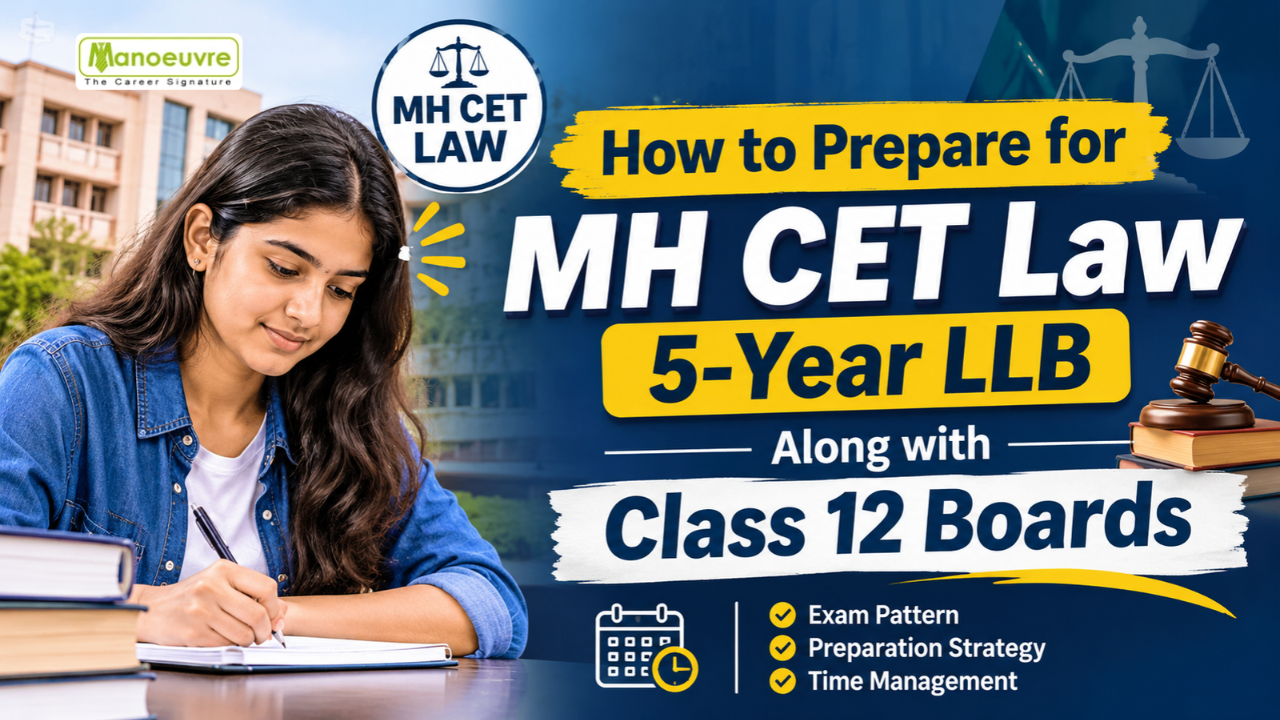
Preparing for Class 12 board examinations and the MH CET Law 5-Year LLB entrance exam simultaneously can feel challenging. Both require consistent preparation, practice and proper time management. However, with a structured study plan, students can manage both examinations without compromising their performance.
For students targeting reputed law colleges such as Government Law College (GLC), Mumbai, and ILS Law College, Pune, starting entrance exam preparation early is particularly important. Aiming for a 95–97 percentile or higher can help students compete for seats in leading institutions, while a 99+ percentile is a competitive target for aspirants aiming for GLC Mumbai and ILS Pune.
The key is to understand that board examinations and the entrance test require different preparation approaches. While Class 12 focuses on academic subjects, the law entrance examination tests aptitude, reasoning, general awareness and language skills.
Here is a practical preparation strategy to help you manage both examinations effectively.

The first step is to understand how these two examinations contribute to your admission journey.
For admission through MH CET Law, your entrance examination score and percentile play a major role in determining your merit position and college allotment. However, students must also satisfy the prescribed Class 12 eligibility requirements.
Therefore, do not ignore your board examinations, but avoid spending all your preparation time on them.
Students should ideally utilise November, December and January to complete a significant portion of their entrance exam syllabus. February can then be dedicated primarily to board examination preparation, while March should focus on entrance exam revision and practice.
This approach prevents last-minute pressure and gives you sufficient time to prepare for both examinations.
Studying for long hours without a clear direction is not an effective strategy. Instead, divide your available study time between board subjects and entrance exam preparation.
During regular school days, dedicate a fixed portion of your schedule to aptitude preparation. On weekends and holidays, increase the time available for entrance exam practice.
An example of a daily timetable is:
You can modify this schedule depending on your school timings, board subject requirements and individual strengths.
The objective is to maintain consistency rather than follow an unrealistic timetable that becomes difficult to sustain.
Consistent practice in English can help candidates enhance their accuracy, reading ability, and speed in this section.
Try to complete the major topics by December 10 so that you have sufficient time for revision and mock tests later.
Focus on the following areas:
Grammar and sentence correction
Vocabulary and word power
Reading comprehension
Verbal ability
Fill in the blanks
Para jumbles
Sentence arrangement and completion
Use topic-wise handouts, grammar rules and recorded lectures to strengthen your fundamentals. Maintaining a vocabulary notebook can also help you revise unfamiliar words regularly.
Instead of studying English for several hours on a single day, practise it consistently for 30–45 minutes.
General Knowledge requires continuous preparation because the syllabus covers a wide range of subjects.
Ideally, aim to complete your major Static GK topics by December.
Divide your preparation into two parts:
Static General Knowledge:
Spend approximately one hour daily covering topics such as:
Indian History
Indian Geography
Indian Constitution
Important Personalities
Science and Technology
Awards and Honours
Important National and International Organisations
Books and Authors
Sports and Important Events
Use topic-wise lectures, study handouts and practice tests. Setting a target of approximately 1,000 Static GK questions can help you cover important areas systematically.
Current Affairs:
Dedicate around 30 minutes daily to important national and international developments.
Cover major events from June/July 2026 through January 2027, including government initiatives, appointments, awards, sports events and important legal developments.
Maintain short notes so that you can revise important information quickly before the examination.
Legal Reasoning and Logical Reasoning require conceptual understanding as well as regular question practice.
Do not postpone these subjects until after completing English and GK. Start practising them alongside your scheduled lectures.
For Legal Reasoning, focus on understanding legal principles, applying rules to given situations and identifying the correct conclusions.
For Logical Reasoning, practise:
Series and sequences
Coding and decoding
Blood relations
Directions
Syllogisms
Analogies
Statement and conclusion
Critical reasoning
Begin with easy-level questions and gradually move towards moderate-level practice.
After completing each topic, attempt topic-wise tests. Regular topic-wise practice can help you recognise your weak areas, reduce errors, solve questions more efficiently, and gain familiarity with different types of questions.
Students who are not particularly comfortable with Mathematics should not panic. The objective is to build confidence in fundamental topics rather than spend excessive time mastering every possible concept.
Prioritise the following topics:
Simplification
Percentage
Average
Profit and Loss
Simple and Compound Interest
Ratio and Proportion
Partnership
Mixture and Alligation
Problems on Ages
Time, Speed and Distance
Time and Work
Basic LCM and HCF
Practise approximately 20–30 questions from each topic after understanding the underlying concepts.
Use a dedicated book or e-book for numerical practice. Prioritise solving questions correctly at first, then work towards increasing your calculation speed through regular practice.
Mock tests should become an essential part of your preparation from around December 25.
Do not wait until you have completed every topic or become completely confident. Your initial mock test scores may be low, but that is a normal part of the learning process.
Follow this approach:
Start attempting full-length practice tests.
Analyse your incorrect and unanswered questions.
Identify topics where you are losing time.
Practise previous years' examination papers, including Slot 1 and Slot 2 papers.
Keep track of your performance by noting your scores and accuracy after each test.
Gradually improve your time management.
Mock tests familiarise you with the actual exam format and help you practise answering questions within the given time limit.
Remember, analysing a mock test is just as important as attempting it.
March should not be the month when you start learning major topics from scratch.
By this stage, your primary syllabus should already be covered. Your preparation should focus on revision, mock examinations and improving your overall performance.
If you are appearing for the first attempt on March 28 and 29, 2027, plan your final revision accordingly.
The announced schedule also lists an optional second attempt on May 24, 2027. Students should consider appearing for both attempts if eligible, as another opportunity may help improve their performance.
However, do not skip the first attempt while preparing for the second one. Treat the first attempt as an important examination in its own right.
Students targeting leading institutions should set clear performance goals.
A percentile of 95–97 or higher can be a useful preparation benchmark for students targeting top law colleges. Those aiming for GLC Mumbai and ILS Pune should consider targeting 99+ percentile to remain competitive.
These are preparation targets, not guaranteed admission cut-offs. Actual college allotment depends on factors such as merit, category, seat availability and the counselling process.
Focus on improving your accuracy, reducing unnecessary mistakes and maintaining consistency across all sections.
One common mistake students make is relying entirely on unstructured self-study. Without proper guidance, it can become difficult to understand which topics to prioritise, how much practice is required and when to begin mock tests.
A structured coaching programme can provide:
A planned syllabus completion schedule
Live or recorded lectures
Subject-wise study materials
Topic-wise practice tests
Full-length mock examinations
Performance analysis
Mentorship and preparation guidance
At Manoeuvre Education, students can explore the 2027 MH CET Law preparation batches, CET + OLET programmes covering examinations such as CULEE, and self-study options.
Students currently in Class 11 can also start early with the 2028 CLAT, CET and OLET preparation batches.
Preparing for Class 12 boards and the MH CET Law 5-Year LLB examination together requires planning, discipline and consistency. You do not need to study for extremely long hours every day; you need to use your available time effectively.
Complete the major entrance exam topics between November and January, prioritise your board examinations in February and reserve March for revision and mock tests.
Most importantly, avoid unnecessary pressure and do not compare your preparation journey with others. With the right strategy, regular practice and proper guidance, you can work towards strong board results while building the competitive entrance exam score needed for admission to a reputed law college.

1. Can I prepare for MH CET Law 5-Year LLB along with Class 12 board examinations?
Yes. With a structured timetable, students can manage both examinations. Start entrance exam preparation early and gradually shift more attention towards board subjects as the examination approaches.
2. When should I start preparing for MH CET Law 2027?
Ideally, students should begin preparation by November or earlier. November to January is an important period for completing the syllabus, while February can be reserved primarily for board examinations.
3. How many hours should I study daily for MH CET Law along with boards?
Students can initially dedicate around 2–3 hours daily to entrance exam preparation alongside their regular board studies. The schedule can be adjusted depending on individual requirements.
4. Is Class 12 board percentage more important than the MH CET Law percentile?
The entrance examination score and percentile play a major role in determining merit and college allotment. However, students must also meet the prescribed Class 12 eligibility criteria for admission.
5. What percentile should I target for GLC Mumbai and ILS Pune?
Aiming for 99+ percentile can be a competitive preparation target for these reputed colleges. However, actual admission depends on the applicable merit list, category, seat availability and counselling process.
6. When should I start attempting full-length mock tests?
Students should ideally begin full-length mock tests around December 25. Early practice helps identify weak areas and improves speed, accuracy and examination readiness.
7. Should I appear for both MH CET Law 2027 attempts?
If eligible, appearing for both attempts is recommended. The second attempt provides another opportunity to improve your performance, but students should not skip the mandatory first attempt.
8. Can I prepare for MH CET Law without coaching?
Yes, self-study is possible with the right books, study materials, mock tests and consistent practice. However, structured guidance and mentorship can help students follow a systematic preparation plan and avoid unnecessary mistakes.
Latest Blog