MBA Entrance
 LAW 5years Entrance
 LAW 3years Entrance
 MCA Entrance
 CUET PG Entrance
 BBA Entrance
 BCA Entrance
 Hotel-Management
 B.ED Entrance

- November 04, 2026
- |
-
0 comments
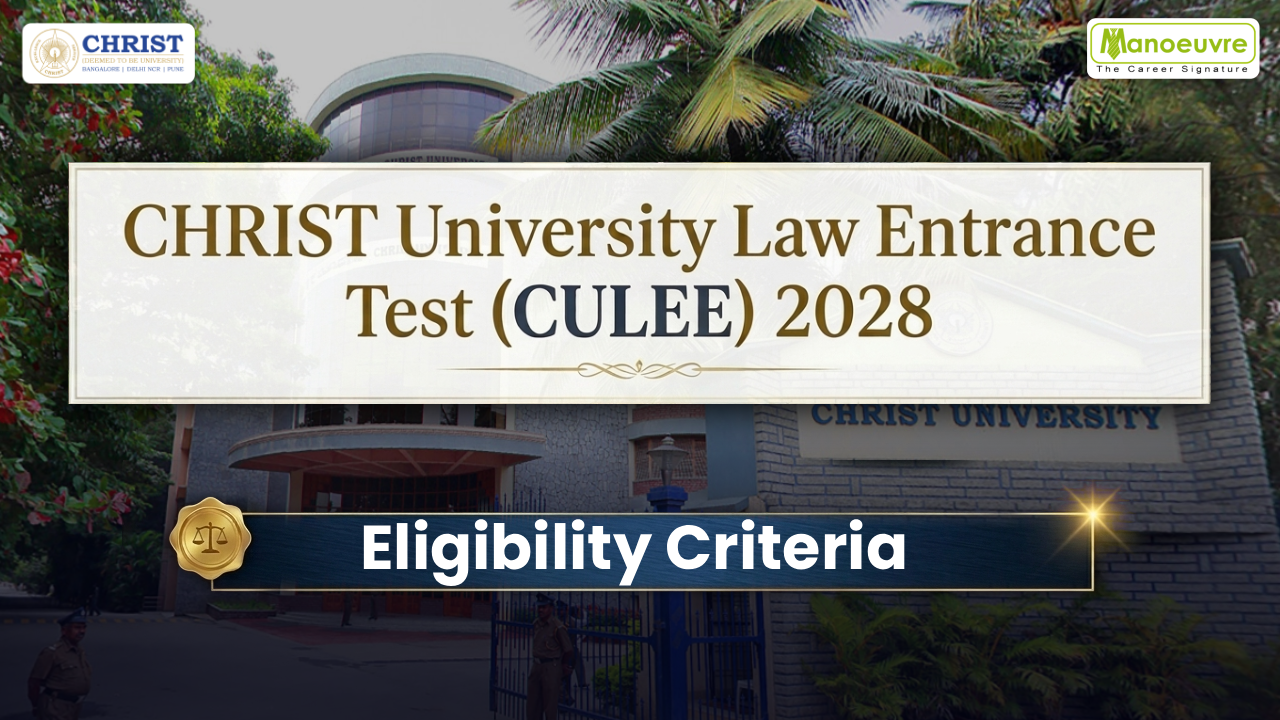
Students planning to pursue a career in law through CHRIST (Deemed to be University) must understand the admission requirements before applying. The CHRIST University Law Entrance Test (CULEE) 2028 is associated with admission to its five-year integrated undergraduate law programmes, namely B.A. LL.B. (Honours) and B.B.A. LL.B. (Honours).
Before beginning the admission process, applicants should understand the academic qualifications, minimum marks, accepted educational boards and other conditions applicable to these programmes. Knowing the CULEE 2028 eligibility criteria helps students determine whether they meet the basic requirements for admission and prepare their applications accordingly.

CHRIST University has certain academic requirements for students seeking admission to its undergraduate law courses. The following table provides a quick summary of the eligibility conditions.
Candidates must satisfy the prescribed academic conditions to be considered for admission to CHRIST University's integrated law programmes. The requirements cover previous educational qualifications, academic performance and the type of qualifying board.
Applicants must have completed their higher secondary education (10+2) or an equivalent qualification from a recognised educational board. Students who have passed Class 12 from a recognised Indian or international education system can apply for the undergraduate law programmes.
The qualifying examination should be recognised by the relevant educational authorities. Candidates must possess the necessary academic documents to establish that they have completed their higher secondary studies.
Academic performance is an important part of the CULEE 2028 admission eligibility requirements. A candidate needs an overall score of at least 45% in the Class 12 or equivalent exam.
Students should calculate their overall qualifying examination percentage carefully to determine whether they meet the minimum academic requirement. Merely passing the Class 12 examination is not sufficient if the candidate does not achieve the prescribed aggregate percentage.
CHRIST University accepts applications from students belonging to different academic streams for its undergraduate law programmes. Candidates do not need to have studied a specific subject combination in Class 11 and Class 12 to become eligible.
Students from the following streams can apply:
● Humanities: Students studying subjects such as Political Science, History, Sociology and Psychology can pursue integrated law programmes.
● Social Sciences: Applicants with an academic background in social science subjects are eligible.
● Commerce: Students who have studied Accountancy, Economics, Business Studies and related subjects can apply.
● Management: Candidates from management-related academic backgrounds can also seek admission.
● Science: Students from PCM, PCB or other science combinations are eligible to pursue undergraduate law courses.
Therefore, students from both science and non-science backgrounds can consider CHRIST University for their legal education.
Students who are currently studying in Class 12 can also submit their applications for CULEE 2028. They do not necessarily need to wait until their final board examination results are declared to begin the application process.
Such applicants can provide their available academic records, including Class 10 and Class 11 marks or Class 12 details, as applicable during registration.
However, admission eligibility must ultimately be established through the final qualifying examination results. Candidates must fulfil the minimum aggregate requirement of 45% in Class 12 to satisfy the academic conditions for admission.
CHRIST University also considers applicants who have completed their higher secondary education through recognised international education systems.
Students studying under the following curricula can apply:
● International Baccalaureate (IB)
● International General Certificate of Secondary Education (IGCSE)
● Other recognised international boards and equivalent qualifications.
Applicants with international academic credentials must meet the applicable equivalence requirements prescribed by the Association of Indian Universities (AIU). The equivalence process helps establish that their previous qualification is comparable to the Indian Class 12 standard.
CHRIST (Deemed to be University) holds recognition as a Minority Educational Institution under Section 2(g) of the National Commission for Minority Educational Institutions Act, 2004. This status distinguishes the university from institutions that are required to implement government-mandated reservation quotas for different social categories.
Accordingly, CHRIST University does not follow the standard Government of India or State Government reservation framework that prescribes fixed seat allocations for categories such as SC, ST and OBC.
The university welcomes students from different social and economic backgrounds and conducts admissions through its institutional selection process. Candidates seeking admission to B.A. LL.B. (Honours) and B.B.A. LL.B. (Honours) are considered under the university's admission framework.
CHRIST University offers two five-year integrated undergraduate law programmes for students interested in pursuing legal education after Class 12. Both programmes combine legal studies with another academic discipline, allowing students to develop a broader understanding of law and its applications.
The Bachelor of Arts and Bachelor of Legislative Law (B.A. LL.B.) is a five-year integrated programme that combines subjects from the humanities and social sciences with professional legal education.
Students interested in areas such as constitutional law, criminal law, civil law and public policy can consider this programme.
Eligibility Requirements:
● Candidates must have passed Class 12 or an equivalent examination from a recognised board.
● A minimum aggregate of 45% marks is required.
● Students from Humanities, Commerce, Science and other eligible streams can apply.
● Students appearing for their Class 12 examinations are also eligible to submit applications.
The Bachelor of Business Administration and Bachelor of Legislative Law (B.B.A. LL.B.) is designed for students who want to understand the relationship between business administration and legal studies.
The programme combines management-related subjects with core law papers, providing an academic foundation for careers involving corporate law, business regulations and commercial legal matters.
Eligibility Requirements:
● You should have cleared Class 12 or a similar qualification
● They must secure at least 45% aggregate marks in the qualifying examination.
● Students from Commerce, Management, Humanities, Science and other recognised streams can apply.
● Candidates awaiting their Class 12 results can also participate in the application process.
Both programmes have the same basic academic eligibility requirements, making them accessible to students from different educational backgrounds.
Candidates should keep their academic certificates and personal identification documents ready while completing the CHRIST University law admission process. These documents help the university establish the applicant's educational background and verify the information provided in the application.
The commonly required documents include:
Students should ensure that their academic records contain accurate personal details and that the submitted information matches their application.
Understanding the CHRIST University Law Entrance Test (CULEE) 2028 eligibility criteria is an important first step for students planning to pursue B.A. LL.B. (Honours) or B.B.A. LL.B. (Honours). With a minimum requirement of 45% aggregate marks in Class 12 and eligibility extended to students from different academic streams, candidates from diverse educational backgrounds can explore these integrated law programmes.
However, academic eligibility alone does not secure a seat at the university. Students should also prepare for the prescribed selection stages and organise their academic documents to complete the admission process smoothly.
Note: The eligibility criteria and admission details may change. Candidates are advised to visit the official CHRIST University website for the latest updates before applying.

Candidates must obtain at least 45% aggregate marks in their Class 12 or equivalent examination to meet the academic eligibility requirements for CHRIST University's undergraduate law programmes.
Yes. Students currently appearing for their Class 12 board examinations can apply using their available academic records. However, they must fulfil the final qualification requirements to secure admission.
Yes. Students from PCM, PCB and other science streams can apply for B.A. LL.B. (Honours) and B.B.A. LL.B. (Honours), provided they satisfy the minimum academic requirements.
Yes. Commerce students are eligible to pursue both integrated law programmes at CHRIST University. There is no compulsory requirement to have studied Humanities in Class 12.
Yes. Students who have completed Class 12 through recognised boards such as CBSE and ISC can apply, provided they meet the required aggregate marks.
CHRIST University is recognised as a Minority Educational Institution under Section 2(g) of the NCMEI Act, 2004. It does not follow the standard government-prescribed reservation quota framework for SC, ST and OBC categories.
Yes. Both programmes require candidates to have completed Class 12 or an equivalent examination with a minimum aggregate of 45% marks. Students from different academic streams can apply.
No. Meeting the academic requirements only establishes a candidate's eligibility to apply. Applicants must also participate in and qualify through CHRIST University's prescribed admission and selection process.
Latest Blog