MBA Entrance
 LAW 5years Entrance
 LAW 3years Entrance
 MCA Entrance
 CUET PG Entrance
 BBA Entrance
 BCA Entrance
 Hotel-Management
 B.ED Entrance
- September 18, 2026
- |
-
0 comments
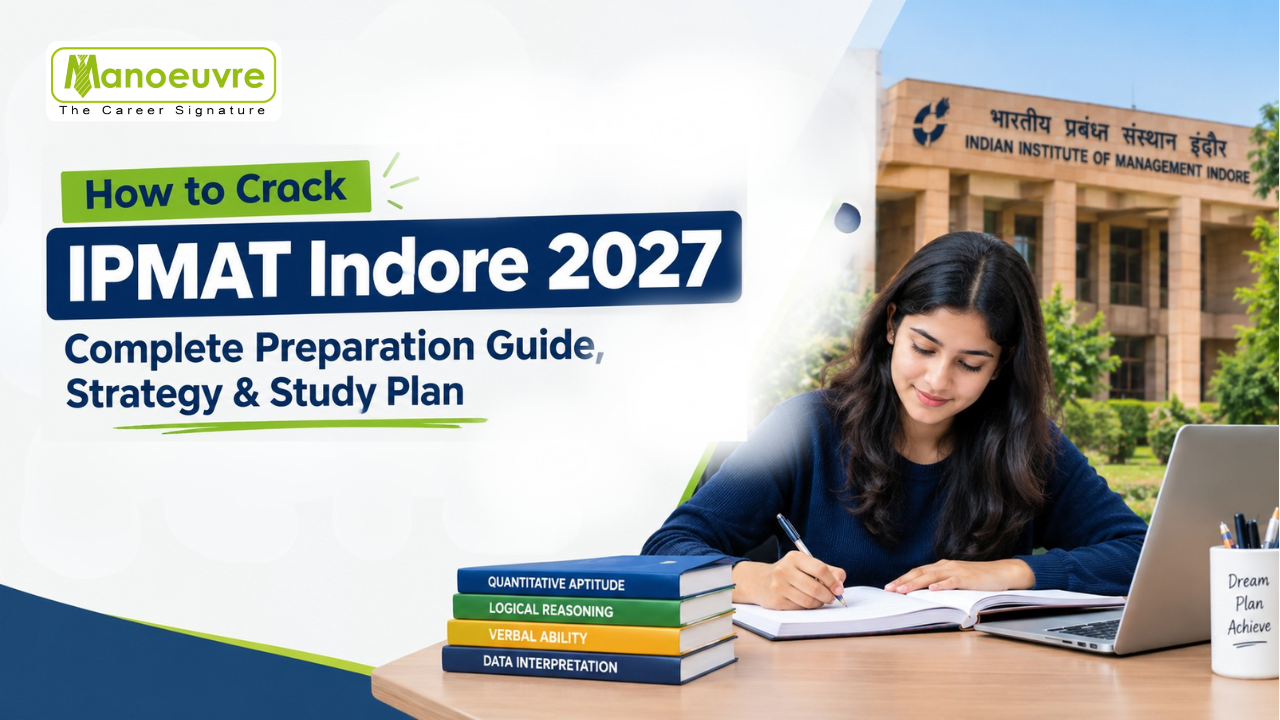
Cracking IPMAT Indore 2027 requires more than simply solving questions every day. You need a clear understanding of the exam, strong fundamentals, consistent practice, smart time management, and a preparation strategy that develops both speed and accuracy.
The Five-Year Integrated Programme in Management (IPM) at IIM Indore is designed for students who want to pursue management education directly after Class 12. IIM Indore launched the programme in 2011, and the programme combines undergraduate-level foundational education with management education in the later years.
If you are planning to appear for IPMAT Indore 2027, starting early can give you enough time to strengthen your concepts, practise different question types, take mock tests, analyse your performance, and prepare for the Personal Interview stage.
This guide explains how to prepare for IPMAT Indore 2027, including the exam structure, section-wise strategy, study plan, mock-test approach, recommended preparation methods, common mistakes, and interview preparation.
Important: IPMAT Indore may revise its admission criteria, exam pattern, eligibility requirements or selection process for the 2027 admission cycle. The 2026 details mentioned below should therefore be treated as the latest available reference until IIM Indore releases the official IPMAT 2027 notification.

Before starting your preparation, understand what the examination is testing.
The latest official IPMAT Indore pattern available for the 2026 admission cycle consisted of three sections:
● Quantitative Ability – Multiple Choice Questions (QA-MCQ)
● Quantitative Ability – Short Answer Questions (QA-SA)
● Verbal Ability – Multiple Choice Questions (VA-MCQ)
Each section had a 40-minute duration, making the total test duration 120 minutes. Each question carried 4 marks. The 2026 pattern specified negative marking for incorrect answers except in the Quantitative Ability Short Answer section.
|
Section |
Question
Type |
2026
Reference Duration |
|
Quantitative Ability |
MCQ |
40 minutes |
|
Quantitative Ability |
Short Answer |
40 minutes |
|
Verbal Ability |
MCQ |
40 minutes |
|
Total |
— |
120 minutes |
The sections were to be attempted in a pre-specified order, with the exact order determined by the institute.
For 2026, candidates needed positive raw scores and minimum section-wise marks to enter the PI-eligible pool. The Aptitude Test Score used a 25% weight each for QA-MCQ and QA-SA and 50% for VA. The final Composite Score used 65% ATS and 35% Personal Interview.
This makes one point very important: you should not prepare only for Quantitative Ability or only chase overall marks. A balanced preparation strategy matters.
A strong preparation strategy can be divided into four broad stages:
Start by strengthening the concepts required for the examination.
For Quantitative Ability, focus on areas such as:
● Number System
● Percentages
● Ratio and Proportion
● Profit and Loss
● Simple and Compound Interest
● Averages
● Time, Speed and Distance
● Time and Work
● Algebra
● Geometry
● Mensuration
● Permutation and Combination
● Probability
● Modern Mathematics
For Verbal Ability, begin building:
● Reading comprehension
● Vocabulary
● Grammar
● Sentence correction
● Para jumbles
● Sentence completion
● Verbal reasoning
Do not rush into difficult questions before your fundamentals are clear.
Once your basic concepts are comfortable, start solving questions under time pressure.
Your goal should not simply be:
“How many questions can I solve?”
Instead, ask:
“How many questions can I solve correctly within the available time?”
Maintain an error log containing:
● Questions answered incorrectly
● Questions that took too long
● Questions you guessed
● Concepts you repeatedly forget
● Calculation mistakes
● Questions you skipped but could have solved
Review this error log regularly.
Previous-year questions help you understand the type and difficulty of questions you may encounter.
Start with topic-wise practice and gradually move towards complete papers and mock tests.
When taking a mock, reproduce actual test conditions:
● Set a timer
● Avoid distractions
● Follow the section sequence
● Do not pause unnecessarily
● Attempt the paper in one sitting
After the mock, spend enough time analysing it.
Your mock analysis should answer:
1. Which section was strongest?
2. Which section was weakest?
3. Which questions consumed excessive time?
4. Which mistakes were conceptual?
5. Which mistakes were careless?
6. Which questions should have been skipped?
7. Which topics need additional practice?
Remember:
A mock test without analysis is only half the preparation.
During the final weeks, avoid constantly adding new study material.
Instead, focus on:
● Formula revision
● Vocabulary revision
● Important concepts
● Previous-year questions
● Error logs
● Mock-test analysis
● Time-management practice
The final stage should improve your accuracy and confidence rather than create unnecessary confusion.
Quantitative Ability can become one of the most important parts of your preparation because it contains both MCQ and Short Answer formats in the latest available IPMAT Indore pattern.
Build strong command over:
● Percentages
● Ratio
● Proportion
● Averages
● Profit and Loss
● Time and Work
● Time, Speed and Distance
● Mixtures
● Simple and Compound Interest
These topics also help develop calculation speed and mathematical thinking.
Once arithmetic is comfortable, work on:
● Linear equations
● Quadratic equations
● Inequalities
● Functions
● Sequences and series
● Algebraic identities
Practise:
● Lines and angles
● Triangles
● Circles
● Quadrilaterals
● Coordinate geometry
● Mensuration
Do not leave Short Answer questions for the final months.
Since there are no answer choices to eliminate, you need to develop the ability to reach the answer independently.
Practise these questions regularly and focus on:
Concept → Calculation → Verification → Answer
Verbal Ability is not a section that can usually be mastered through last-minute preparation.
The best approach is consistent exposure to English.
Read for approximately 30–45 minutes every day.
You can use:
● Editorial articles
● Newspapers
● Business articles
● Opinion pieces
● Essays
● Long-form articles
● Quality non-fiction
While reading, don't simply focus on finishing the article.
Try to identify:
● Main idea
● Author's tone
● Argument
● Supporting evidence
● Inference
● Meaning of unfamiliar words from context
Instead of memorising hundreds of isolated words, learn words through sentences.
Maintain a vocabulary notebook with:
Word → Meaning → Synonym → Antonym → Example sentence
Revise the words repeatedly rather than continuously adding new ones.
Start with shorter passages and gradually move towards longer and more difficult ones.
After solving each passage, analyse:
● Why your answer was correct
● Why the other options were incorrect
● Which sentence contained the relevant evidence
● Whether you made an inference error
Your study plan should change as you move closer to the examination.
Focus on fundamentals.
Priority:
● Quantitative concepts
● Basic grammar
● Reading habit
● Vocabulary
● Topic-wise practice
Increase practice intensity.
Priority:
● Advanced topic-wise questions
● Previous-year questions
● Timed practice
● RC practice
● Short-answer Quant practice
Start introducing regular mock tests.
Priority:
● Full-length mocks
● Sectional tests
● Time management
● Error analysis
● Revision
Shift towards exam-oriented preparation.
Priority:
● Full mocks
● Previous-year papers
● Error log
● Formula revision
● Vocabulary revision
● Weak-topic improvement
A student preparing alongside Class 11 or Class 12 studies can divide their preparation approximately like this:
|
Activity |
Suggested
Time |
|
Quantitative Ability Concepts |
60 minutes |
|
Quantitative Practice |
60 minutes |
|
Reading Comprehension |
30 minutes |
|
Vocabulary & Grammar |
30 minutes |
|
Previous-Year Questions / Error
Analysis |
30 minutes |
|
Total |
3.5 hours |
This is only a sample. Your schedule should be adjusted according to your school, board-exam workload, current preparation level and available time.
The key is consistency rather than simply studying for a large number of hours on a few days.
Many students worry that board preparation and IPMAT preparation will clash.
A better approach is to identify the overlap.
Your school mathematics preparation can strengthen several quantitative fundamentals, while regular English reading can support both board-level comprehension and entrance-exam preparation.
During periods of heavy board-exam workload:
● Prioritise your board syllabus
● Maintain a short daily reading habit
● Revise Quant formulas
● Continue vocabulary practice
● Reduce mock frequency temporarily
After major board examinations, increase entrance-exam practice and mock-test frequency.
There is no universal number of mocks that guarantees success.
Instead of chasing a particular number, build your mock frequency progressively.
Focus more on sectional and topic-wise tests.
Add full-length mocks regularly.
Increase full-length mock frequency while leaving enough time for analysis.
For every mock, record:
|
Metric |
What
to Track |
|
Score |
Overall performance |
|
Accuracy |
Correct vs attempted |
|
Time |
Time spent per section/question |
|
Errors |
Conceptual vs careless |
|
Skipped Questions |
Whether skipping was appropriate |
|
Weak Topics |
Areas requiring revision |
The objective is not simply to increase your number of mocks.
The objective is to make every mock improve your next attempt.
Previous-year questions can help you understand:
● Question formats
● Difficulty level
● Recurring concepts
● Time pressure
● Sectional demands
● Your current preparation level
Start by solving questions topic-wise.
Later, attempt them under timed conditions.
Keep particularly difficult questions in a separate revision folder so that you can revisit them before the examination.
The selection process can include a Personal Interview, and the latest official 2026 domestic admission procedure used the PI as part of the final Composite Score.
Do not wait until after the aptitude test to start thinking about the interview.
Prepare around areas such as:
Be comfortable discussing:
● Your Class 10 and 12 subjects
● Favourite subjects
● Academic interests
● Projects and activities
You should be able to explain your interest in management naturally rather than memorising a prepared speech.
Follow:
● Business
● Economy
● Technology
● Major national developments
● International developments
● Important social issues
Be prepared to discuss:
● Your strengths
● Areas you are working on
● Hobbies
● Achievements
● Extracurricular activities
● Career interests
Practise speaking clearly and concisely.
The goal is not to memorise perfect answers.
The goal is to communicate your actual thoughts confidently.
Advanced questions are of little use if your fundamentals are weak.
Build your base first.
Some students spend most of their preparation time on Quant and leave English for later.
That can create an unnecessary disadvantage.
Maintain daily reading and verbal practice.
Do not postpone Short Answer preparation.
Practise solving without relying on options.
Your score alone doesn't tell you what went wrong.
Analyse every important mistake.
More study material does not automatically mean better preparation.
Choose reliable resources and complete them properly.
Knowing how to solve a question is different from solving it efficiently under exam conditions.
Practise timed sets regularly.
Students often keep learning new concepts but fail to revisit old ones.
Schedule weekly revision.
A simple improvement cycle is:
Learn → Practise → Test → Analyse → Revise → Repeat
For example:
Learn: Percentages
↓
Practise: 30–50 questions
↓
Test: Timed sectional test
↓
Analyse: Identify errors
↓
Revise: Review concepts
↓
Repeat: Attempt a new test
This cycle is more effective than repeatedly solving random questions without analysing performance.
Yes, structured self-study is possible.
However, the important question is not simply whether coaching is necessary.
Ask yourself:
● Can you create and follow a study plan?
● Can you identify your weak areas?
● Can you find reliable preparation material?
● Can you analyse mock tests objectively?
● Can you maintain consistency?
● Do you have access to quality doubt-solving support?
If you can manage these independently, self-study can work.
If you struggle with planning, consistency, test analysis or doubt resolution, structured coaching can provide additional support.
Don't judge your preparation only by the number of chapters completed.
Track measurable indicators:
● Accuracy
● Average solving time
● Short-answer performance
● Topic-wise scores
● RC accuracy
● Reading speed
● Vocabulary retention
● Grammar accuracy
● Overall score
● Section-wise performance
● Accuracy
● Time management
● Repeated mistakes
Your performance should gradually become more consistent as the examination approaches.
1. Start with fundamentals.
2. Practise Quant every week.
3. Read English every day.
4. Do not ignore Short Answer Quant.
5. Solve previous-year questions.
6. Take regular mock tests.
7. Analyse every mock.
8. Maintain an error log.
9. Revise consistently.
10. Start PI preparation before the aptitude test is over.
Starting early gives you more time to strengthen fundamentals, practise questions and gradually introduce mock tests. Ideally, begin as early as your academic schedule allows.
The difficulty depends on your preparation level, fundamentals, speed, accuracy and ability to perform under time pressure. Consistent preparation is important because the test combines Quantitative Ability and Verbal Ability.
In the latest available 2026 pattern, the Aptitude Test had Quantitative Ability MCQ, Quantitative Ability Short Answer and Verbal Ability MCQ sections.
The 2026 official admission procedure specified a negative mark for each incorrect answer except in the Quantitative Ability Short Answer section. Candidates should check the official 2027 notification for the applicable rules.
They require you to arrive at an answer without relying on multiple-choice options, making conceptual understanding and calculation accuracy particularly important.
There is no fixed number of hours that works for every student. A consistent 3–4 hours of focused preparation can be more productive than irregular long study sessions.
Yes. Previous-year questions can help you understand the question formats, difficulty and areas you need to improve.
Yes. Mocks help you practise time management and identify weaknesses. However, analysing the mock is as important as taking it.
Yes. With proper scheduling, many preparation activities can complement your academic preparation. Increase entrance-focused practice when your board-exam workload decreases.
Coaching is not the only route to preparation. Students can prepare through self-study, provided they have a structured plan, reliable resources, regular practice and effective mock-test analysis.
Start developing communication skills and awareness well before the aptitude test. Once shortlisted, move to focused PI preparation.
Always refer to the official IIM Indore admission notification for the 2027 cycle because eligibility, exam pattern, dates and selection criteria can change from one admission cycle to another. The institute's official admissions page is the authoritative source for updates.

Cracking IPMAT Indore 2027 is not about studying everything at once. It is about following a structured process consistently.
Build your Quantitative Ability fundamentals, develop a strong reading habit, practise Verbal Ability regularly, master both MCQ and Short Answer Quant formats, solve previous-year questions, take mock tests and analyse your mistakes.
At the same time, don't ignore the Personal Interview stage. Your preparation should gradually develop not only your aptitude but also your ability to communicate clearly and discuss your academic interests and current affairs.
The most effective preparation cycle is simple:
Build Concepts → Practise → Take Tests → Analyse → Revise → Improve
Start early, track your progress, and keep adjusting your strategy based on your performance.
For the latest eligibility criteria, exam pattern, dates and admission rules, always check the official IIM Indore notification when the IPMAT Indore 2027 admission cycle is announced.
Your preparation does not need to be perfect from Day 1. It needs to become better every week.
Latest Blog