MBA Entrance
 LAW 5years Entrance
 LAW 3years Entrance
 MCA Entrance
 CUET PG Entrance
 BBA Entrance
 BCA Entrance
 Hotel-Management
 B.ED Entrance

- October 31, 2026
- |
-
0 comments
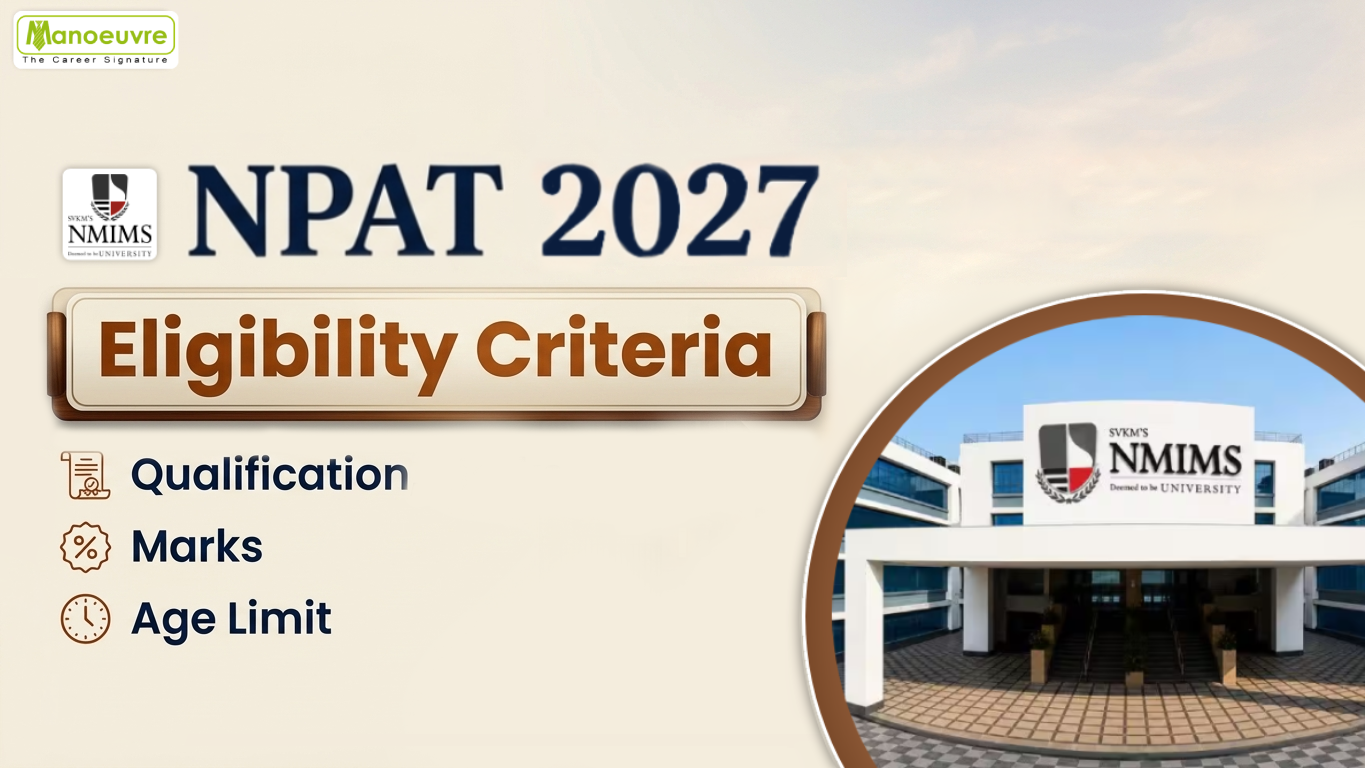
Planning to pursue BBA, B.Com or another undergraduate course at NMIMS after Class 12? Before preparing for the entrance test, it is important to check whether you meet the admission requirements. The NPAT Eligibility Criteria 2027 cover your Class 12 marks, compulsory subjects, age and qualifying examination.
The Narsee Monjee Institute of Management Studies (NMIMS) offers several undergraduate programmes through its admission process. While many courses require a minimum of 50% aggregate marks, some have additional subject requirements, and BBA (International Business) has a higher percentage requirement.
Here is a breakdown of the eligibility conditions to help you identify which programmes may suit your academic background.

The following table summarises the main eligibility requirements candidates should check before applying.
These are the main eligibility conditions, but candidates should also check the requirements of their preferred course. Meeting the minimum marks does not automatically guarantee admission.
Candidates must have passed Class 12 or an equivalent examination from a recognised board. Students appearing for their final 10+2 examination can also apply, provided they fulfil the prescribed conditions before admission is confirmed.
Students from CBSE, ISC and recognised State Boards can consider the programmes for which they meet the eligibility requirements. Those with international qualifications should check the applicable equivalence rules.
Keep these points in mind:
● Your aggregate marks must meet the minimum percentage required for the chosen programme.
● You must pass Mathematics or Statistics if it is compulsory for your course.
● NMIMS considers all subjects taken and attempted when calculating aggregate marks, rather than only the best four or five subjects.
● You must fulfil the applicable examination and document-verification conditions.
Most of the listed undergraduate programmes require at least 50% aggregate marks in Class 12. BBA (International Business), a dual-degree programme offered in collaboration with Kingston University, London, requires a minimum of 60%.
Remember: The required percentage is only one part of eligibility. For example, a candidate with 55% in Class 12 may meet the minimum marks requirement for B.Sc. Finance but must also have passed Mathematics or Statistics.
Mathematics is not compulsory for every NPAT programme. The requirement depends on the course you choose, so students should check their Class 12 subject combination before applying.
Candidates must have studied and passed Mathematics or Statistics for the following programmes:
● B.Sc. Finance
● BBA (FinTech)
● B.Sc. Economics
● BBA Finance
If you are interested in finance or economics, check this condition carefully. Meeting the aggregate percentage without passing the required subject may not be sufficient.
Mathematics is not specified as a compulsory Class 12 subject for the following programmes under the stated eligibility rules:
● BBA
● B.Com
● Integrated BBA-MBA
● BBA (Branding & Advertising)
● BA Liberal Arts
● BBA (Management & Marketing)
● BBA (International Business)
This gives students from Arts and Commerce backgrounds several options to explore. For instance, a Commerce student who did not take Mathematics may consider BBA or B.Com, subject to the other eligibility conditions.
The maximum age limit for the relevant NPAT undergraduate programmes is 25 years. Students who completed Class 12 earlier or took a gap before applying should check this requirement before registering.
The undergraduate law programmes, BA LL.B. (Hons.) and BBA LL.B. (Hons.), have separate provisions for candidates above 25 years. Such candidates can apply through the NLAT route rather than the regular NPAT route.
Students from CBSE, ISC, State Boards and international education systems must meet the applicable qualification and marks requirements. The rules for calculating aggregate marks and verifying qualifications may differ by board.
Candidates must pass their qualifying examination and meet the prescribed aggregate requirement. NMIMS considers all subjects taken and attempted, rather than allowing candidates to calculate their eligibility using only their best-performing subjects.
The admission handout also specifies single-attempt conditions and rules concerning compartmentalised mark sheets. Candidates should check the applicable provisions before submitting their documents.
IB candidates must satisfy the university's equivalence conditions for their particular qualification. Under the specified IB Diploma route, candidates must meet the prescribed credit or grade requirements, including three Higher Level (HL) and three Standard Level (SL) subjects, along with the applicable Extended Essay and Theory of Knowledge requirements.
The university also specifies requirements for IB Diploma Programme courses and IB Career-related Programme candidates. Students should check which provisions apply to their qualification.
Candidates following Cambridge qualifications must meet the applicable examination requirements. For A-Level qualifications, a minimum of three Advanced Level subjects is considered when calculating aggregate marks. Ungraded subjects are excluded from the calculation.
Students who completed Class 12 through recognised open-schooling, distance-learning or correspondence routes should check whether their qualification meets NMIMS's recognition requirements.
Candidates with overseas qualifications must submit an Association of Indian Universities (AIU) equivalence certificate where required. This establishes whether their qualification is equivalent to the Indian Class 12 examination.
Do not assume that every open-school or international qualification is automatically accepted. Confirm the applicable rules and documentation requirements before proceeding with admission.
Keeping your academic documents ready can make the admission process easier. Depending on your qualification, you may need:
● Class 10 certificate or marksheet, as applicable.
● Class 12 marksheet or final result.
● Subject-wise marks and aggregate details.
● Grade conversion or equivalence documents for applicable international qualifications.
● AIU equivalence certificate for overseas qualifications, where required.
● Any additional documents requested by NMIMS.
Students admitted provisionally while awaiting their final results must submit the required documents within the prescribed timeline. Failure to meet the eligibility or documentation conditions may affect admission.
Before applying for NPAT, compare your Class 12 marks and subjects with the requirements of your preferred programme. If you have not studied Mathematics, you can still explore several undergraduate options, while finance- and economics-related courses may require a specific subject combination.
Checking these details early will help you shortlist suitable courses and avoid eligibility-related surprises during admission. Always review the applicable NMIMS admission requirements before submitting your application.
To be sure you are reading correct and up-to-date information, visit the NMIMS website before applying and see what it says about NPAT eligibility, admission requirements and programme-wise updates.

Most of the listed programmes require 50% aggregate marks in Class 12. BBA (International Business) requires 60%. Subject-specific requirements may also apply.
No. Mathematics or Statistics is required for B.Sc. Finance, BBA (FinTech), B.Sc. Economics and BBA Finance, but it is not specified as compulsory for several other listed programmes.
Yes. Arts students can consider programmes such as BBA, BBA (Branding & Advertising) and BA Liberal Arts, provided they meet the relevant eligibility conditions.
Yes. Students appearing for their final qualifying examination can apply, subject to fulfilling the academic requirements and submitting their results within the prescribed timeline.
The maximum age limit is 25 years for the relevant NPAT programmes. Undergraduate law programmes have separate eligibility provisions.
They may be eligible if their qualification meets the applicable recognition and equivalence requirements. Candidates should confirm the rules for their particular board.
No. Minimum marks, compulsory subjects and additional conditions vary by programme. Check the requirements of your preferred course before applying.
No. Candidates must meet the eligibility conditions and complete the prescribed admission process. Meeting the minimum percentage alone does not guarantee a seat.
Latest Blog