MBA Entrance
 LAW 5years Entrance
 LAW 3years Entrance
 MCA Entrance
 CUET PG Entrance
 BBA Entrance
 BCA Entrance
 Hotel-Management
 B.ED Entrance

- November 27, 2026
- |
-
0 comments
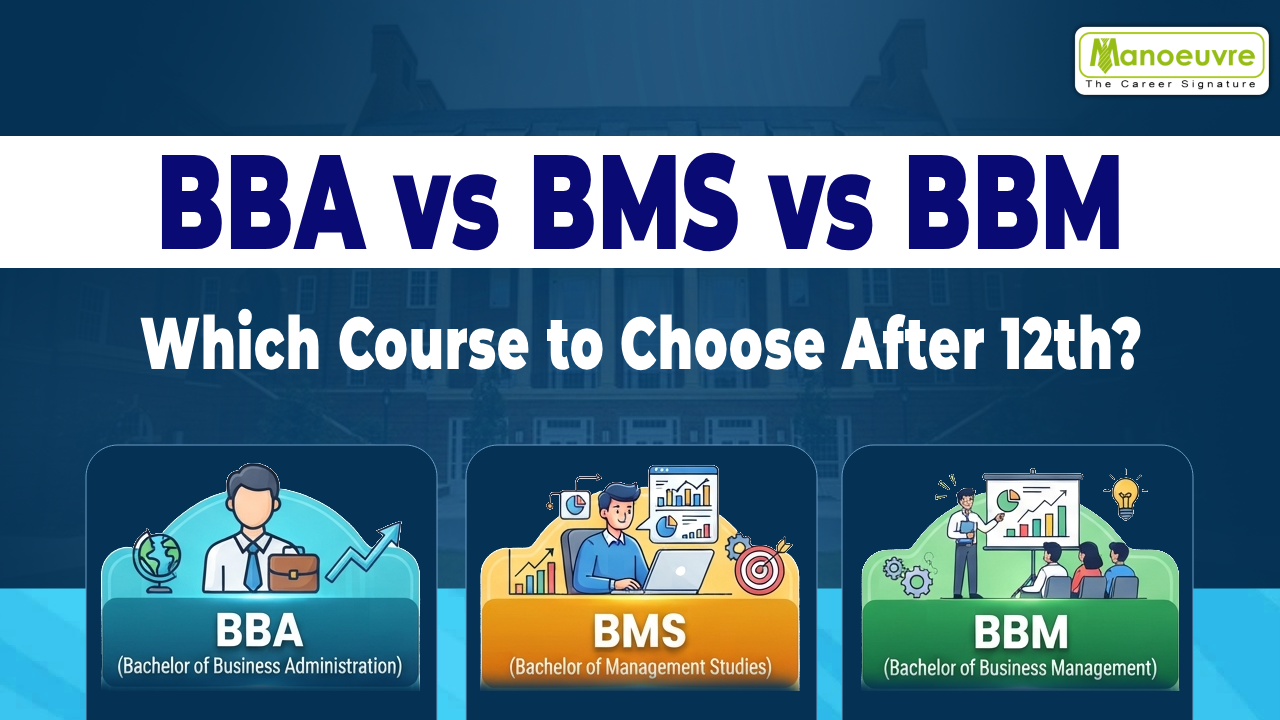
Choosing the right undergraduate course after Class 12 is an important decision, especially for students interested in business, management and entrepreneurship. Among the popular options, BBA (Bachelor of Business Administration), BMS (Bachelor of Management Studies) and BBM (Bachelor of Business Management) are three degrees that attract students looking to build careers in the corporate world.
Although these programmes share several subjects and career opportunities, their academic approaches and areas of emphasis can differ depending on the university.
If you are confused about BBA vs BMS vs BBM, understanding their course structure, specialisations, career scope and admission requirements can help you make an informed decision.

BBA is an undergraduate programme designed to introduce students to the different functions involved in running a business. It provides foundational knowledge of marketing, finance, human resources, operations and business development.
The course focuses on understanding how different departments work together to achieve organisational goals and generate revenue.
For example: Imagine you want to open a cafe. You need to understand how to manage finances, hire employees, attract customers, promote your products and maintain customer satisfaction. A BBA programme introduces you to these different business functions.
Major areas covered in BBA:
Principles of Management
Marketing Management
Financial Accounting
Human Resource Management
Business Communication
Business Economics
Entrepreneurship
Career opportunities after BBA:
Marketing Executive
Sales Executive
Business Development Executive
HR Assistant
Management Trainee
BBA is suitable for students who want broad business knowledge and are interested in exploring different management functions before choosing a specialisation or pursuing an MBA.
BMS is an undergraduate degree that focuses on management principles, analytical thinking, research, planning and business decision-making.
While BBA generally introduces students to different business functions, BMS programmes often place greater emphasis on understanding management challenges, evaluating information and developing solutions.
For example: Suppose a company experiences a sudden decline in sales. A management professional needs to investigate the reasons, study customer behaviour, analyse market trends and identify strategies to improve performance. These analytical and decision-making approaches are important parts of management studies.
Major areas covered in BMS:
Business Research Methods
Organisational Behaviour
Strategic Management
Financial Management
Marketing Management
Business Analytics
Operations Management
Career opportunities after BMS:
Business Analyst
Management Trainee
Marketing Executive
HR Assistant
Operations Executive
BMS can be a good option for students who enjoy analysing situations, solving business problems, working with information and making strategic decisions.
BBM is an undergraduate management programme that focuses on business administration, organisational management and the practical functioning of business operations.
The curriculum generally covers how different departments coordinate their activities, manage resources and maintain smooth business processes. However, the exact focus varies across universities.
For example: Consider a company with separate sales, finance and HR departments. These teams need to coordinate their responsibilities, complete daily tasks, manage employees and meet organisational targets. BBM introduces students to the management principles and operational processes involved in keeping a business running efficiently.
Major areas covered in BBM:
Business Management
Operations Management
Human Resource Management
Marketing Principles
Financial Management
Business Communication
Entrepreneurship Development
Career opportunities after BBM:
Business Development Executive
Operations Executive
Sales Executive
HR Assistant
Management Trainee
BBM may suit students interested in organisational management, coordinating teams and understanding how businesses function in their day-to-day activities.
Although all three degrees belong to the management education stream, their emphasis can differ based on the university and programme structure.
An easy way to remember the difference:
BBA = Business Basics: Understand how different business departments function together.
BMS = Management Decisions: Learn to analyse problems, evaluate information and make decisions.
BBM = Business Management: Understand organisational activities, team coordination and business processes.
Remember that these are broad distinctions rather than fixed rules. Two universities offering the same degree may have different subjects, teaching methods and specialisations.
Despite their differences, these programmes share several foundational subjects because they prepare students for careers in business and management.
Common subjects include:
Marketing: Introduction to online marketing, offline promotions, advertising, sales and customer behaviour.
Finance and Accounting: Understanding business finances, budgeting, taxation, accounting and financial planning.
Human Resources: Learning about recruitment, employee management, workplace relationships and organisational development.
Economics: Understanding markets, demand, supply and economic factors affecting businesses.
Business Communication: Developing professional writing, presentation and communication abilities.
Important skills developed during these programmes:
Communication and interpersonal skills.
Teamwork and leadership abilities.
Analytical thinking and problem-solving.
Planning and organisational skills.
Presentation and public speaking.
Understanding of business fundamentals.
These skills are useful for students planning to enter the corporate sector, pursue higher education or establish their own businesses.
Admission to undergraduate management programmes depends on the college and university. Some institutions conduct their own entrance examinations, while others accept national or state-level entrance test scores.
Here are some important admission routes students should know about:
Important: Entrance examination requirements differ by institution and admission year. Some universities accept multiple examination scores, while others conduct separate selection processes. Students should identify the specific programme and check its admission requirements before applying.
Completing any of these undergraduate programmes provides several opportunities for further education and employment.
1. Pursue an MBA: Students interested in developing advanced management skills can pursue an MBA after graduation. Popular specialisations include Marketing, Finance, Human Resources, Operations and Business Analytics.
2. Join a Corporate Organisation: Graduates can apply for entry-level positions in companies, startups and multinational corporations (MNCs). Their responsibilities may involve sales, marketing, administration, HR or business development.
3. Start Your Own Business: Students interested in entrepreneurship can use their business knowledge to establish a startup, family business or independent venture.
4. Pursue Further Studies: Depending on eligibility and interests, students can explore postgraduate programmes in management, finance, economics, marketing and related fields.
The right choice depends on your interests, strengths and long-term career plans rather than simply the name of the degree.
Consider the following:
Choose BBA if you want to understand different business functions, explore marketing and finance, and develop a broad foundation in business administration.
Choose BMS if you enjoy research, analytical thinking, evaluating business problems and developing management strategies.
Choose BBM if you are interested in organisational management, coordinating teams and understanding business operations.
Before selecting a college, compare its curriculum, faculty, internship opportunities, industry exposure, placement support and available specialisations.
Ultimately, all three programmes can provide a foundation for a career in management. Your learning experience, practical exposure and skills will play an important role in shaping your professional journey.
BBA, BMS and BBM are valuable undergraduate options for students interested in business and management after Class 12. While BBA offers broad business fundamentals, BMS often emphasises analytical and managerial decision-making, and BBM focuses on business and organisational management.
Instead of choosing a programme based only on its popularity, understand what each course offers and identify the one that matches your interests. Research colleges, compare admission requirements and start preparing for the relevant entrance examinations early to improve your chances of securing admission to your preferred institution.

All three are good undergraduate management options. BBA focuses on business fundamentals, BMS emphasises management and analytical skills, while BBM covers business and organisational management. The best choice depends on your interests and the university's curriculum.
Yes. Students graduating with BBA, BMS or BBM can pursue an MBA, provided they meet the eligibility requirements of the respective institution.
Mathematics requirements vary across universities and programmes. Some colleges accept students from all streams, while others may have specific subject requirements.
These programmes generally have a duration of three to four years, depending on the university, curriculum and applicable undergraduate education structure.
Popular entrance examinations include CUET UG, NPAT, SET, IPMAT, JIPMAT and MAH BBA/BMS/BBM CET. The applicable examination depends on the college.
Yes. Commerce students can apply for these programmes if they satisfy the eligibility criteria of their preferred colleges. Students from science and arts backgrounds may also be eligible.
Graduates can explore positions such as marketing executive, business development executive, HR assistant, sales executive, operations executive and management trainee.
Latest Blog