 MBA Entrance
 LAW 5years Entrance
 LAW 3years Entrance
 MCA Entrance
 CUET PG Entrance
 BBA Entrance
 BCA Entrance
 Hotel-Management
 B.ED Entrance
- September 21, 2026
- |
-
0 comments
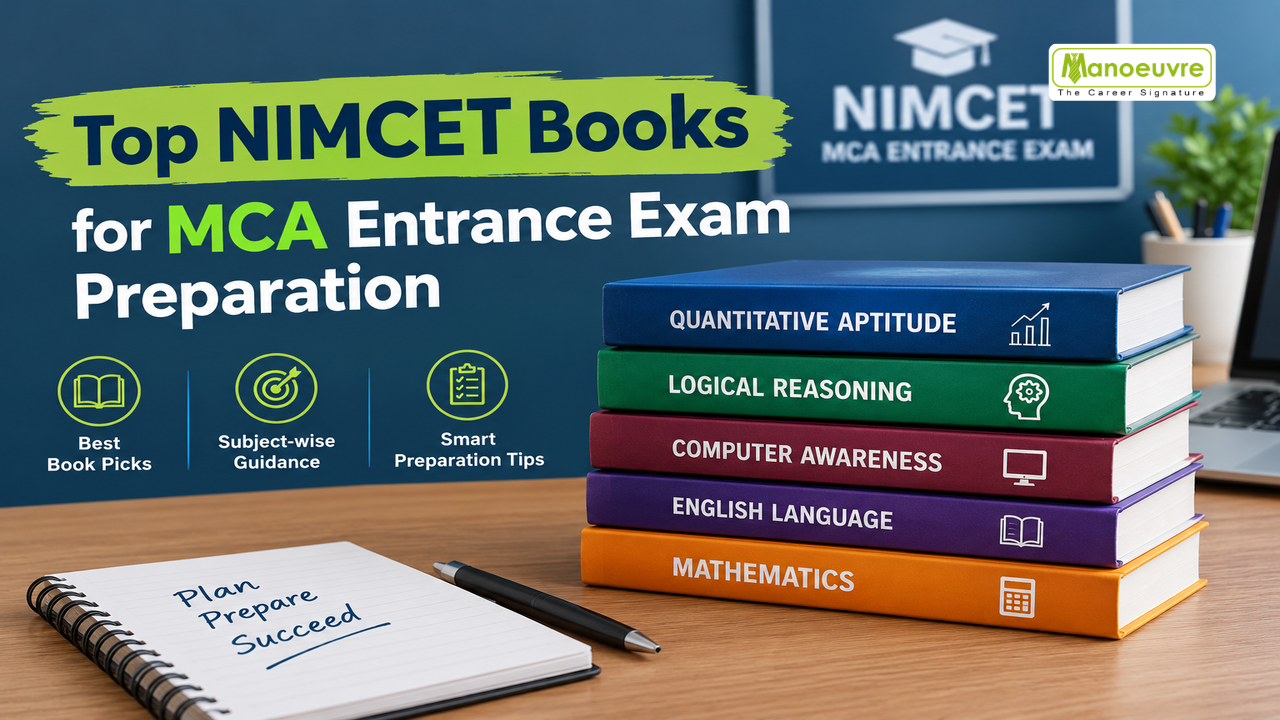
Choosing the right books can make NIMCET preparation much more manageable. The challenge is not finding study material; there is plenty of it available. The real challenge is deciding what is actually worth studying and which resources cover the topics you are expected to prepare.
For students targeting MCA in NITs, NIMCET is an important entrance exam, and preparation needs to be focused on the current syllabus. A good NIMCET book should help you understand concepts, practise different types of questions and gradually improve your accuracy and speed.
Instead of collecting several books and switching between them, it is better to choose resources that match the exam and use them consistently.
The revised NIMCET syllabus, effective from 2026, covers four sections: Mathematics, Analytical Ability & Logical Reasoning, Computer Awareness and General English. Mathematics has the highest number of questions, followed by Analytical Ability & Logical Reasoning.
|
Section |
Questions |
Major
Areas |
|
Mathematics |
50 |
Algebra,
Calculus, Coordinate Geometry, Trigonometry, Probability & Statistics,
Set Theory & Logic |
|
Analytical
Ability & Logical Reasoning |
40 |
Reasoning,
Puzzles, Coding-Decoding, Data Interpretation, Data Sufficiency and more |
|
Computer
Awareness |
20 |
Computer
Basics, Hardware, Software, Data Representation, Internet and Email |
|
General
English |
10 |
Vocabulary,
Grammar, Comprehension, Word & Phrase Meaning, Technical Writing |
This is why there is no single book for NIMCET preparation that needs to do everything. Your resources should collectively cover the syllabus properly.
Before buying a book, check what it actually offers. A popular title is not automatically the right choice for your preparation.
Start with the current NIMCET syllabus and compare it with the contents of the book. This is particularly important for Mathematics because the syllabus covers several areas, including Algebra, Calculus, Coordinate Geometry and Trigonometry.
A book should give you more than explanations. Once you understand a concept, you need enough questions to become comfortable solving it under time pressure.
Topic-wise questions make preparation easier to organise. You can finish one topic, identify mistakes and then move to the next instead of solving random questions without knowing what needs improvement.
A useful NIMCET book should ideally include basic questions along with moderate and exam-level problems. Starting with difficult questions without understanding the fundamentals can make preparation unnecessarily frustrating.
Previous-year questions are useful for understanding how concepts are tested. They can also show you which areas need more attention.
Having five books for one section does not mean you are better prepared. In most cases, completing one reliable resource properly is more useful than repeatedly starting new ones.
Mathematics deserves the most attention because it carries 50 questions in the current NIMCET syllabus.
When choosing a Mathematics book, look for proper coverage of:
● Set Theory and Logic
● Probability and Statistics
● Algebra
● Coordinate Geometry
● Calculus
● Trigonometry
The Mathematics syllabus goes beyond basic arithmetic. It includes topics such as quadratic equations, logarithms, progressions, matrices and determinants, permutations and combinations, binomial theorem, conics, limits, differentiation, integration and trigonometric equations.
A good Mathematics resource should therefore provide clear explanations followed by plenty of questions. Students who are weak in Mathematics should first focus on understanding the concept before moving towards timed practice.
Analytical Ability & Logical Reasoning accounts for 40 questions, making it another major part of the exam.
Your reasoning book should provide practice for areas such as:
● Blood relations
● Coding-decoding
● Direction tests
● Seating arrangements
● Puzzles
● Syllogisms
● Alphanumeric series
● Statements and conclusions
● Verbal and non-verbal reasoning
● Data interpretation
● Data sufficiency
● Numerical reasoning
The current syllabus also includes deductive reasoning, inductive reasoning, problem solving, critical thinking and data visualization.
For this section, practice matters as much as understanding the method. The more different question types you solve, the easier it becomes to recognise the approach needed during the actual NIMCET exam.
Computer Awareness has 20 questions and focuses mainly on fundamental computer concepts rather than advanced programming.
A suitable MCA NIMCET book or Computer Awareness resource should cover:
● Computer organisation
● CPU and instructions
● Input and output devices
● Computer memory
● Storage devices
● Binary and hexadecimal representation
● Binary arithmetic
● Two's complement
● Floating-point representation
● Boolean algebra
● Operating systems
● System and application software
● Internet and email
● Basic online security
The best resource for this section is one that explains these concepts in a straightforward way and provides objective questions for practice.
General English carries 10 questions, but it should not be completely ignored. The syllabus includes comprehension, vocabulary, grammar, sentence forms, word formation, meanings of words and phrases, technical writing, accuracy and fluency.
For this section, choose a resource that gives you regular practice in:
● Grammar
● Vocabulary
● Reading comprehension
● Sentence usage
● Word and phrase meanings
● Basic technical English
You can combine book-based practice with regular reading. This is often more useful than trying to memorise large vocabulary lists without seeing how words are actually used.
Students searching for NIMCET books for MCA entrance should remember that NIMCET preparation needs to follow the NIMCET syllabus specifically.
A general MCA entrance book may contain useful questions, but it should not replace a resource that covers the topics prescribed for NIMCET. The same applies to a generic NIT entrance test preparation book.
If your goal is an MCA in NIT, start with the official syllabus, select section-wise resources and then add previous-year questions and mock tests to your preparation.
There is no fixed number of books that every student needs.
A practical approach is to have:
● One main Mathematics resource
● One Logical Reasoning resource
● One Computer Awareness resource
● One English resource
● Previous-year questions
● Mock tests
You can use additional material if a particular topic is difficult, but there is little benefit in continuously changing books.
The important thing is to finish what you start, revise regularly and keep track of the questions you get wrong.
Simply reading a book from beginning to end is not enough. Try to use your resources in stages.
Start with concepts: Understand the basic method before attempting difficult questions.
Practise topic-wise: Solve enough questions to become comfortable with a particular topic.
Review mistakes: Dig into your error instead of just checking the answer.
Return to weak areas: If you repeatedly make mistakes in the same topic, revise it instead of moving on just because the chapter is completed.
Add timed practice: Once your concepts are reasonably strong, start solving questions with a time limit.
Use previous-year questions: They help you connect what you have studied with the kind of questions you may face in the exam.
Books help you build concepts and practise different types of questions, while mock tests help you apply that preparation under time pressure. Using both gives your NIMCET preparation a better balance between learning and exam practice.
|
Resource |
Main
Benefit |
|
NIMCET
Books |
Build
concepts and strengthen fundamentals |
|
Topic-wise
Practice |
Improve
accuracy and question-solving skills |
|
Previous-Year
Questions |
Understand
the type and level of questions |
|
Mock
Tests |
Improve
speed, time management and accuracy |
|
Mock
Analysis |
Identify
mistakes and weak topics |
|
Revision |
Retain
important concepts and formulas |
Don't focus only on your mock-test score. Check the questions you got wrong, left unanswered or took too long to solve. Use your NIMCET exam preparation books to revise weak topics and then practise them again.
A simple approach is: learn from books → practise → attempt mocks → analyse mistakes → revise. This helps you make better use of both your study material and mock tests.
A few mistakes can make preparation harder than it needs to be:
● Buying too many books without finishing any
● Choosing books without checking the current syllabus
● Spending most of the preparation time on Mathematics while ignoring other sections
● Reading concepts without solving enough questions
● Skipping previous-year questions
● Changing resources every time a topic feels difficult
● Taking mock tests without analysing mistakes
The goal is not to complete the maximum number of books. It is to become comfortable with the questions you are likely to face.
The right NIMCET books can make preparation more organised, but the book itself is only one part of the process. Start with the current syllabus, choose resources that cover the required topics and give yourself enough time to practise.
Focus especially on Mathematics and Analytical Ability & Logical Reasoning, while keeping Computer Awareness and General English in your regular study routine. Once your concepts are clear, bring in previous-year questions and mock tests to see how well you can apply what you have learned.
A small set of useful resources, used consistently, is usually far more valuable than a large collection of books that remain unfinished.
Eligibility depends on the current admission and academic requirements specified for NIMCET. Students should always check the latest official admission notification before applying.
There is no single book that is best for every student. Choose resources based on the current syllabus, your preparation level and the amount of practice they provide.
NIMCET can be challenging because students need to manage different sections along with speed and accuracy. Consistent preparation and regular practice can make the exam much more manageable.
For students interested in pursuing MCA through participating NITs and other institutes accepting NIMCET scores, it can be a valuable entrance exam. Students should compare the participating institutes, programmes and admission requirements before deciding.
You do not need a large collection of books. A few well-chosen section-wise resources, combined with previous-year questions and mock tests, can provide a solid preparation base.
Choose a Mathematics book that matches the current NIMCET syllabus and offers clear concepts, solved examples and sufficient practice questions across the major topics.
Yes. Previous-year questions help you understand the types of problems asked and give you an opportunity to practise applying concepts in an exam-oriented way.
Yes. Books can help you build concepts and practise questions, while mock tests help you improve speed, accuracy and time management. Using both gives your preparation a more complete structure.
Latest Blog


