MBA Entrance
 LAW 5years Entrance
 LAW 3years Entrance
 MCA Entrance
 CUET PG Entrance
 BBA Entrance
 BCA Entrance
 Hotel-Management
 B.ED Entrance
- March 06, 2026
- |
-
0 comments
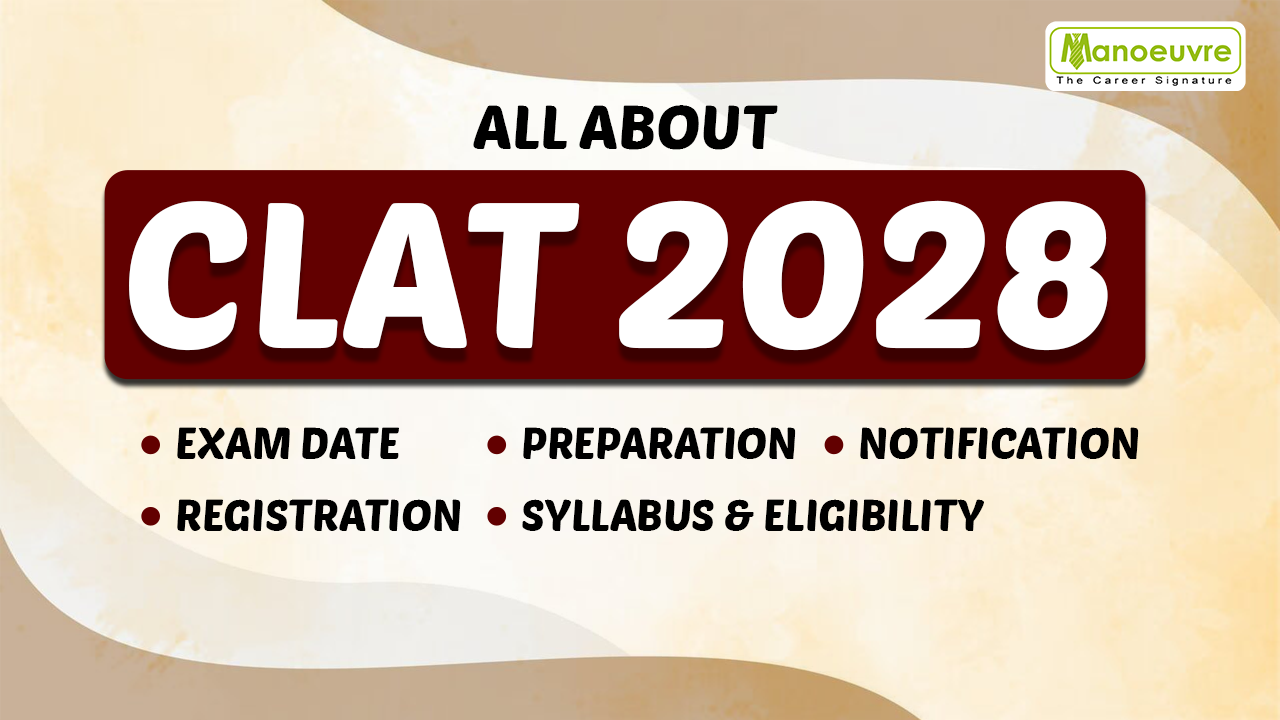
If you are planning to pursue law after Class 12, understanding CLAT 2028 early can give you a strong competitive advantage. The Common Law Admission Test serves as the entry route to India’s leading National Law Universities (NLUs), and thousands of aspirants compete every year for limited seats.
In this detailed guide, we will cover everything you need to know — expected notification timeline, application process, eligibility criteria, syllabus structure, preparation strategy, and important updates related to the upcoming exam cycle.

The Common Law Admission Test is a national-level entrance exam conducted by the Consortium of National Law Universities for admission to undergraduate (5-year integrated LL.B.) and postgraduate (LL.M.) law programs across participating NLUs.
Currently, there are 24 NLUs across India that accept CLAT scores. Some private universities and affiliated colleges also use the same score for admissions.
While the official notification for CLAT 2028 has not yet been released, based on recent trends, the exam is typically conducted in December of the previous year.
Notification Release: July–August 2027
Registration Start: August 2027
Last Date to Apply: October–November 2027
Admit Card Release: November 2027
Exam Date: December 2027
Result Declaration: Late December 2027
Since the exam schedule has shifted to December in recent cycles, aspirants should prepare assuming the test will be held in December 2027.
Keep checking the official website of the Consortium of National Law Universities for confirmed updates.
Before submitting the application, candidates should confirm that they fulfill the eligibility criteria.
Must have passed Class 12 or equivalent examination from a recognized board.
Minimum marks required:
45% for General/OBC/PWD/NRI candidates
40% for SC/ST candidates
Students appearing in Class 12 in 2028 are also eligible to apply.
There is no upper age limit currently for the undergraduate program.
Must have completed LL.B. (3-year or 5-year) from a recognized university.
Minimum percentage criteria similar to UG category norms.
Always verify the final eligibility conditions in the official notification once released.
The registration process is completely online.
Access the official website of the Consortium of National Law Universities.
Create your account using a valid email ID and mobile number.
Fill in personal, academic, and communication details.
Upload required documents:
Passport-size photograph
Signature
Category certificate (if applicable)
Pay the application fee online.
Submit and download the confirmation page.
General/OBC/PWD/NRI: Around ₹4,000
SC/ST/BPL: Around ₹3,500
The fee structure may change, so refer to the official brochure when released.
Understanding the structure of the exam is crucial for smart preparation.
Mode: Offline (Pen & Paper Based)
Duration: 2 hours
Total Questions: 120
Type: Passage-based MCQs
Negative Marking: 0.25 marks will be deducted for every incorrect answer.
All sections are comprehension-based, meaning most questions are asked from passages rather than direct fact-based questions.
Let’s break down the expected structure in detail.
This section evaluates reading comprehension and language skills.
Topics include:
Reading passages (450 words approx.)
Vocabulary in context
Inference-based questions
Tone and main idea identification
Grammar usage
Focus on improving reading speed and comprehension accuracy.
This section primarily focuses on:
National and international events
Legal developments
Government schemes
Important judgments
Awards and appointments
Static GK linked to current events
Regular newspaper reading is essential. Follow credible sources and maintain concise notes.
One of the most important sections in the exam.
It tests:
Legal principles
Application of law to factual scenarios
Analytical reasoning
Contemporary legal issues
No prior legal knowledge is required, but familiarity with constitutional principles and landmark judgments helps.
This section includes:
Critical reasoning
Arguments and assumptions
Logical inference
Statement-based reasoning
Cause and effect
Develop structured thinking and analytical clarity.
This section includes:
Basic arithmetic
Ratios and percentages
Profit and loss
Averages
Data interpretation (tables, graphs)
Mathematics is based on Class 10 level concepts.
Since the exam is highly competitive, early preparation can make a significant difference.
Improve reading habits (newspapers + editorials).
Revise basic math concepts.
Practice grammar fundamentals.
Start solving small logical reasoning sets.
English:
Read daily. Practice inference-based questions.
GK:
Make monthly current affairs notes.
Legal Reasoning:
Solve passage-based legal problem sets regularly.
Logical Reasoning:
Practice critical reasoning questions daily.
Quantitative Techniques:
Focus on accuracy rather than speed initially.
After building basics, start taking full-length mock tests:
Analyze mistakes thoroughly.
Identify weak areas.
Improve time management.
Track score improvement consistently.
Mock test analysis is more important than simply attempting multiple tests.
If you are currently in:
Focus on building reading habits.
Strengthen vocabulary and reasoning skills.
Light preparation with weekly practice.
Structured preparation with mock tests.
Balanced board + entrance exam focus.
Monthly performance review.
Intensive preparation plan.
3–4 mock tests per month.
While many books are available, focus on:
Standard English comprehension books
Legal reasoning practice material
Monthly current affairs compilations
Logical reasoning practice sets
Class 10 mathematics reference for basics
Avoid collecting too many books. Master limited but quality resources.
Ignoring Current Affairs.
Memorizing legal facts instead of understanding principles.
Not analyzing mock tests.
Starting preparation too late.
Neglecting Quantitative Techniques.
Consistency matters more than studying for long hours irregularly.
Competition is increasing every year.
Passage-based format requires long-term reading habits.
Current affairs preparation needs continuity.
Analytical thinking develops gradually.
Starting early reduces pressure and increases confidence.
Some of the leading universities accepting CLAT scores include:
National Law School of India University
NALSAR University of Law
National Law University Delhi (Note: Admits through AILET, not CLAT)
West Bengal National University of Juridical Sciences
National Law University Jodhpur
Admission to these institutions requires a high rank, so strategic preparation is essential.
Read newspapers daily (at least 45 minutes).
Maintain handwritten notes for GK.
Solve previous year papers.
Practice under timed conditions.
Stay consistent and disciplined.
Most importantly, believe in your preparation journey. Law is a prestigious and rewarding career path, and this entrance exam is your first step toward becoming a legal professional.
Preparing for CLAT 2028 requires clarity, consistency, and smart strategy. From understanding the exam pattern to mastering reading comprehension and legal reasoning, every element plays a crucial role. Start early, stay focused, and build a structured study plan. With disciplined preparation and regular mock analysis, you can significantly improve your chances of securing admission to a top National Law University. If you begin today, you’re already ahead of many aspirants.

FAQ'S
The official notification is expected around July or August 2027. The conducting body, the Consortium of National Law Universities, generally releases the detailed brochure along with registration dates, eligibility, and exam pattern on its official website.
Based on recent trends, the exam is likely to be conducted in December 2027. However, candidates should wait for the official announcement for confirmation.
The undergraduate syllabus consists of five sections: English Language, Current Affairs & GK, Legal Reasoning, Logical Reasoning, and Quantitative Techniques. The paper is passage-based and tests comprehension and analytical ability rather than rote memorization.
Students in Class 11 should begin by building strong reading habits, improving vocabulary, and practicing basic logical reasoning. Starting early helps in mastering comprehension-based questions and developing analytical skills gradually.
Yes, there is negative marking. A deduction of 0.25 marks is applied for each wrong answer. Therefore, accuracy and smart attempt strategy are very important.
Candidates must have passed or be appearing in Class 12 from a recognized board. General category candidates need at least 45% marks, while SC/ST candidates require 40%. There is currently no upper age limit.
Aspirants should ideally attempt 25–40 full-length mock tests before the exam. More importantly, detailed analysis of each mock is crucial to identify weak areas and improve performance.
Several leading law universities accept CLAT scores, including:
National Law School of India University
NALSAR University of Law
West Bengal National University of Juridical Sciences
National Law University Jodhpur
These institutions are highly competitive and require strong preparation to secure admission.
Latest Blog