MBA Entrance
 LAW 5years Entrance
 LAW 3years Entrance
 MCA Entrance
 CUET PG Entrance
 BBA Entrance
 BCA Entrance
 Hotel-Management
 B.ED Entrance
- May 08, 2026
- |
-
0 comments
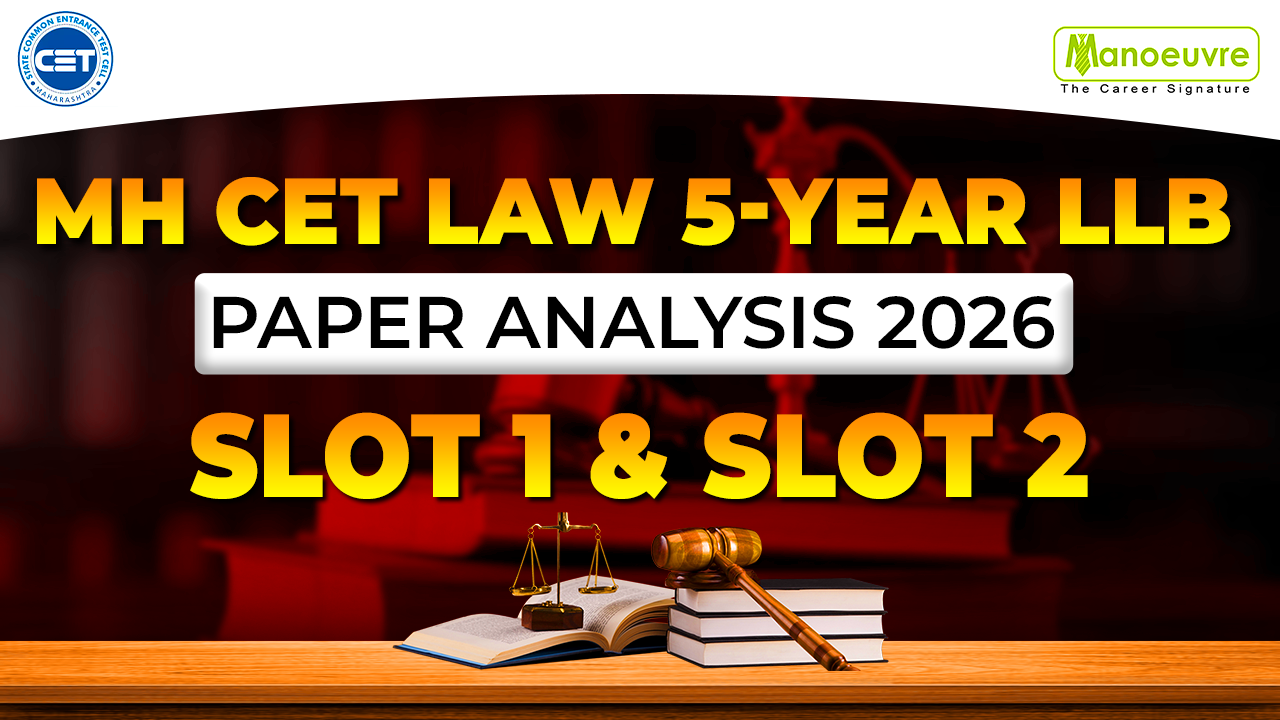
The MH CET Law 5 Years entrance exam 2026 was conducted successfully in multiple slots across different exam centers in Maharashtra and other states. Candidates appearing for the examination were eager to understand the overall difficulty level, section-wise trends, important topics, and expected cut-off marks immediately after the exam.
Based on student reactions, expert discussions, and live analysis sessions of both slots, the paper was largely moderate in difficulty with a few tricky areas in Legal Aptitude and Logical Reasoning. Candidates who maintained speed with accuracy were able to attempt a good number of questions.
This detailed analysis covers Slot 1 and Slot 2 exam reviews, question trends, difficulty comparison, expected good attempts, and preparation insights for future aspirants.

The 5-year integrated law entrance examination is conducted for admission into BA LLB and other integrated law programs offered by various law colleges in Maharashtra.
Particulars | Details |
Exam Name | MH CET Law 5 Years |
Mode of Exam | Online CBT |
Total Questions | 120 |
Total Marks | 120 |
Question Type | Multiple Choice Questions |
Duration | 2 Hours |
Negative Marking | No |
The examination included questions from:
● Legal Aptitude & Legal Reasoning
● General Knowledge & Current Affairs
● Logical & Analytical Reasoning
● English
● Basic Mathematics
The first slot was considered moderate overall by most students. The paper had a balanced mix of conceptual, factual, and reasoning-based questions. Students found English and Mathematics comparatively easier, while Legal Aptitude required careful reading.
This section was moderately difficult and lengthy for some candidates. Several principle-fact questions required analytical thinking rather than direct answers.
Important areas included:
● Constitution basics
● Law of torts
● Criminal law concepts
● Contract law
● Legal maxims
● Landmark judgments
A few questions were statement-based and required careful interpretation.
Difficulty Level: Moderate to Slightly Difficult
The GK section included a mix of static and current affairs questions. Many questions were asked from national events, awards, sports, politics, and legal developments.
Topics observed:
● Supreme Court-related updates
● Government schemes
● International organizations
● Sports events
● Important appointments
● Indian polity
Students who regularly followed current affairs found this section manageable.
Difficulty Level: Moderate
This section was relatively scoring. Most questions were direct and solvable within limited time.
Major topics included:
● Coding-decoding
● Blood relations
● Syllogisms
● Direction sense
● Number series
● Analogies
There were fewer lengthy puzzles compared to previous years.
Difficulty Level: Easy to Moderate
The English section was easy for most candidates. Vocabulary and grammar questions were direct.
Questions included:
● Reading comprehension
● Synonyms & antonyms
● Sentence correction
● Error spotting
● Fill in the blanks
The RC passages were short and easy to understand.
Difficulty Level: Easy
Mathematics had straightforward questions mainly from school-level concepts.
Topics included:
● Percentage
● Profit & loss
● Ratio & proportion
● Average
● Simplification
Students with basic numerical ability could solve most questions quickly.
Difficulty Level: Moderate
The second slot was slightly more challenging than Slot 1 according to student feedback. Legal Reasoning and Current Affairs sections required more time and deeper understanding.
However, the overall paper remained within the expected exam pattern.
This section had more comprehension-based questions compared to Slot 1. Some legal principle questions were lengthy and demanded strong interpretation skills.
Important topics observed:
● Constitutional amendments
● IPC concepts
● Legal terminology
● Consumer protection laws
● Important case laws
Students who practiced mock tests regularly managed the section better.
Difficulty Level: Moderate to Difficult
The current affairs section was slightly unpredictable in Slot 2. Several questions came from recent national developments and international events.
Important areas included:
● Awards & honors
● International summits
● Legal news
● Economy updates
● Science & technology
Static GK also carried decent weightage.
Difficulty Level: Moderate
This section remained manageable and scoring in Slot 2 as well.
Questions were asked from:
● Series
● Critical reasoning
● Arrangements
● Clocks & calendars
● Statement-conclusion
Time management was important due to lengthy legal questions consuming extra time.
Difficulty Level: Easy to Moderate
English continued to be one of the easiest sections across both slots. Grammar-based questions dominated the section.
Students reported:
● Easy vocabulary
● Simple RC passages
● Direct grammar questions
Difficulty Level: Easy
Mathematics questions were basic and formula-oriented.
Most questions came from:
● Time & work
● Simple interest
● Percentages
● Ratio
Candidates with regular practice found the section highly scoring.
Difficulty Level: Easy
Section | Slot 1 | Slot 2 |
Legal Aptitude | Moderate | Moderate to Difficult |
GK & Current Affairs | Moderate | Moderate |
Logical Reasoning | Easy to Moderate | Easy to Moderate |
English | Easy | Easy |
Mathematics | Moderate | Easy |
Overall Difficulty | Moderate | Moderate |
Slot 2 was marginally tougher mainly because of lengthy legal reasoning questions.
Based on expert analysis and student reactions, the expected good attempts are:
Difficulty Level | Good Attempts |
Easy Paper | 95+ |
Moderate Paper | 85–95 |
Tough Paper | 75–85 |
Candidates with high accuracy in the range of 85+ attempts may expect strong chances for top law colleges.
The expected cut-off may vary depending on:
● Number of candidates
● Difficulty level
● Reservation category
● College preference
● Seat availability
Top colleges are likely to witness high competition again this year.
Some major observations from the exam include:
● Legal Reasoning carried significant weightage
● Current affairs preparation played a crucial role
● English and Mathematics remained scoring sections
● Speed and comprehension were essential for time management
● Mock test practice helped candidates handle lengthy legal questions effectively
Students preparing for future law entrance exams can learn several important lessons from this year's paper pattern.
The exam increasingly tests analytical ability instead of rote learning. Candidates should practice principle-fact questions regularly.
Questions from recent legal and national events continue to dominate the GK section.
Lengthy legal passages require faster comprehension skills. Reading newspapers and legal articles can help.
Mock tests improve:
● Accuracy
● Time management
● Section strategy
● Confidence under pressure
The MH CET Law 5 Years examination 2026 maintained a balanced difficulty level across both slots. While Slot 2 was slightly lengthier and more analytical, overall the paper followed expected patterns.
Students with strong preparation in Legal Aptitude, Current Affairs, and Logical Reasoning are expected to perform well in the final merit rankings. Since there was no negative marking, candidates attempting more questions with reasonable accuracy may gain an advantage.
Candidates should now focus on answer key updates, score calculation, and counselling preparation for the admission process.
Yes, according to student feedback, Slot 2 was slightly tougher because of lengthy legal reasoning questions.
English and Mathematics were considered the easiest sections in both slots.
The overall examination was moderate in difficulty.
Constitution, tort law, contract law, criminal law, and legal maxims were among the major topics.
Attempting around 85–95 questions with good accuracy may be considered a strong performance in a moderate paper.

Latest Blog