MBA Entrance
 LAW Entrance
 MCA Entrance
 TISS Entrance
 BBA Entrance
 Hotel-Management
 B.ED Entrance
 BCA Entrance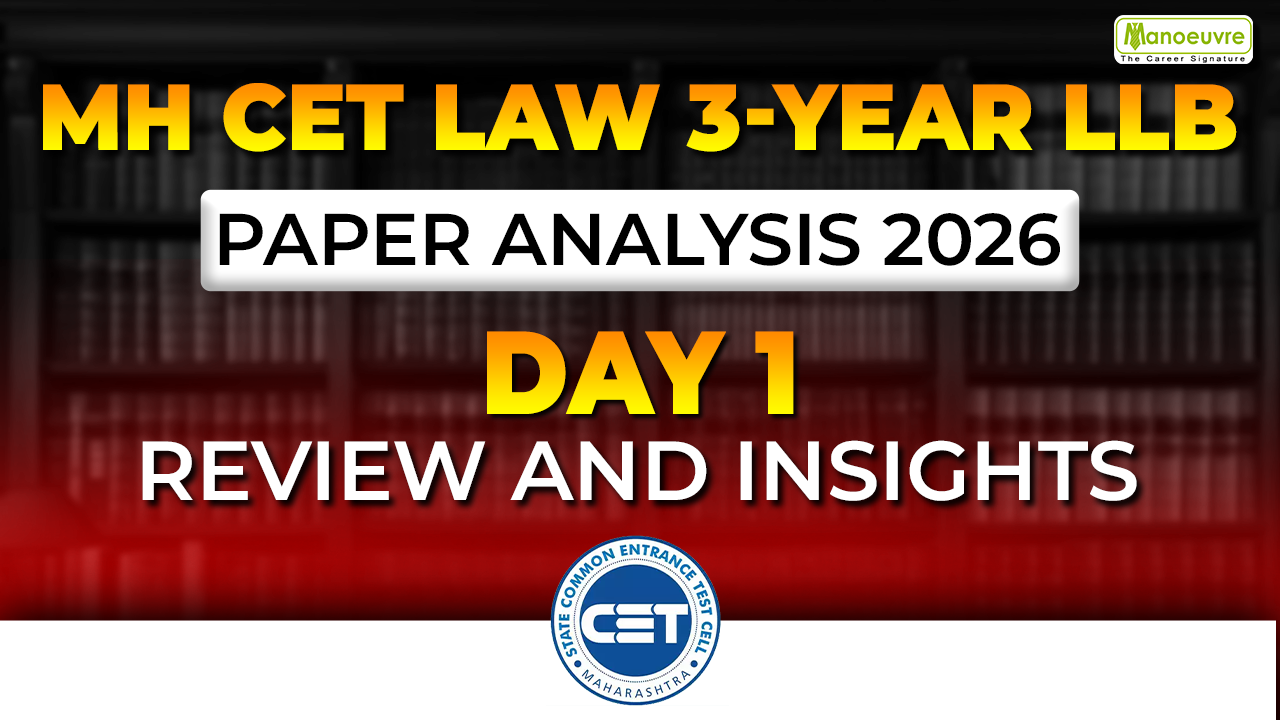
- April 10, 2026
- |
-
0 comments
- Enquiry: +91 88285 81455 |
- Support: +91 88579 45882 |
- 10:00 AM - 07:00 PM

The MH CET Law 3-Year LLB 2026 exam began with its Day 1 shifts, and the overall reaction from students was quite balanced. The paper was largely easy to moderate in difficulty, with no major surprises in pattern, but a few sections felt lengthy and time-consuming.
This analysis gives you a clear breakdown of the exam pattern, section-wise difficulty, important topics, and expected cut-offs in a structured format similar to official exam reports.
Day 1 of the MH CET Law exam followed a familiar structure, making it comfortable for well-prepared candidates. However, speed and accuracy played a major role, especially in reasoning and English sections.
● Overall difficulty level: Easy to Moderate
● Paper style: Concept-based with predictable pattern
● Most scoring section: Legal Aptitude
● Time-consuming section: Logical Reasoning
The paper did not contain unexpected changes, but emphasis on certain topics was slightly different compared to previous years.
This section turned out to be lengthy and slightly tricky in terms of time management. The focus shifted more towards critical reasoning-based questions rather than puzzles.
● Critical reasoning (assumptions, conclusions, cause-effect): 10+ questions
● Coding-decoding: 2 questions
● Series: 2–3 questions
● Odd one out: 2 questions
● Blood relations: 3 questions
● Puzzles and arrangements: 3–4 questions only
Unlike previous patterns, puzzles were reduced, while reasoning-based theory questions increased. This made the section more reading-intensive.
English was a scoring section for students with strong grammar fundamentals, but less dependent on comprehension this time.
● Reading Comprehension: 1–2 passages (varied by slot)
● Tenses, Articles, Voice, Speech: Major focus
● Vocabulary: Synonyms, antonyms, idioms, spelling errors
● Fill in the blanks: Based on grammar and word usage
Grammar dominated the section, making accuracy more important than speed.
The GK section was surprisingly static-heavy, with fewer questions from current affairs compared to expectations.
● Static GK: Majority portion
● Current Affairs: Around 5–6 questions
● Indian History
● Polity and Constitution
● Economics basics
● Science & Technology
● Art and Culture
Students relying only on current affairs may have found this section challenging. Static preparation played a key role.
Legal Aptitude remained the easiest and most scoring section of the paper. Questions were direct and based on basic legal principles.
● Constitution: 5–6 questions
● IPC (Criminal Law): 3–4 questions
● Contracts: 2–3 questions
● Torts: 2–3 questions
● Legal terms & principles: 4–5 questions
The section tested conceptual clarity rather than complex legal interpretation.
● Logical Reasoning: Moderate to lengthy
● English: Easy to Moderate
● GK: Moderate (static-heavy)
● Legal Aptitude: Easy
The paper was balanced and fair, suitable for students who practiced mock tests and focused on fundamentals.
Based on student feedback and exam difficulty, the expected cut-offs are likely to remain competitive:
● Top rankers: 110+ marks
● GLC Mumbai: around 100–105 marks
● ILS Pune: 100+ marks
● Other top law colleges: 90–95 marks
These are approximate estimates and may vary based on normalization.
● Logical Reasoning was lengthy due to heavy critical reasoning focus
● English was grammar-oriented instead of passage-heavy
● GK leaned more towards static topics
● Legal Aptitude remained highly scoring
● Time management was crucial across sections
Revise:
● Tenses
● Articles
● Voice change
● Direct & indirect speech
Do not ignore:
● Indian history
● Polity basics
● Science fundamentals
● Economics concepts
Focus on:
● Assumptions and conclusions
● Cause-effect relationships
● Statement-based logic
Since the paper is slightly lengthy, timed practice is essential.
The MH CET Law 3-Year LLB 2026 Day 1 exam maintained a balanced and predictable structure, making it accessible for prepared candidates. While the paper was not difficult, it tested clarity of concepts, reading ability, and time management skills.
Students appearing in upcoming slots should focus on revision of basics rather than learning new topics at the last moment.

The Day 1 paper was overall easy to moderate. Most students found it manageable, though Logical Reasoning was slightly lengthy.
Logical & Analytical Reasoning was the most time-consuming section due to a higher number of critical reasoning questions.
No, the English section was moderate. It was mainly based on grammar and vocabulary rather than reading comprehension.
The GK section was mostly static-based with fewer current affairs questions. Topics like history, polity, and economics were more important.
Legal Aptitude was the most scoring section as it contained direct and concept-based questions from Constitution, IPC, and contracts.
Reading comprehension was limited. Some slots had 1–2 passages, while others had very few or none.
Expected cut-offs are around 110+ for top rankers, 100–105 for GLC Mumbai, and 100+ for ILS Pune (approximate).
The overall pattern remained similar, but Logical Reasoning became more critical-reasoning focused, and GK leaned more towards static topics.
Latest Blog