MBA Entrance
 LAW Entrance
 MCA Entrance
 TISS Entrance
 BBA Entrance
 Hotel-Management
 B.ED Entrance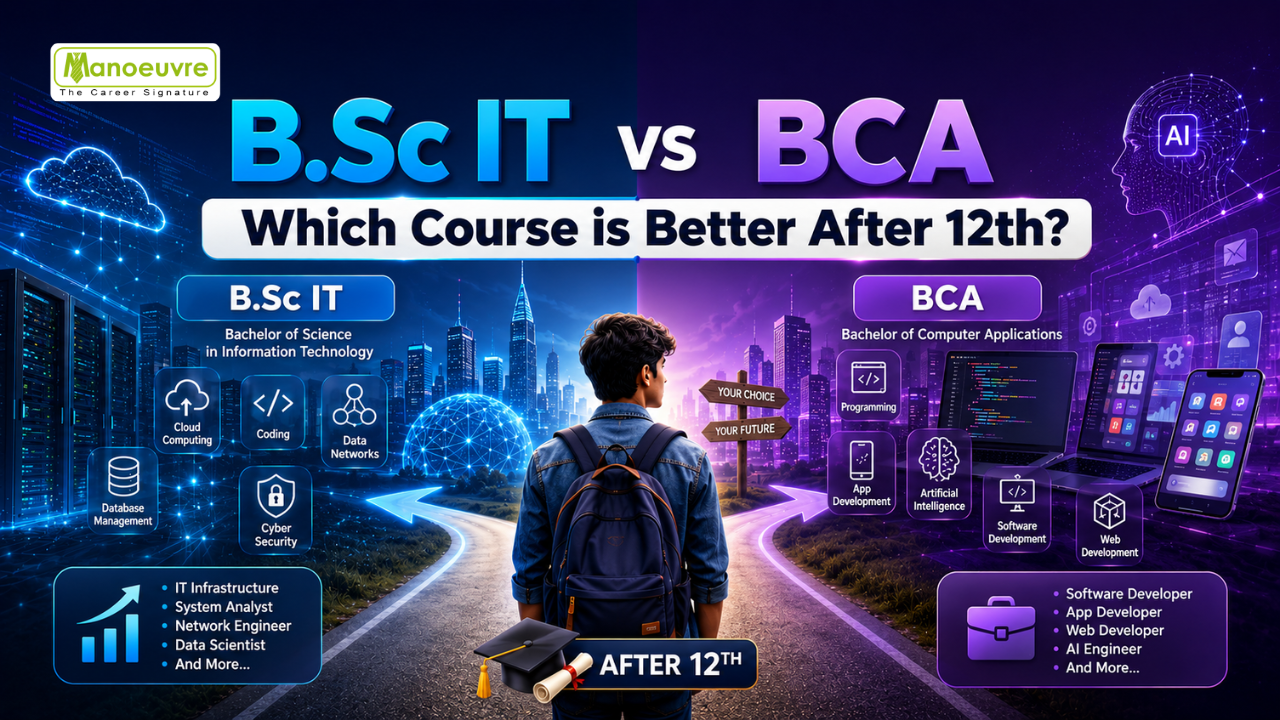
- July 20, 2026
- |
-
0 comments
- Enquiry: +91 88285 81455 |
- Support: +91 88579 45882 |
- 10:00 AM - 07:00 PM

If you've just finished Class 12 and you're eyeing a career in tech, there's a good chance you've run into this exact dilemma: BCA or B.Sc IT? It's one of the most common questions students ask, and honestly, it's a fair one. India's IT sector isn't slowing down anytime soon, and with fields like AI, cybersecurity, cloud computing, and data science expanding every year, picking the "right" starting point can feel like a high-stakes decision.
Here's the thing, though — both courses are solid. They just take you down different paths. This guide breaks down what each course actually involves, how they differ in terms of subjects and skills, what kind of jobs you can expect afterward, and how to figure out which one fits you better.
BCA, or Bachelor of Computer Applications, is a three-year degree built around software development and programming. Think coding-heavy coursework — you'll be writing programs, building applications, working with databases, and getting hands-on with web and mobile development throughout the course.
It's a great fit if you genuinely enjoy sitting down and solving problems through code, or if the idea of building an app or website from scratch sounds exciting rather than intimidating.
Typical career paths after BCA include roles like software developer, web developer, mobile app developer, and IT consultant — basically, jobs where you're actively creating software.

B.Sc IT (Bachelor of Science in Information Technology) is also a three-year program, but the focus shifts. Instead of centering everything on writing software, this course dives into how technology infrastructure actually functions — networking, databases, cybersecurity, cloud systems, and the broader mechanics of how organizations keep their systems running and secure.
If you're more curious about how networks talk to each other, how systems stay protected from threats, or how cloud infrastructure is managed, this course tends to align better with those interests than pure software development does.
Aspect | BCA | B.Sc IT |
Full Name | Bachelor of Computer Applications | Bachelor of Science in Information Technology |
Duration | 3 years | 3 years |
Core Focus | Programming & software development | IT systems & infrastructure |
Teaching Style | Hands-on, project-driven | Theory-heavy with applied components |
Amount of Coding | High | Moderate |
Math Involvement | Moderate | Often higher priority |
Suits Students Who... | Want to build software | Want to work with networks, systems, security |
Every institute sets its own bar, but broadly speaking:
For BCA, you'll need to have cleared 10+2 from a recognized board, meet whatever minimum marks the college sets, and in some cases have studied Math or Computer Science in school. A number of universities also run entrance exams for admission.
For B.Sc IT, the base requirement is the same — Class 12 completion — but Math tends to matter more here, with several institutions making it a preferred or even mandatory subject. Some colleges go purely by merit, others by entrance test scores.
Bottom line: always double-check the specific admission rules for the colleges you're targeting, since they can vary quite a bit.
BCA coursework typically covers programming languages like C, C++, Java, and Python, along with data structures, database management, software engineering principles, operating systems, web and mobile app development, computer networks, and a basic introduction to AI. Essentially, you're constantly building and coding throughout the degree.
B.Sc IT coursework leans into information systems, computer networks, database administration, cybersecurity, cloud computing, network security, Linux administration, operating systems, and data analytics. You come out with a much deeper understanding of how enterprise-level IT systems actually operate.
If your end goal is to become a developer, this question probably matters most to you. Generally speaking, BCA wins here — it's structured around continuous programming practice, with students regularly building websites, desktop tools, and mobile apps as part of the coursework.
B.Sc IT still includes programming, but it's not the centerpiece. The emphasis shifts toward networking, database systems, and infrastructure-related subjects instead. So if writing code is what excites you most, BCA is likely the stronger match.
From BCA, expect to build skills in programming, software development, problem-solving, application design, database handling, web development, mobile app creation, and software testing.
From B.Sc IT, you'll pick up skills around network administration, cybersecurity, cloud computing, database management, system administration, IT support, infrastructure management, and information security.
Both are technical, in-demand skill sets — they just point in different directions.
BCA graduates often land roles such as software developer, web developer, mobile app developer, full stack developer, software tester, technical support engineer, database programmer, or UI developer — all centered around designing and maintaining software.
B.Sc IT graduates tend to move into positions like network engineer, system administrator, database administrator, cybersecurity analyst, cloud support engineer, IT infrastructure engineer, system analyst, or technical support specialist — roles focused on keeping enterprise systems running smoothly and securely.
Here's something worth knowing upfront: pay isn't really determined by which degree you hold. It comes down to your skills, certifications, internship experience, and the company you join.
Career Stage | BCA | B.Sc IT |
Fresher | ₹3.5–6 LPA | ₹3.5–6 LPA |
3–5 Years Experience | ₹6–10 LPA | ₹6–10 LPA |
Experienced Professional | ₹12 LPA+ | ₹12 LPA+ |
As you can see, the ranges are nearly identical — so don't pick your course based on expected salary alone.
After BCA, popular next steps include an MCA, MBA, M.Sc in Computer Science, a PG diploma in Data Science, or specialized AI programs. MCA in particular is a common choice for students who want to go deeper into software development.
After B.Sc IT, students often pursue an M.Sc in Information Technology, MCA, M.Sc in Cyber Security, an MBA, or certification-based tracks in cloud computing and data analytics — all useful for carving out a specialization in a growing tech niche.
Just having the degree on paper isn't enough anymore — recruiters want to see real, applied experience too.
If you're in BCA, try to:
● Build your own software projects on the side
● Maintain an active GitHub with real code
● Learn current frameworks that employers actually use
● Take part in coding contests
● Do internships whenever possible
● Keep practicing data structures and algorithms
If you're in B.Sc IT, consider:
● Getting certified in CCNA, CompTIA, AWS, or Microsoft Azure
● Getting real hands-on time with networking setups
● Learning Linux administration properly
● Trying out cybersecurity labs and simulations
● Interning in IT support or infrastructure teams
● Building practical cloud computing skills
These extras can make a noticeable difference when you're job hunting later.
Don't just go with whatever's trending — go with what genuinely interests you.
Lean toward BCA if you:
● Genuinely enjoy programming
● Picture yourself as a software developer
● Like the idea of building apps and websites
● Learn best through hands-on projects
● Want to eventually work at a software product company
Lean toward B.Sc IT if you:
● Find the "how systems work" side of tech more interesting
● Are drawn to networking and cybersecurity
● Want exposure to cloud technologies
● Enjoy the idea of managing IT infrastructure
● Prefer system administration over writing code all day
Neither course is objectively "better" — it really comes down to what kind of work you can see yourself doing long-term.
Both BCA and B.Sc IT open solid doors into India's tech industry, just via different routes. BCA suits people who want to code and build software; B.Sc IT suits people drawn to networks, infrastructure, cloud systems, and security.
Whichever path you take, the degree itself is only part of the story — internships, certifications, and hands-on project work are what really shape your career outcomes. Pick the course that matches your natural curiosity, and put in the consistent effort to build real skills alongside it.

1. Which is better after 12th — B.Sc IT or BCA?
It really depends on where you see yourself. Go with BCA for software development, or B.Sc IT if networking, cybersecurity, and infrastructure appeal to you more.
2. Does BCA involve more coding than B.Sc IT?
Yes, generally. BCA is more programming-intensive and software-focused overall.
3. Which course pays better?
Starting salaries are quite similar for both. What really moves the needle is your skill set, internships, certifications, and the company you end up joining.
4. Can someone with a B.Sc IT degree do an MCA later?
Yes, most universities allow this, as long as you meet their specific eligibility requirements.
5. Is Math compulsory for these courses?
It varies by institution, but many colleges do prefer or require Math — particularly for B.Sc IT.
6. Which course is better suited for a cybersecurity career?
B.Sc IT tends to give you a stronger foundation in networking and systems security, making it a more natural fit for cybersecurity roles.
7. Can a B.Sc IT graduate become a software developer?
Absolutely — with solid coding practice, personal projects, and internships, B.Sc IT graduates can transition into development roles just fine.
8. Which course has better long-term career scope?
Both hold strong potential given the ongoing demand in software, cloud, AI, cybersecurity, and digital transformation. Your outcomes will depend more on continuous skill-building than on which of the two you choose.
Latest Blog